Music and Texts of GARY BACHLUND
Vocal Music | Piano | Organ | Chamber Music | Orchestral | Articles and Commentary | Poems and Stories | Miscellany | FAQs
After Apple-picking - (2005)
Robert Frost
for baritone and pianofrom North of Boston, 1914
My long two-pointed ladder’s sticking through a tree
Toward heaven still,
And there’s a barrel that I didn’t fill
Beside it, and there may be two or three
Apples I didn’t pick upon some bough.
But I am done with apple-picking now.
Essence of winter sleep is on the night,
The scent of apples: I am drowsing off.
I cannot rub the strangeness from my sight
I got from looking through a pane of glass
I skimmed this morning from the drinking trough
And held against the world of hoary grass.
It melted, and I let it fall and break.
But I was well
Upon my way to sleep before it fell,
And I could tell
What form my dreaming was about to take.
Magnified apples appear and disappear,
Stem end and blossom end,
And every fleck of russet showing clear.
My instep arch not only keeps the ache,
It keeps the pressure of a ladder-round.
I feel the ladder sway as the boughs bend.
And I keep hearing from the cellar bin
The rumbling sound
Of load on load of apples coming in.
For I have had too much
Of apple-picking: I am overtired
Of the great harvest I myself desired.
There were ten thousand thousand fruit to touch,
Cherish in hand, lift down, and not let fall.
For all
That struck the earth,
No matter if not bruised or spiked with stubble,
Went surely to the cider-apple heap
As of no worth.
One can see what will trouble
This sleep of mine, whatever sleep it is.
Were he not gone,
The woodchuck could say whether it’s like his
Long sleep, as I describe its coming on,
Or just some human sleep.[ 8 pages, circa 7' 00" ]
Robert Frost
Robert Frost (1874–1963) is regarded as one of America's leading 20th-century poets, a four-time winner of the Pulitzer Prize. An pastoral poet often with rural New England, Frost wrote poems whose philosophical dimensions. He is said to have been a pioneer in the interplay of rhythm and meter and in the poetic use of the vocabulary and inflections of everyday speech, and this and a few other poems make real one of his life's ambition, which was to write "a few poems it will be hard to get rid of." That was and remains an admirable goal for any creative artist.
The setting is minimalist, rocking gently back and forth between tonic and subdominant. In suspension, some passages reside only over the sub-dominant and its repetition of the accompaniment's gestures. The detailed rhythmic notation of the vocal part is meant to convey a conversational "free verse" declamation of the text, not falling always on the beats of the accompaniment.
The dream is faster and more harmonically unsettled, moving quickly through tessitura and lightly polytonal colors, before the setting settles back and ends with the piano alone, as at the beginning.



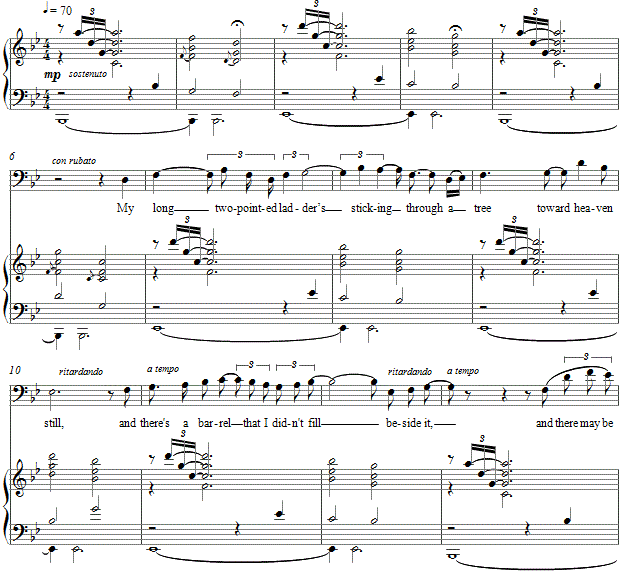
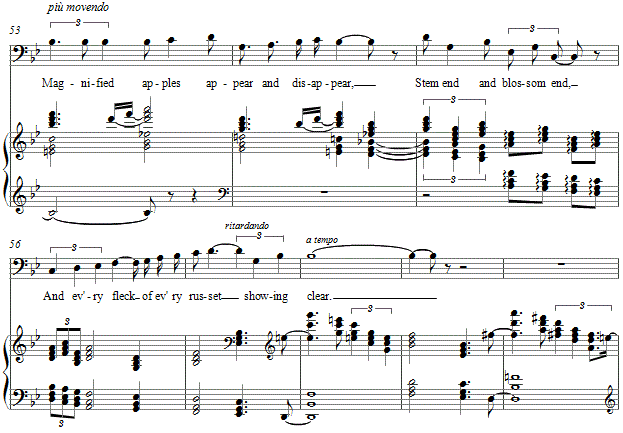
The score for After apple-picking is available as a free PDF download, though any major commercial performance or recording of the work is prohibited without prior arrangement with the composer. Click on the graphic below for this piano-vocal score.


