Music and Texts of GARY BACHLUND
Vocal Music | Piano | Organ | Chamber Music | Orchestral | Articles and Commentary | Poems and Stories | Miscellany | FAQs
Sonnet CXVI - (1983)
William Shakespeare
for medium high voice and piano
Let me not to the marriage of true minds
Admit impediments. Love is not love
Which alters when it alteration finds,
Or bends with the remover to remove:
O no! it is an ever-fixed mark
That looks on tempests and is never shaken;
It is the star to every wandering bark,
Whose worth's unknown, although his height be taken.
Love's not Time's fool, though rosy lips and cheeks
Within his bending sickle's compass come:
Love alters not with his brief hours and weeks,
But bears it out even to the edge of doom.
If this be error and upon me proved,
I never writ, nor no man ever loved.
William Shakespeare
Tucker explains that the first two lines are a "manifest allusion to the words of the Marriage Service: 'If any of you know cause or just impediment why these two persons should not be joined together in holy matrimony;' cf. Much Ado 4.1.12. 'If either of you know any inward impediment why you should not be conjoined.' Where minds are true - in possessing love in the real sense dwelt upon in the following lines - there can be no 'impediments' through change of circumstances, outward appearance, or temporary lapses in conduct." (T. G. Tucker, ed. Sonnets of Shakespeare. Cambridge: University Press, 1924, [192])
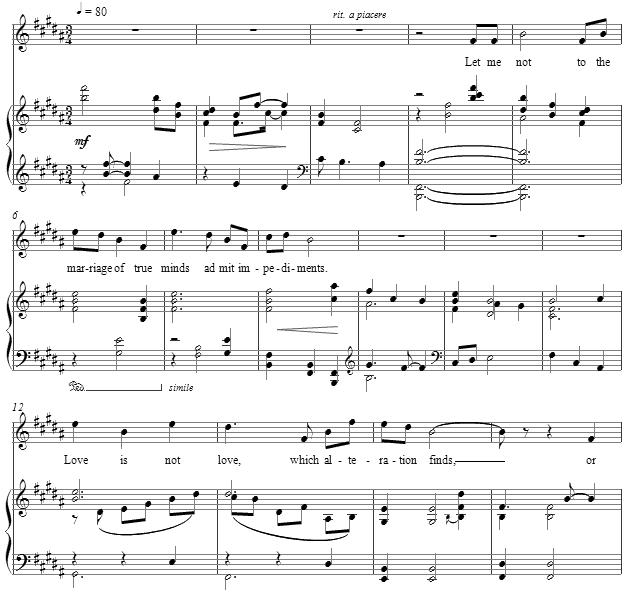
Written for medium high voice, this setting is colored with pleasant diatonically related polytonal colors, as the vocal line rises and falls with the sense of the various quatrains and couplet of this well beloved text. The last lines are remarkable for their argument, which disallows and disavows its own possible opposition. For that the concluding couplet is set as an afterthought, in a quasi recitativo style before the final cadence.
The score is available as a free PDF download, though any major commercial performance or recording of the work is prohibited without prior arrangement with the composer. Click on the graphic below for this piano-vocal score.