Music and Texts of GARY BACHLUND
Vocal Music | Piano | Organ | Chamber Music | Orchestral | Articles and Commentary | Poems and Stories | Miscellany | FAQs
Collected Poetry
VOLUME ONE
Original materials - Copyright © 1986-2009 by Gary Bachlund All international rights reserved
"A single death is a tragedy; a million deaths is a statistic." Joseph Stalin (1878-1953)
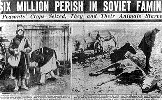
Memory of the Holomodor
"Opinions on corporate management are all too frequently imbued with a spirit of sheer ignorance, an anti-expert spirit." Vladimir Lenin, to the 1920 Communist Party Congress.
Business is the culprit,
the enemy of man,
So say those little tyrants
who've had some other plan
To starve a productive systemof its productive work,
Or lure on those who'd merelysit, complain and shirk,
But in the empty market stalls
Ignorance stumbles, then it falls.
Lenin blamed "sheer ignorance,"
after he'd shown the same -- his own.
Lenin -- a murderous smarty-pants
as his murderous history's shown.
Business makes a product.
as boon to other men,
But tyrants rage and wrongly think
it's simple, simply when
They threaten a working systemin its productive work,
Or urge on those who'd merelysit, complain and shirk,
But in the busied market stalls
It's freedom which fills the market halls.
Envoi: “The elimination of profit, whatever methods may be resorted to for its execution, must transform society into a senseless jumble.” Ludwig von Mises (1881-1973)
Addendum of a Madman: "Lenin is not comparable to any revolutionary figure in history. Revolutionaries have had ideals. Lenin has none. He is a madman, an immolator, wishful of burning, and slaughter, and sacrificing. " As quoted in "Peter Kropotkin : From Prince to Rebel" (1996) by George Woodcock and Ivan Avakumovic, Black Rose Books, 1996.
Addendum of Another Madman Declaring Genius: "Here is the formulation – a formulation of genius – of the essence of historical materialism given by Marx in 1859 in his historic Preface to his famous book, A Contribution to the Critique of Political Economy.' In the social production of their life, men enter into definite relations that are indispensable and independent of their will, relations of production which correspond to a definite stage of development of their material productive forces. The sum total of these relations of production constitutes the economic structure of society, the real foundation, on which rises a legal and political superstructure and to which correspond definite forms of social consciousness. The mode of production of material life conditions the social, political and intellectual life process in general. It is not the consciousness of men that determines their being, but, on the contrary, their social being that determines their consciousness. ...Such is Marxist materialism as applied to social life, to the history of society." In "Dialectical and Historical Materialism," by Joseph Stalin, via Marxists.org, September 1938.
Addendum: "They pretend to pay us and we pretend to work." Attributed to an anonymous Soviet citizen. [ 1 ]
Post-Soviet Addendum: "Gorbachev continued to be fairly insipid politically. The agriculture position was regarded as a kind of political hot seat whose occupant could easily lose his job. And so the newcomer proceeded with caution and loyalty. But the fact that he would be considered for the post of general secretary just a few years later came down to his age and eloquence, which was completely exceptional in party circles. He was just 54, and the youngest Politburo member, when Soviet leader Konstantin Chernenko died at the age of 73, the third death of a party leader to befall the country in 28 months. His greatest deficiency was that he wouldn't bring much experience to the top job. When Gorbachev came to power in 1985, even his close colleagues knew neither his political views nor his political goals. At the time, he probably didn't even know them himself. 'We can't go on like this.' That was his only slogan." In "The Mystery of Mikhail: Gorbachev's Ambiguous Legacy," by Christian Neef and Matthias Schepp, Spiegel, 18 August 2013.
Addendum of Prevailing Ignorance: "Where justice is denied, where poverty is enforced, where ignorance prevails, and where any one class is made to feel that society is an organized conspiracy to oppress, rob and degrade them, neither persons nor property will be safe." Frederick Douglass (1818-1895)
Addendum of Leninist Lynching: "Do it in such a fashion that for hundreds of kilometres around the people might see, tremble, know, shout: 'they are strangling, and will strangle to death, the bloodsucking kulaks'." In "Lenin's Hanging Order, Wikipedia article, n.d., a translation sourced as 'hanging order' by Robert Service, "Lenin a Biography," Macmillan, 2000.
Addendum Remembering a Fool: "Looking back and judging in the light of history, it is perhaps just what one should have expected. But since the clamor of economic emphasis, coming, as I have said, from both defenders and enemies of the Bolshevik scheme, may have confused others as it certainly confused me, I can hardly do better than record the impression, as overwhelming as it was unexpected, that the outstanding fact in Russia is a revolution, involving a release of human powers on such an unprecedented scale that it is of incalculable significance not only for that country, but for the world." In "Impressions of Soviet Russia and the revolutionary world," by John Dewey, New Republic, 1929. [ 2 ]
Addendum Remembering Lenin's Own Words: "To underscore the point about Lenin, let me conclude by quoting from a typical memorandum written by that murderous Bolshevik on August 11, 1918: '1. Hang (hang without fail so the people see) no fewer than one hundred known kulaks, rich men, bloodsuckers. 2. Publish their names. 3. Take from them all the grain. 4. Designate hostages -- as per yesterday's telegram. Do it in such a way that for hundreds of versts [one verst is about one kilometer] around, people will see, tremble, know, shout: they are strangling and will strangle to death the bloodsucker kulaks. . . . P.S. Find . . . truly hard people'." In "Killers with Ideologies," review by Simon Sebag Montefiore, Washington Post, 12 August 2007.
Addendum as Hindsight: "Shop shelves were often bare, it was normal to have to join a long queue if you wanted to buy groceries and many of the people looked ground down after a century of desperate poverty. The dismal state of the USSR's economy, during a time of rapidly improving living standards in the West, was a result of its dogmatic Communist political system, which stifled free enterprise and stopped the country moving on from its feudal past." In "Poverty, prostitutes and the long, slow death of the Soviet Union: Haunting pictures show desperate struggle to survive in last days of USSR," Daily Mail, 1 January 2013. [ 3 ]
Addendum for Students Not Wanting to Remain Ignorant: " 'How can I get a job and earn money if I study Marxism and Leninism?' Hanoi high school student Nguyen Lan Huong told AFP." In "Vietnam offers free education to Marxism students," France 24, 16 August 2013. [ 4 ]
Addendum of Socialists' Numbers: "Of course the numbers had been fictitious all along. There really was a gradual decline going on, but the numbers didn't show it. And, without knowing all the tricks the Soviets used at the time, the main one is obvious, namely counting all or most government spending as a full addition to GDP. Where government owns the main businesses and controls most of the distribution of resources, not to mention prices, the measure of GDP becomes more and more arbitrary." In "On Socialist Death Spirals," by Francis Menton, Manhattan Contrarian, 28 June 2015. [ 5 ]
Addendum of Siding with Rulers: " 'Intellectuals have always disdained commerce' says Whole Foods Market co-founder John Mackey. They 'have always sided...with the aristocrats to maintain a society where the businesspeople were kind of kept down'." In "Whole Foods' John Mackey: Why Intellectuals Hate Capitalism - They're jealous, he says, they side with rulers, and they don't understand how markets work," by Nick Gillespie and Todd Krainin, Reason, 12 August 2015. [ 6 ]
Addendum of Market Leninism: "Beijing’s botched efforts to prop up the country’s stock markets have collapsed. An estimated $300bn of state-orchestrated buying achieved nothing, overwhelmed by an avalanche of selling by investors forced to cover margin debt. Professor Christopher Balding from Peking University wrote on FT Alphaville that China is lurching from one incoherent policy to another, shedding credibility and its aura of omnipotence at every stage." In "China's market Leninism turns dangerous for the world," by Ambrose Evans-Pritchard, Telegraph UK, 24 August 2015. [ 7 ]
Addendum of Genocide: "We will soon be marking the hundredth anniversary of the Bolshevik Revolution in Russia (November 1917) under the Marxist revolutionary leader, Vladimir Lenin. In Soviet Russia, alone, it has been calculated by Russian and Western historians who had limited access to the secret archives of the Communist Party of the Soviet Union and the KGB (the Soviet secret police) in the 1990s, that around 68 million innocent, unarmed men, women and children were killed over the nearly 75 years of communist rule in the Soviet Union. The communist revolutionaries in Russia proudly declared their goal to be destruction and death to everything that existed before the revolution, so as to have a clean slate upon which to mold the new socialist man. The evil of the Soviet system is that it was not cruelty for cruelty’s sake. Rather it was cruelty for a purpose – to make a new Soviet man and a new Soviet society." In "The Human Cost of Socialism in Power," by Richard Ebeling, Epic Times, 7 September 2015. [ 8 ]
Addendum of the Sheer Ignorance of Socialism's Patronage: "According to USA Today, the policies of Chávez's 'Socialism for the 21st century' included 'the bloating of state oil company Petróleos de Venezuela S.A., or PDVSA, with patronage hires' which led to mismanagement of the petroleum industry in Venezuela according to experts. Financial Times also called the PDVSA 'a source of patronage' and that "the number of employees, hired on the basis of their loyalty to the 'Bolivarian Revolution', has tripled since 2003 to more than 121,000'. In 2006, Rafael Ramírez, then energy minister, gave PDVSA workers a choice: Support President Hugo Chávez, or lose their jobs. The minister also said: 'PDVSA is red [the color identified with Chávez's political party], red from top to bottom'. Chávez defended Ramírez, saying that public workers should back the 'revolution'." In "Corruption in Venezuela," Wikipedia, n. d. [ 9 ]
Addendum of a Century of Sheer and Deadly Ignorance: "... a century of communism in power—with holdouts even now in Cuba, North Korea and China—has made clear the human cost of a political program bent on overthrowing capitalism. Again and again, the effort to eliminate markets and private property has brought about the deaths of an astounding number of people. Since 1917—in the Soviet Union, China, Mongolia, Eastern Europe, Indochina, Africa, Afghanistan and parts of Latin America—communism has claimed at least 65 million lives, according to the painstaking research of demographers." In "The Communist Century," by Stephen Kotkin, Wall Street Journal, 3 November 2017.
Addendum of Looking Back with a Historian's Eye: "...Lenin was an opportunist who never maintained a consistent political vision, but instead maneuvered constantly to increase his own power. 'From this perspective, the main thing about Leninism that remains to this day…is a lack of respect for his own people and a tendency to view oneself as the subject of history. Not the people or society but oneself. This is nothing new -- it is seen throughout the history of authoritarianism -- an alienation from the people and a tendency to view the people as clay or material for one’s own creations. In this regard, we still need to shed Leninism'." In "Lenin At 150: Even Without COVID-19, Russia Was Set To Snub The Soviet Union's Founder," by Sergei Medvedev and Robert Coalson, Radio Free Europe/Radio liberty, 21 April 2020. [ 10 ]
Addendum of Looking Back with a Catholic Perspective: "Holodomor deniers – using the term in its proper sense – maintain that the genocide of 1932-1933 in the Soviet Ukraine never happened or that it occurred without premeditation. The regime's censorship contributed to hiding a tragedy that today is recognized by many countries as a crime against humanity and that, upon analysis of its method and goal, was also an example of a 'Great Reset.' If a Ukrainian had wondered how it could be that the Russian government, faced with a famine, did not help the population by sending food but rather forbade commercial activity and movement, thereby aggravating the situation, he would have committed the same error as many today who, in the presence of an alleged pandemic, ask why governments have preemptively undermined public health, weakened national pandemic plans, forbidden effective treatments, and administered harmful if not deadly treatments and are now forcing citizens – using the blackmail of perpetual lockdowns, stay-at-home orders, and unconstitutional 'green passes' – to submit to vaccines that not only do not guarantee any immunity but actually carry serious short-term and long-term side effects, as well as further spreading more resistant forms of the virus." In "More Reflections on the Great Reset," by Archbishop Carlo Maria Vigano, Catholic Family News, 31 May 2021. [ 11 ]
NOTES
[ 1 ] "Any discussion about the Russian work ethic inevitably ends up focusing on the Soviet Union, which did more than any other period in the country's history to corrupt work habits. Although much has improved since the Soviet collapse, Russians haven't been able to shake off some of the worst legacies of the Soviet work ethic. Pofigizm. Combining apathy, indifference and fatalism, pofigizm can be translated as "I don't give a damn." To be sure, pofigizm existed as a national phenomenon long before the Soviet Union. Take, for example, the centuries-old Russian folklore hero Yemelya or the 19th-century literary character Ilya Oblomov, both of whom were quintessential national symbols of pofigizm. Yet nothing did more than the Soviet Union's systemic political and economic stagnation, particularly in the Brezhnev years, to exacerbate the key elements of pofigizm — inertia, hopelessness and disillusionment — in the workplace." In "Why We Should All Work Like Putin," by Michael Bohm, Moscow Times, 30 May 2013.
The Socialist Shortage of Goods
The same theme is echoed in scholarly work: "The single most pervasive phenomenon in socialist countries is shortage of goods. Consumers goods ranging from necessities, such as food, to luxuries, such as cars and gold, as well as many intermediate inputs, are typically in short supply." In "Pervasive shortages under socialism," by Andrei Shleifer and Robert Vishny, RAND Journal of Economics, Vol. 23, No. 2, Summer 1992 [Scholars at Harvard].
On the same theme one reads, ""The soft-budget-constraint problem, associated with the name of Kornai (1980), relates to a well-known situation under socialism where the planner could not commit not to bail out money-losing firms. Soft budget constraints were a key characteristic of socialist economies. J. Kornai (1980, 1992) not only coined the concept but showed the role of soft budget constraints in explaining the emergence and reproduction of shortages, the weakening of price responsiveness of firms, and various other inefficiencies in the socialist economy. He also emphasized their existence and relevance in capitalist economies in the banking sector, the public sector, and other spheres of the economy." In "Transition and Economics, Politics, Markets, and Firms," by Gérard Roland, MIT Press, 2000.
One might additionally observe that this noted "existence" in capitalist economies is in fact an importation of socialist practices in "banking, the public sector...." such that these capitalist economies are in fact mixed between capitalist and socialist tendencies.
It is most interesting to note that in those areas cited above, one consistent behavior is invoked, i.e. the passing of losses mostly onto the backs of the bourgeois middle class taxpayers.
The privatization of profits and the public assignment of losses is in fact not a capitalist notion at all, but a socialist element injecting into a mixed economic system by government fiat.
For this, another look at Lenin's quote above shows that "a spirit of sheer ignorance" is corrected by quickly advancing insolvency and collapse within the capitalist arena, while slowly when undergirded and protected with political power in socialist systems. Thus the economic and eventual political collapse of the USSR was decades in the making, held together for a time by sheer political power which protected that "spirit of sheer ignorance."
[ 2 ] " 'It is the duty of every honest person to write the truth about Stalin,' Anton Antonov-Ovseyenko, a Soviet historian and dissident, wrote in the preface of his seminal book 'The Time of Stalin: Portrait of a Tyranny,' published illegally in 1981." In "Anton Antonov Ovseyenko, Who Exposed Stalin Terror, Dies at 93." by Michael Schwirtz, New York Times, 10 July 2013.
Compare the praise of Dewey to the cursory details found here: Totalitarian
. One may with clear hindsight conclude that Dewey's view was either "sheer ignorance" or ideological and partisan. Either way, Russian dissident Antonov-Ovseyenko and Russian President Dmitry Medvedev testify that Dewey was wholly in error.
[ 3 ] "...the time is nearing when they must act to smash the old state machine, replace it by a new one, and in this way make their political rule the foundation for the socialist reorganization of society, they have actually preached to the masses the very opposite and have depicted the 'conquest of power' in a way that has left thousands of loopholes for opportunism. The distortion and hushing up of the question of the relation of the proletarian revolution to the state could not but play an immense role at a time when states, which possess a military apparatus expanded as a consequence of imperialist rivalry, have become military monsters which are exterminating millions of people in order to settle the issue as to whether Britain or Germany—this or that finance capital—is to rule the world." In "The State and Revolution, The Marxist Theory of the State & the Tasks of the Proletariat in the Revolution," by V. I. Lenin, "Collected Works, Volume 25," 1918.
How sadly amusing it is to realize that Lenin and later Stalin were in Lenin's own terms herein imperialists as demonstrated by attempts to make Communism (Marxism) international. The only issue for Lenin ultimately was who was to rule. "Exterminating millions of people" has been proven to have been a demonstrable specialty of Communism as documented by history in the USSR, China, Cambodia and elsewhere. Of course, for the "state" was always the focus of Marxist thought and its assumption that a dictatorship was an interim though necessary step to the utopia envisioned by said Marxist thought. As a meditation on the state as the antithesis of society, please see: The funniest thing
[ 4 ] The conundrum for today's Marxist-socialists is great. If Lenin's view of the "sheer ignorance" of corporate leaders is compared to the proven ignorance of decades of thuggish yet inept Soviet Socialist rule culminating in the economic collapse of the USSR itself, one sees with clarity that Lenin was ignorant though prolific in his writing.
He helped spawn a continuing ignorance which enslaved satellite nations as well as Russia's own. and then simply and suddenly imploded. One learns Marxism's skeptical view of the utility of man, in which men as a proletariat are to serve their socialist dictatorship. Perhaps not the masters as Marx and Lenin portrayed capitalism's masters, but masters nonetheless. And so, one comes to understand: A Working Class Classified
[ 5 ] That the Union of Soviet Socialist Republics collapsed is no longer debatable. It is historical fact. While Lenin almost a century ago accused business of "sheer ignorance," in retrospect it has now been proven that the "experts" of the USSR's centrally planned economy proved their sheer ignorance. From failed five-year plans for productivity, to the Potemkin village pretenses (for other Potemkin villages, see: We ran out
Lenin, a verbose ideologue with many volumes of his writings, is thus also proved wrong. Of course, this does not dissuade the true believers, for socialism has always been a methodology for the pursuit of centralized power over a people, while freedom is and remains the antithesis.
Sheer ignorance can be demonstrated in an individual's life and not collapse and entire society, but sheer ignorance in governing a society will always result in collapse. This is the end of the belief system which I ridicule as So shall ism
[ 6 ] The simplest lesson of history is now unassailable as well as unavoidable. The Union of Soviet Socialist Republics collapsed, and the governments of many of its satellite states with it. Lenin was wrong about so much.
The same so-called experiment with socialism was played out as a Soviet satellite, the so-called German Democratic Republic, now the economically collapsed government of East Germany, found its citizens risking their lives as they Fled from empty market shelves
The same so-called experiment with socialism is being played out in the slow motion economic collapses of Cuba, Venezuela, Zimbabwe and Greece as can be reviewed as such socialist governments find themselves Freshly out of options
The same so-called experiment with socialism so easily has led to wealth accumulation by a corrupt socialist elite and can be repeatedly seen in the Old-fashioned
The Upper Class of Politics
What is it about so-called intellectuals such as Lenin to proclaim that "sheer ignorance" is found in business, when it is now so easily proven in socialist thinking? Mackey observes: "Intellectuals have always disdained commerce. That is something that tradesmen did; people that were in a lower class. And so you had minorities, oftentimes did it, like you had the Jews in the West. And when they became wealthy and successful and rose, then they were envied, then they were persecuted and their wealth confiscated, and many times they were run out of country after country. Same thing happened with the Chinese in the East. They were great businesspeople as well. So the intellectuals have always sided kind of with the aristocrats to maintain a society where the businesspeople were kind of kept down. You might say that capitalism was the first time that businesspeople kinda caught a break, because of Adam Smith and the philosophy that came along with that, and the industrial revolution began this huge upwards surge of prosperity."
What is that "dictatorship of the proletariat" then? Repeatedly it has become the ruler replacing a previous ruler, a tyranny replacing an earlier tyranny, and an efficient method of acquiring wealth for the privileged few at the expense of entire societies. To become well off, the "intellectual" as Mackey sees such a person sides with that rule which privileges him, and even protects him from being held accountable for demonstrable errors. Consider The Privileges of Intellectuals
There have been so many Enemies of Capitalism
And yet, after the defeat of National Socialism followed the implosion of Soviet Socialism add to the current stagnation of Cuban Socialism and withering of Chavez' Venezuelan socialism as examples, one finds new that poverty diminishes due to that force which the anti-capitalist detests -- capitalism.
Abandonment of Central Planning
One reads: "...hundreds of billions of dollars in foreign aid accomplished little. The rise of the non-Western world has been a result of economic growth spurred by the abandonment of central-planning and integration of many non-Western countries into the global economy. Inflation-adjusted average per-capita income in China, for example, has increased 13-fold since the start of economic reforms in 1978. Following liberalization in India, real income rose three-fold." In "Global Poverty's Defeat Is Capitalism's Triumph," by Marian L. Tupy, Investors, 9 October 2015.
Much work is left to be done of course. One reads that caution is advised: "The Bank’s own statisticians urge caution. 'The comparability of poverty measures across time remains a big issue,' says Francisco Ferreira, who is part of a World Bank commission looking into better methods for measuring poverty. The commission will make its recommendations next year, which may include dispensing with dramatic PPP revisions. Counting the poor, it seems, is almost as hard as helping them." In "The tricky work of measuring falling global poverty," Economist, 12 October 2015.
The Rise of the Middle Class and Economic Development
That a corporate spirit among a private sector in many different nations is producing a middle class angers the ardent socialist. But one reads clearly: While the number of middle class worldwide grew last year at a slower pace than the wealthy, it 'will continue to expand in emerging economies overall, with a lion's share of that growth to occur in Asia,' Credit Suisse chief executive Tidjane Thiam said in a statement accompanying the bank's annual Global Wealth Report. 'As a result, we will see changing consumption patterns as well as societal changes as, historically, the middle class has acted as an agent of stability and prosperity,' he added. The report said size and wealth of the middle class was a key factor in economic development, and the middle class was often at the heart of political movements and new consumption trends." In "Chinese middle class now the world's largest," Agence France Presse, 13 October 2015.
What is amassing historically is demonstrable proof that freedom and the economic growth of a middle class are agents of "stability and prosperity." In no centrally planned, socialist system in the last century has a middle class grown and prosperity for more than only a political elite been demonstrated.
Nonetheless, one reads above that in socialist systems, shortage of goods is a common theme alongside a political class which is sheltered from such shortages by party privilege. On the other hand, movement away from poverty and the filling of shortages with supply is a feature of societies which behave in a more capitalist manner. Moreover, once political corruption and state- and ideology-sponsored violence is factored in, one finds that poverty in a modern world is more a phenomenon of "government" than a phenomenon of greater freedom from government.
Lenin's Sheer Ignorance
One then only look through the cast of socialist characters historically to see that socialism has been a worldwide display of "sheer ignorance" on the part of socialists when they have taken the reins of government, often murderous and regularly destructive governance.
A commenter to the Economist article with the moniker Connect the Dots noted: "Worldwide Poverty is down. / Hunger is down. / Disease is down. / Violence is down. /===/ Worldwide War is up. / And because of War; Poverty, Hunger, Disease and Violence are all up dramatically in the Mideast and North Africa, Arab and Muslim World. / The World has not seen this level of War since World War II."
Sheer ignorance then is demonstrated as one feature of certain ideologies, while rule of law and the lessened restraint on small enterprises' activities and citizens' freedoms are a large part of the cure of "sheer ignorance."
Lenin's Bolshevik revolution brought death to millions, eventual collapse and wars of aggression around the world, as "international socialism" strove to expand. It has contracted, collapsed and proven itself thereby for what it is -- a method for a political cadre to aggrandize themselves in terms of power and wealth over their citizenry. This is the proof of sheer ignorance.
[ 7 ] Among the created parlance of some journalists and academic intellectuals has been "crony capitalism," which has been an attempt to link capitalism, used as a pejorative, to corrupt acts of the state. This is however not the case, for playing favoritism with one's crony friends is in fact that Old-fashioned
The Pretense of Science
The same holds true with the phrase, "state capitalism," which some socialist theorists have put forth to attempt to distance central command of an economy from the principles of socialism -- I prefer my cognate, So shall ism
Yet one finds the fifth tenet of Communism has been clearly stated to be "Centralisation of credit in the hands of the state, by means of a national bank with State capital and an exclusive monopoly." In "Manifesto of the Communist Party," trans. by Samuel Moore in cooperation with Frederick Engels, 1888.One has now seen and is seeing the "centralization" in "the hands of the state" so incompetent that the "market Leninism" which markets the 2015 turmoil in China's economy and Potemkin markets is proven inexpert, as was the proven in the economic collapse of the Union of Soviet Socialist Republics.
Whether one labels central command -- that fifth, documented tenet of Communism, and a monopolization of power -- "state capitalism" or "crony capitalism" (which in a more free society is properly called graft, and is regularly made illegal), it is still socialism, whose first tenet has always been "Abolition of property in land and application of all rents of land to public purposes." How very often did those "public purposes" benefit the elite in socialist leadership, living far better than their fellow citizens? Consistently. After all, it is the elite which dictate what is a "public purpose."
Thus through the dictatorship of the proletariat have arisen corrupt men, cronies each to the other, such as the massively wealthy of Communist Chinese leadership so clearly prove. See: Capital for Communists
[ 8 ] One reads: "As of 2011, academic consensus has not been achieved on causes of large scale killings by states, including by states governed by communists. In particular, the number of comparative studies suggesting causes is limited. The highest death tolls that have been documented in communist states occurred in the Soviet Union under Joseph Stalin, in the People's Republic of China under Mao Zedong, and in Cambodia under the Khmer Rouge. The estimates of the number of non-combatants killed by these three regimes alone range from a low of 21 million to a high of 70 million. There have also been killings on a smaller scale in North Korea, Vietnam, and some Eastern European and African countries." In "Mass killings under Communist regimes," Wikipedia article, n. d.
Murderous Communism
Wikipedia, a useful but sometimes politicized reference with many editors, marked claims of evidence as "dubious," though tracing the link finds no scholarly proof that estimates are in any way dubious. Later in the article about murderous Communist regimes, one reads: "Genocide scholar Adam Jones claims that 'there is very little in the record of human experience to match the violence unleashed between 1917, when the Bolsheviks took power, and 1953, when Joseph Stalin died and the Soviet Union moved to adopt a more restrained and largely non-murderous domestic policy.' He notes the exceptions being the Khmer Rouge (in relative terms) and Mao's rule in China (in absolute terms)."
The "scholarly" hair-splitting between genocide and apparently non-genocidal "crimes against humanity" seems to be more far more political than scholarly per se, for the implications of such mass murder under various forms of Communism are profound. Communism has repeatedly turned murderous to its own citizenry, all with a purpose, as Ebeling notes: it was "cruelty for a purpose – to make a new Soviet man and a new Soviet society." A murderous society, and in the case of the Soviet Union a warmongering government as well as, in hindsight, a collapsed economy.
"Sheer ignorance" is the clear judgment of Soviet Socialism evidenced, excepting such cruelty. These Communists were never ignorant of their cruelty. It was their plan.
[ 9 ] That the economic collapse of socialist Venezuela is well underway is without dispute, as the New York Times and other media observe when socialists are Left to their own devices
[ 10 ] It will be seen that all the totalitarians have been self-serving and unprincipled. Lenin is a fine portrait of this. The article notes: "For Lenin, the historian argued, there was only one consistent position. 'He was a fundamental believer in violence as the solution to any problem,' Sokolov said. 'We see this at every stage of his development beginning at the very start, which I studied when I wrote my dissertation about the famine of 1891. Lenin, who was 20, argued against giving charitable aid to the peasants and destroyed the work of the Samara charity committee, arguing that one shouldn’t improve their lives' but instead let them 'become bestial and unleash monstrous violence'."
Monstrous Violence -- Nothing New
To see this tendency acting out today, one only need Scratch a Leftist
As the article in the quote above observes: "This is nothing new -- it is seen throughout the history of authoritarianism -- an alienation from the people and a tendency to view the people as clay or material for one’s own creations."
[ 11 ] The Holomodor was denied by news reporting in that time from such as the New York Times, pretending that no such event was occurring. How like the later 'resets' as one considers the contemporary urge for a next Reset
.
As has been the case over centuries, such horrors as the Holomodor, Holocaust and China's Cultural Revolution are recurring patterns of a political elite's drive for Power and money
Put the past to rest - ignore the dead oppressed
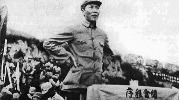
"It is now believed that as many as 60 million to 80 million people may have died because of Mao's policies--making him responsible for more deaths than Adolf Hitler and Josef Stalin combined. Gong said killer is not a strong enough word to describe Mao. "He was a monster," she said. Hitler's policies led to tens of millions of deaths during World War II and in concentration camps, and Stalin is blamed for tens of millions more. Chinese government figures say between 15 million and 25 million people died unnatural deaths during Mao's reign from 1949 until his death in 1976. But both Chinese and Western scholars know those figures are no longer valid. One document, published in the Shanghai University journal Society last year--and immediately yanked from shelves--said 40 million people died during the great famine of 1959-1961. Some China experts say it is time to move on and put the past to rest. In "Scholars Continue to Reveal Mao's Monstrosities : Asia: Exiled Chinese historians emerge with evidence of cannibalism and up to 80 million deaths under the Communist leader's regime." By Beth Duff-Brown, Los Angeles Times, 20 November 1994.
Put the past to rest
As an inconvenient truth.
Learn nothing from its lesson;
Act the deaf and dumbest sleuth.
Monsters who become icons
Should be given a little slack,
For it's cool to be a radical
And never to look back.
Andy Warhol's Mao hangs,
Brightly big and biggly bright,
Telling nothing of the murdered
Andy never kept in sight.
Revolutionary fervor
Without reason, sense or rhyme,
Is carved from just forgetting
About millions dead in time.
Put the past to rest
As avoidable is such truth.
Learn nothing from its lessons;
Think such lessons are uncouth.
Put the past to rest,
And then live it once again,
For having not quite learned,
Men will murder yet more men.Envoi: "An army of the people is invincible!" Mao Tse-tung, Quotations from Chairman Mao Tsetung [ 1 ]
Couplet: Put the past to rest? / What do such words suggest? (gb)
Addendum of Maoist Democide: "This exceeds the 61,911,000 murdered by the Soviet Union 1917-1987, with Hitler far behind at 20,946,000 wiped out 1933-1945. For perspective on Mao's most bloody rule, all wars 1900-1987 cost in combat dead 34,021,000 -- including WWI and II, Vietnam, Korea, and the Mexican and Russian Revolutions. Mao alone murdered over twice as many as were killed in combat in all these wars." In "Reevaluated democide totals for 20th C. and China," Rudy J. Rummel, Professor Emeritus of Political Science, University of Hawaii, 2005 [ 2 ]
Addendum of Preserving Power: "Communist Party cadres have filled meeting halls around China to hear a somber, secretive warning issued by senior leaders. Power could escape their grip, they have been told, unless the party eradicates seven subversive currents coursing through Chinese society. These seven perils were enumerated in a memo, referred to as Document No. 9, that bears the unmistakable imprimatur of Xi Jinping, China’s new top leader. The first was 'Western constitutional democracy'; others included promoting 'universal values' of human rights, Western-inspired notions of media independence and civic participation, ardently pro-market 'neo-liberalism,' and 'nihilist' criticisms of the party’s traumatic past." In "China Takes Aim at Western Ideas," by Chris Buckley, NYTimes, 19 August 2013.
Moral Clarity Check: "The more power a government has, the more it can act arbitrarily according to the whims and desires of the elite, the more it will make war on others and murder its foreign and domestic subjects. The more constrained the power of governments, the more it is diffused, checked and balanced, the less it will aggress on others and commit democide. At the extremes of Power, totalitarian communist governments slaughter their people by the tens of millions, while many democracies can barely bring themselves to execute even serial murderers." In "Death by Government," by R. J. Rummel, Professor Emeritus of Political Science, University of Hawaii.
Addendum to Catch Up in Chinese Communist History to the Present: "The 2013 edition of the Forbes China Rich List published today identifies a record 168 billionaires from the country, surpassing the previous high of 146 in 2011 and last year’s total of 113. The increase adds to China’s standing as a country with one of the world’s fastest-growing number of billionaires in the past decade." In "Inside The 2013 Forbes China 400: Facts And Figures On China's Richest," Forbes, 15 October 2013. [ 3 ]
Addendum of Clamping Down on Perceived Threats to Power: "...professors were reporting tighter controls, including government monitors filing covert reports on classroom lectures. Control over professors has significantly tightened since Xi took power in late 2012, Lam said. 'For intellectuals, this is a disturbing phenomenon. It's a return to Maoist values,' he said. The recent clampdown reflects the thinking of a document leaked last year and believed to outline the Chinese leadership's top perceived threats to its power. Known as Document 9, it warned of 'Western anti-China forces' and unhealthy criticism that 'appear in public lectures, seminars, university classrooms, class discussion forums, civilian study groups, and individual publications'." In "China says its colleges must champion core socialist values," by Jack Chang, Associated Press, 20 January 2015.
Addendum of Forces and Restrictions: "Virtually every penny of their earnings is going into getting their children an education that would be free if they’d been born in Beijing. This is true of almost every family you meet in the ant-tribe warrens beneath the streets: out-of-town hukou, university education, huge sacrifice. The Xie family, and their neighbours, should be exactly the sort of people Xi Jinping wants to turn into middle-class consumers. But they are victims of the strange hybrid of freedom and state control that has sent investors fleeing from the stock market. Unlike the hundreds of millions of peasants who became workers (like their parents), the Xie family are well aware of the forces and restrictions at work on them." In "The 'ant tribe' of China," by Doug Sanders, Globe and Mail, 21 August 2015.
Addendum of the Modern Single Party State: "According to the ACLU, 'China appears to be leveraging all the tools of the information age—electronic purchasing data, social networks, algorithmic sorting—to construct the ultimate tool of social control. It is, as one commentator put it, ‘authoritarianism, gamified.' In the system, everyone is measured by a score ranging from 350 to 950, and that score is linked to a national ID card. In addition to measuring your financial credit, it will also measure political compliance. Expressing the wrong opinion—or merely having friends who express the wrong opinion—will hurt your score. The higher your score, the more privileges the government will grant you." In "China’s Creepy New Form of Oppression," Weekly Standard, 19 October 2015.
Addendum of Requiring Absolute Loyalty: "Chinese President Xi Jinping made a rare, high-profile tour of the country’s top three state-run media outlets Friday, telling editors and reporters they must pledge absolute loyalty to the party and closely follow its leadership in 'thought, politics and action.' The remarks by Xi, also head of the ruling Communist Party, are the latest sign of the party’s increasingly tighter control over all media and Xi’s unceasing efforts to consolidate his powers." In "Xi tours Chinese top state media, demands total loyalty," by Didi Tang, Associated Press via Washington Post, 19 February 2016.
Addendum of an Impression of Mao: "...it’s hard to avoid the impression that Mao would have criticized what China and the CCP have become. Massive inequalities of wealth, opportunity, and power now define Chinese society, and the country’s ideologically mixed 'socialist market economy' seems, at street level, to look like thinly-regulated capitalism. Party rule itself is ill, as deeply entrenched corruption festers and many local officials seem indifferent to the needs of ordinary people. Ironically, one of the best examples of this disconnect is the 120-pound gold and jade statue of Mao on display in Shenzhen, a city where there are more migrant laborers (semi-legal and poorly paid) than legal workers." In "How Andy Warhol Explains China's Attitudes Toward Chairman Mao," by Julian Gewirtz, Atlantic, 26 December 2013.
Addendum of the Intolerant Religion of Communism: "The country’s ruling Communist party has chosen to eradicate the faith amongst its 1.38 billion residents, going as far as banning children from visiting churches. For the government, China’s Christian community has long been a source of embarrassment, resulting in bans on the Bible and on public displays of the cross. Church leadership is also required to request approval from the Communist party and even church teachings must now be in line with party ideals." In "CRACKDOWN ON CHRISTIANITY China rips down posters of Jesus and replaces them with President Xi and ban kids visiting Church," by Sofia Petkar and Jamie Seidel for news.com.au, 14 August 2018.
See: Revising History
NOTES
[ 1 ] As the story begins to be told anew, one sees the hand of revisionism in history, hoping to wipe away the horrors of Sino-socialism, as with Soviet Socialism. Yet such enormous horrors cannot be swept from history.
One reads: "The Cultural Revolution was a lost decade of tragedy and waste. What historians Roderick Macfarquhar and Michael Schoenhals call the 'chaos, killing and [ultimately] stagnation' claimed lives throughout the country and at all levels. Under pressure due to the Great Famine, and unnerved by the Soviet repudiation of Stalin, Mao wielded mass support to see off rivals. Frustrated that Communist ideology had not truly taken root, he also sought to destroy old ideas and institutions. Top leaders and revered intellectuals were humiliated, beaten and driven to suicide. Youthful Red Guards abused or murdered teachers and bad class elements. In Chongqing rival factions battled with guns and tanks; in Guangxi, there are reports of cannibalism. Friends, neighbours, colleagues and families turned upon each other. Cultural treasures were destroyed; universities shuttered. Millions of "educated youth" were sent to labour in the countryside. The economy was devastated." In "China's Cultural Revolution: son's guilt over the mother he sent to her death," by Tania Branigan, The Guardian UK, 27 March 2013.
Tabulating the Costs
One also reads: "By the time the Cultural Revolution sputtered to a halt, there were many ways to tally its effects: about two hundred million people in the countryside suffered from chronic malnutrition, because the economy had been crippled; up to twenty million people had been uprooted and sent to the countryside; and up to one and a half million had been executed or driven to suicide. The taint of foreign ideas, real or imagined, was often the basis for an accusation; libraries of foreign texts were destroyed, and the British embassy was burned." In "The Cost of the Cultural Revolution, Fifty Years Later," by Evan Osnos, New Yorker, 6 May 2016.
Soviet Socialism behaved similarly. "By the end of 1933, millions of people had starved to death or had otherwise died unnaturally in Ukraine and the other Soviet republics. The total number of population losses (famine death and birth deficit) across the entire Soviet Union is estimated as 6–7 million. The Soviet Union long denied that the famine had taken place." In Wikipedia article "Holodomor."
Another form of communism also followed this same brutal pathway: "The Communist Party of Kampuchea (CPK), otherwise known as the Khmer Rouge, took control of Cambodia on April 17, 1975. The CPK created the state of Democratic Kampuchea in 1976 and ruled the country until January 1979. The party's existence was kept secret until 1977, and no one outside the CPK knew who its leaders were (the leaders called themselves 'Angkar Padevat').
While the Khmer Rouge was in power, they set up policies that disregarded human life and produced repression and massacres on a massive scale. They turned the country into a huge detention center, which later became a graveyard for nearly two million people, including their own members and even some senior leaders." In "Overview," Cambodia Tribunal Monitor, Northwestern University School of Law Center for International Human Rights and Documentation Center of Cambodia.
[ 2 ] "The Cultural Revolution was a campaign launched by Mao to rid the Party of his rivals, but which ended up destroying much of China's social fabric. At its start, Mao and his supporters mobilised thousands of young, radical "Red Guards" who were ordered to destroy the "four olds" in Chinese culture – old customs, habits, culture and thinking. Colleges were shut so students could concentrate on "revolution", and as the fervour of the movement spread, they began to attack almost anything and anybody that stood for authority." In "Cultural Revolution," BBC, accessed May 2013.
This synopsis is of course oddly incorrect, for "anything that stood for authority" in that period was in fact Mao and his "young, radical 'Red Guards.' " This begs the question of authority and government, for when culture is attacked with the resultant death of millions by government, which is "authority?"
It becomes obvious that authority is the exercise of power, and that Mao's authority was meant to trump any opposition.
One Man Rule
One reads: "The Great Proletarian Cultural Revolution was the biggest non-wartime, concentrated social upheaval in world history. Conventionally dated from 1966 to 1976, the event saw a nation of 800 million people apparently respond to the whims of one man. Mao Zedong called on Chinese, particularly the young, to renew his revolution in order that China might avoid the perils of revisionism and complacency he observed in the Soviet Union. Only through perpetual efforts could the achievements of his Chinese Communist Party be secured for future generations. But the Cultural Revolution ended shortly after the death of its instigator. China since 1978 has been transformed by economic policies that are the antithesis of Mao’s." In "The Chinese Cultural Revolution," by Paul Clark, Cambridge University, 2008.
I would argue that the various murderous dictatorships established under the rationale of various versions of socialist theory were nothing particularly different from all the absolute monarchies and earlier dictatorships throughout history.
Stripping away narrative components of names and places, one finds merely that extreme power in the hands of a few throughout history has been consistently murderous as well as destructive of a culture.
For this I further argue that socialist theory in its various versions is not a polar opposite to capitalism, but rather set of tools for amassing power for the few, i.e. socialism is not an economic theory, but rather a political theory of power over others, which likes to masquerade as an arbiter of fairness and evenhanded concern for citizens.
Sino-socialism has proven itself destructive of its own, as had National Socialism in Germany, Italian Fascism, Soviet Socialism in the Holomodor, and the "killing fields" of the Khmer Rouge.
[ 3 ] One follows recent history from Chinese Communist revolution to the Chinese single-party state, and finds capital wealth being formed in contradistinction to the economic philosophy of Marxism which became Sino-socialism. Nonetheless it is one-party politics in which political dissent is not allowed.
One follows the money: "China created 40,000 new millionaires in 2013, bringing the total to 1.09 million, according to a new study. The growth of 3.8 percent is a bit of an improvement from last year's 3 percent gain. But it's still only about half the growth rate of 2010 and 2011, suggesting that China's economic slowdown and the government's crackdown on corruption is slowing its millionaire manufacturing machine." In "China creates 40,000 new millionaires," by Robert Frank, CNBC, 12 September 2014. Such is the reality of today's Capital for Communists
Given the Chinese Communist Party rules, that which it allows it allows. The logic is as simple as that. The party remains a monopoly to the economic interests of its elite to date.
It becomes instructive to think in terms of quid pro quo about how one might Bring presents to the party
"Alarm grows as governments and navies are rendered legally powerless to conduct security operations on the high seas," in "Iranian grain ship seized as Somali pirates hold world to ransom," The Times, November 19, 2008
Powerless to act against attack,
The world's powers say.
It's nice to learn that leaders earn
So much for such little sway.
Powerless to act against attack
But pricey, nonetheless,
The world's powers pricey towers
Couldn't win a game of chess.
A game of bluff with bandits tough
Shows world powers' brawn
Is weak-kneed as it's gone to seed,
And such powers are but pawns.
Call the police? Call for this to cease?
Ah, call for something strong,
Because powers can't act against attack
While being both nice and wrong.
In the shooting game, talk is to blame
For never firing back,
And talk is cheap as victims weep
When powers can't attack.
Powerless to act against attack,
The world's powers say.
Their price is steep when leaders reap
So much for such little sway.
Addendum of Inaction in the Face of Slaughter: "The number of dead in Syria’s civil war more than doubled in the past year to at least 191,000, the United Nations human rights office said Friday. The agency’s chief, Navi Pillay, bluntly criticized Western nations, saying their inaction in the face of the slaughter had 'empowered and emboldened' the killers. In its third report on Syria commissioned by the United Nations, the Human Rights Data Analysis Group identified 191,369 deaths from the start of the conflict in March 2011 to April 2014, more than double the 92,901 deaths cited in the group’s last report, which covered the first two years of the conflict." In "Death Toll in Syria Estimated at 191,000," by Nick Cumming-Bruce, New York Times, 23 August 2014.
Addendum of Weakness: "It was a time of weakness. The most powerful nation on earth was tired of far-flung wars, its will and treasury depleted by absence of victory. An ungrateful world could damn well police itself." In "The Great Unraveling," by Roger Cohen, New York Times, 15 September 2014.
Addendum of Powers Knowing and Failing to Act: "Citing recently released UN documents that show the Allies were aware of the scale of the Holocaust in 1942, some two years earlier than previously assumed, Netanyahu said in a speech marking Holocaust Remembrance Day that this new research assumed 'a terrible significance.' 'If the powers in 1942 had acted against the death camps — and all that was needed was repeated bombing of the camps — had they acted then, they could have saved 4 million Jews and millions of other people,' he said at the official state ceremony marking the start of the memorial day. 'The powers knew, and they did not act,' he told the audience at the Yad Vashem Holocaust memorial in Jerusalem. 'When terrible crimes were being committed against the Jews, when our brothers and sisters were being sent to the furnaces,' he went on, 'the powers knew and did not act'." In "Netanyahu: Allies could have saved 4 million Jews if they’d bombed death camps in 1942, Times of Israel, 23 April 2017.
How can I increase myself
at the expense of others?
Equality is all quite fine,
but it really is my druthers
To be the big kid on the block,
the bully with clenched fists,
But never be quite known for this
as folks would be right pissed.
How can I increase myself
and pass the costs to others?
Equal wages are all quite fine,
but it really is my druthers
To be the fat kid on the block,
the belly porked with candy,
But never be quite known for this
because that would not be dandy.
How can I increase myself
by making others small?
Equality for all just stinks,
I'd rake in the largest haul
And be the rich kid on the block,
a wallet stuffed with money,
But never be quite known for this
as that would seem quite funny.
How can I increase myself
and never be found out?
Equality is all just a game,
what counts for all is clout,
To be the tough kid on the block,
the brawler with the stick,
But never be quite known for this
as voters are so thick.
Envoi: “He knows nothing; and he thinks he knows everything. That points clearly to a political career.” George Bernard Shaw, Major Barbara (first performed 1905, published 1907)
Couplet: Money paid to the rich is politics' bait-and-switch. / Seeing who scratches explains this itch. (gb)
Addendum: "Legislators like pork because it helps them get reelected. They are interested in administrative details because long tenure promotes narrow specialization. The constituent service racket allows lawmakers to ignore big problems by fixing small ones. In fact, one of the biggest benefits of non-professional legislators is that they would be unlikely to join with the bureaucrats and special interests in blowing smoke at the voters." Eric Felton
Addendum of Democrats' Contempt in Congress: "Among the various sections of the House-passed CR are 28 words that would pay $174,000 to the widow of the late Sen. Frank R. Lautenberg, D-N.J. 'Sec. 134. Notwithstanding any other provision of this joint resolution, there is appropriated for payment to Bonnie Englebardt Lautenberg, widow of Frank R. Lautenberg, late a Senator from New Jersey, $174,000.' The death gratuity — a long-practiced, little-known, unofficial perk of office — has been a staple of congressional deaths. ...Before Lautenberg’s death, he was No. 8 on Roll Call’s 50 Richest Members of Congress with a net worth of at least $56.8 million. That raises a question for the government watchdogs at Citizens for Responsibility and Ethics in Washington: 'Why is the government throwing money at a multimillionaire?' " In "House CR Forks Over $174,000 for Late Senator’s Wife," by Matt Fuller, Roll Call, 20 September 2013.
Addendum of Republicans' Contempt in Congress: "The Georgia Republican, whose latest personal financial-disclosure forms show his net worth is at least $3 million, had little sympathy for lawmakers and even less for staff. Capitol Hill aides, he said 'may be 33 years old now and not making a lot of money. But in a few years they can just go to K Street,' the Washington, D.C., vernacular for becoming a lobbyist, 'and make $500,000 a year. Meanwhile I’m stuck here making $172,000 a year'." In "Congressman on Obamacare Exemption: 'Go Home and Talk to Your Wife'," by Jonathan Strong, National Review, 18 September 2013.
See: Corruption
Let's have some quail, by George
"According to the White House, tonight's dinner to kick off the G-20 summit includes such dishes as 'Fruitwood-smoked Quail,' 'Thyme-roasted Rack of Lamb,' and 'Tomato, Fennel and Eggplant Fondue Chanterelle Jus.' To wash it all down, world leaders will be served Shafer Cabernet 'Hillside Select' 2003, a wine that sells at $499...." CNN, November 15, 2008
Let's have some quail, by George,
As businesses slow and fail,
And with it a fine rack of lamb,
As treasuries bail and bail.
Have some eggplant fondue, by George,
While little folks struggle and wail,
And wash it down with the finest,
While businesses go up for sale.
While each worldwide fraud and scam
Costs bundles of tax payers' cash,
We will toast such problems, by George,
As markets seem ready to crash.
World leaders gobble, by George,
The best that the world can serve,
Because leaders have really no reason
To scratch or to save or conserve.
Left, right or center, it's all the same game,
As Gordon and Angela show,
Emirs and gluttonous ministers, by George,
The best on themselves bestow.
Addendum of Food Inflation for State Dinners paid for with Taxes: "...when Obama received Indian Prime Minister Manmohan Singh in 2009, the cost was approximately $487,000 or $1,441 per guest. In 2010, the cost of feting Mexican President Felipe Calderón reached $907,000 or $4,800 per persons, including transportation and other incidental costs. This year, according to Sohu.com – a Chinese website – the cost of feeding President Xi and other honored guests reached $500,000, all at the cost of the Treasury Department and the American taxpayer." In "Costs for Obama's state dinners continue to rise," by Martin Barillas, Spero News, 10 June 2013. [ 1 ]
Addendum that Ain't Cheap: "In response to a Freedom of Information request to which it took the State Department 13 months to respond, CBS News has obtained the Office of Protocol’s expense calculations for the first five state dinners of the Obama presidency. 1. Nov. 24, 2009 – State dinner for Prime Minister Manmohan Singh of India. $572,187.36; 2 .May 19, 2010 – State dinner for President Felipe Calderon of Mexico. $563,479.92; 3. Jan. 19, 2011 – State dinner for President Hu Jintao of China. $412,329.73, 4. June 7, 2011 – State dinner for Chancellor Angela Merkel of Germany. $215,883.36; 5. Oct. 13, 2011 – State dinner for President Lee Myung-bak of South Korea. $203,053.34." In "How much do state dinners cost? They ain't cheap," by Mark Knoller, CBSNews, 11 February 2014. [ 2 ]
Addendum of Food Inflation for Home Cooking not paid for by taxes: "While the government says prices are up 6.4 percent since 2011, chicken is up 18.4 percent, ground beef is up 16.8 percent and bacon has skyrocketed up 22.8 percent, making it a holiday when it's on sale." In "Food prices soar as incomes stand still," by Michelle Miller, CBS News, 15 February 2014. [ 3 ]
Addendum of Each President's Style: "Each president’s style had a different effect on how many state dinners were held. For example, President Ronald Reagan hosted 35, President George H. W. Bush hosted 21 and President Bill Clinton hosted 19 dinners. But after 9/11, President George W. Bush only hosted six official dinners at the White House, often preferring smaller dinners at his ranch in Crawford." In "Why Do White House State Dinners Cost So Much?" by Heather Brown, CBS News, 11 February 2014.
Addendum of Dinner Out in an Era of Income Inequality: "The half million dollars is to become a 'Charter Member.' A cheaper membership option the restaurant offers is 'Special Member,' which costs only $50,000. The restaurant's prix fixe menu is reportedly $295, with a 13-15 course meal. One local magazine estimates 'total bill for two, with wine, will approach $1,000'." In "Obamas Dine at Restaurant Charging $500,000 for Membership," by Daniel Halper, Weekly Standard, 2 January 2015. [ 4 ]
Addendum to Compare and Contrast $10,000-a-plate and $35,800-per-person: "You got these $10,000-a-plate dinners and Golden Circles Clubs. I think when the average voter looks at that, they rightly feel they're locked out of the process. They can't attend a $10,000 breakfast and they know that those who can are going to get the kind of access they can't imagine." Obama as quoted in "A Newcomer to the Business of Politics has Seen Enough to Reach Some Conclusions About Restoring Voters' Trust", by Joe Frolik, Plain Dealer, 3 August 1996. And "Even loyal Obama supporters are raising their eyebrows at the very pricey fundraising — like that exclusive $35,800-per-person dinner in San Francisco — planned as part of the President’s April 20 visit to the Bay Area. The April Western U.S. swing by the President, which includes a stop in Reno and Los Angeles as well as San Francisco, is part of Obama’s 2012 re-election kickoff campaign." In "“Sticker shock” for Obama’s pricey April SF fundraiser — $35,800 PER PERSON?" by Carla Marinucci, SFGate, 5 April 2011.
Addendum of the $33,400-per-ticket Inequality Speech: "...he urged donors attending the $33,400-per-ticket fundraiser to understand that populist candidates in both parties are tapping into something real. 'Despite all the progress we've made ... what is true is that people are anxious,' the president said. 'People are deeply concerned about inequality in the sense that the system is rigged against ordinary folks. And they're not wrong.' Obama’s audience was full of members of the “'1 percent,' the type of people Sanders, a democratic socialist, has railed against." In "Obama to 2016 media: Calm down," by Jordan Fabian, The Hill, 2 February 2016.
Addendum of Urging On the Little People: "Hypocritical Prince Charles begged people to save energy by switching off their lights — then jumped in a helicopter to travel just 80 miles." In "Load of hot heir," by Emily Nash, Sun UK, 31 March 2015.
Addendum of More Expensive Plates: "Though President Obama had a lot to say about last night’s Charleston, South Carolina church massacre that left nine dead, one thing that hasn’t happened is a change in his schedule. Instead of diverting Air Force One to the Palmetto State, he’s sticking with previous plans to attend fundraisers in California, with tickets costing up to $33,400." In "Despite Charleston killings, Obama sticks to fundraising schedule," by Brian Maloney, MediaEqualizer, 18 June 2015.
Addendum of the Davos Elite Plastered with Slogans: "Same as every other year, Davos is again plastered with the slogan of the World Economic Forum: 'Committed to Improving the State of the World.' But whatever improvements are supposed to be made, one can safely assume they will not conflict with those in attendance continuing to enjoy the state of the world as it is now, with canapés and aged Bordeaux and private jets at the ready." In "Davos Elite Fret About Inequality Over Vintage Wine and Canapés," by Peter S. Goodman, New York Times, 18 January 2017.
Addendum of the Priciest Ticket: "The Los Altos Town Crier posted the invite: Ticket prices range from $10,000 for the opportunity to attend with no photo to $355,000 for a VIP reception, 'access to the National Finance Committee Benefits' and a 'premium package' for the 2020 Democratic Convention in Milwaukee. The $35,000 'champion' level includes a photo as well as the Finance Committee perk." In "$355,000 is priciest ticket to Obama appearance in Silicon Valley," by Amy Graff, San Francisco Chronicle, 13 November 2019.
Addendum of a Press Complaint: "It would have been a swell party. There was an oyster tower made from solid ice and charcuterie tables piled high in every room. The Charles Orban Champagne was flowing at this annual soiree, hosted by the French ambassador at the official residence, which is one of the prettier piles of brick in this town. What there wasn’t: anyone recognizable from the White House." In "The Pall Before Christmas," by Shawn McCreesh, New York Times, 22 December 2019. [ 5 ]
See: Let's All Sacrifice
NOTES
[ 1 ] The Washington Times reports that the cost of Obama's Africa trip, estimated as high as $100 million, is overshadowing President Obama's agenda. If past VIP trips are any indication, lodging and local transportation would represent only a fraction of the $100 million, yet those costs would likely still dwarf those of the average citizen traveling abroad. In late March, Vice President Joe Biden's $321,000 limo bill and $585,000 Paris hotel bill for his trip to Europe earlier this year were revealed." In "High Cost of VIP Travel: Biden's $665,545 Hotel Bill in Moscow, Obama's $450,000 Warsaw Tab In Copenhagen, $430,285.70 for hotel and $200,629 for limousines," by Jeryl Bier, Weekly Standard, 29 June 2013.
Living Large on the Backs of the Many
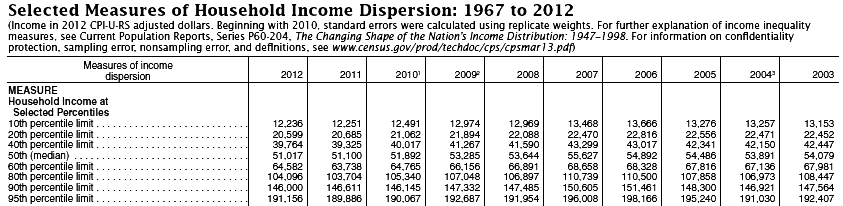
By way of comparison between the United States political elite and average Americans, one reads: "While inflation-adjusted ("real") household income had been increasing almost every year from 1945 to 1999, it has since been flat and even decreased recently. U.S. median household income fell from $51,144 in 2010 to $50,502 in 2011. Extreme poverty in the United States, meaning households living on less than $2 per day before government benefits, doubled from 1996 to 1.5 million households in 2011, including 2.8 million children." In "Household income in the United States," Wikipedia accessed June 2013.
"Fruitwood-smoked Quail" and wine "that sells at $499" and a hotel bill of $665,545 compares rather favorably to 2.8 million children "living on less than $2 per day." Any questions? These are among the sorts of politicians who speak loftily of social justice and income inequality.
[ 2 ] For any who would rationalize such excess, please take the test as found in the first footnote titled "Addendum for the Celebrity Income Inequality Activist" under Income Inequality
An Insult of Which to Be Ashamed
What is especially telling about the news article courtesy of CBS is that the government took 13 months to divulge five simple numbers. One would do well to recall an American's perspective of aristocracies in this remarkably modern quote:
"...the people! They were the quaintest and simplest and trustingest race; why, they were nothing but rabbits. It was pitiful for a person born in a wholesome free atmosphere to listen to their humble and hearty outpourings of loyalty toward their king and Church and nobility; as if they had any more occasion to love and honor king and Church and noble than a slave has to love and honor the lash, or a dog has to love and honor the stranger that kicks him! Why, dear me, ANY kind of royalty, howsoever modified, ANY kind of aristocracy, howsoever pruned, is rightly an insult; but if you are born and brought up under that sort of arrangement you probably never find it out for yourself, and don't believe it when somebody else tells you. It is enough to make a body ashamed of his race to think of the sort of froth that has always occupied its thrones without shadow of right or reason, and the seventh-rate people that have always figured as its aristocracies -- a company of monarchs and nobles who, as a rule, would have achieved only poverty and obscurity if left, like their betters, to their own exertions." In Chapter 8 of "A Connecticut Yankee in King Arthur's Court," by Mark Twain, 1889.
When one considers a company of men who "have achieved only poverty and obscurity," one only need refer to the bankruptcies of cities underway in the United States today, and growing public pension crises of underfunding while over-promising. One only look at Fat cats richly rich of late - a comparative and sourced criticism of the nouveau "fair share" folks.
Other literature from other times speaks in parallel: "There was an air of indifference about them, a calm produced by the gratification of every passion; and through their manners were suave, one could sense beneath them that special brutality which comes from the habit of breaking down half-hearted resistances that keep one fit and tickle one’s vanity...." In "Madame Bovary," by Gustave Flaubert (1856).
Suave manners? Gratification? An air of indifference?
Excess Atop Poverty
One tallies recent excesses while pondering poverty and income inequality: "... their 350 guests set about honoring Mr. Hollande at a lavish event that featured quail eggs, Hawaiian chocolate-malted ganache, and purple irises and free-flowing vines meant to evoke Monet. Plenty of Hollywood names were in attendance: the film star Bradley Cooper, who was seen chatting with Secretary of State John Kerry; the actress Cicely Tyson; and Julia Louis-Dreyfus, who plays a dysfunctional vice president in the HBO series 'Veep.' She was seated next to the actual vice president, Joseph R. Biden Jr." In "State Dinner Guest List for Hollande Is Impressive, if Minus One," by Mark landler, New York Times, 11 February 2014.
Further pondering income inequality over "quail eggs, Hawaiian chocolate-malted ganache, and purple irises and free-flowing vines meant to evoke Monet," one learns that among the Obamas' guest, one Bradley Cooper is among the 1%ers. "Thanks to The Hangover, Cooper has become one of the best-paid actors in Hollywood. We estimate he earned $28 million between June 2012 and June 2013, more than fellow actors Will Smith and Ben Affleck, who both landed on the Celebrity 100." In "Bradley Cooper And Lena Dunham Top Our List Of Celebrity 100 Up and Comers," by Dorothy Pomerantz, Forbes, 26 June 2013.
Might one imagine the festive conversation even mentioned "households living on less than $2 per day before government benefits?" Somehow, one can imagine that Bush's fruitwood-smoked quail -- quail being theme here -- and Obama's quail eggs compare favorably to "extreme poverty." Especially when shared with wealthy and influential guests.
Let someone eat cake. And chatter on about Income Inequality
[ 3 ] While the ruling class dine high on the proverbial hog and chatter in their chic, populist rhetoric, one reads of a reality which much political reporting fails to mix into the discussion:
"About 16.1 million children and 3.9 million people aged 65 years and older were living in poverty last year. 'Millions are struggling to keep their heads above water, while the richest one percent is doing better than ever,' said Joan Entmacher, vice president of Family Economic Security at the National Women's Law Center in Washington." In "U.S. poverty rises despite economic recovery," by Lucia Mutikani, Caroline Humer and Susan Heavey, Reuters, 17 September 2013.
Given the "rising costs" and upscale guests list of state dinners, it seems that indeed "the richest one percent is doing better than ever." This includes many guests at the state dinners, celebrating themselves -- the wealthy and powerful.
[ 4 ] It is amusing to use an Internet search engine to seek out presidential expenditures. The referred-to sites side with one political party or the other, rationalizing why "their" side spends lavishly with good cause while the opposing side wastes public as well as privately donated funds. The point is other than "either or."
The point is for people to Bring presents to the party
[ 5 ] The delightful and delightfully funny complaint the New York Times published was so easily answered by an opposing view.
Who Attends to the Self-Absorption Buffet?
One reads in response to McCreesh: "The front of the New York Times Sunday Styles section was a microcosm of self-absorbed journalists indulging themselves over the holidays: 'The Pall Before Christmas.' It was written by Shawn McCreesh, previously an editorial assistant to Maureen Dowd and who here shares Dowd’s contemptuous irreverence toward Trump. It takes some gall, after prominent Democrats have encouraged confrontation of Trump staffers (and the Times running op-eds advocating 'doxxing' migrant detention center employees), for the paper to suddenly wonder where everyone is." In "Trump-Hating NY Times Pouts Trump Doesn’t Throw Christmas Parties for Journalists," by Clay Waters, MRC, 24 December 2019.
Love or hate Trump, the hyperbole has been ridiculously excessive. One read: "...the first reason the comparison of Donald Trump to Adolf Hitler bothers me is not because it belittles the deaths of millions of innocents, but because, frankly, it belittles Adolf Hitler." In "Don’t compare Donald Trump to Adolf Hitler. It belittles Hitler,” by Shalom Auslander, Washington Post, 13 September 2016.
There is a simple explanation to much which the world's self-anointed bright boys and girls of the media so easily forget. Sometimes it's just that, after misuse and abuse, People walk away
Consider the media rhetoric with a sourced True socialism, oh yes, he said
"The afternoon knows what the morning never suspected." Robert Frost (1874–1963)
One old woman lived far too many years.
She smoked and drank and had too many fears.
She was dry as a leaf but she was sharp as a knife,
But then death paid a call and snuffed out her life.
That old woman lived far too many years.
She smoked and drank and had too many fears.
When I'm no younger than that old woman was,
I will drink to my fears as I smoke my cigars.
I'll look gaunt and peaked, maybe look even worse,
Because dying is nasty, while old age ain't such a curse.
O God, let me live far too many years,
To smoke and drink and even have too many fears.
Envoi: "When I was younger, I could remember anything, whether it had happened or not; but my faculties are decaying now and soon I shall be so I cannot remember any but the things that never happened. It is sad to go to pieces like this but we all have to do it." Mark Twain (1835-1910)
Addendum of Whiskey and Cigarettes: "Dorothy believes smoking is the secret to her old age - and a regular drop of whisky. Relaxing with her favourite tipple of Bell’s, she said: 'I put my health down to whisky and cigarettes. I only drink when I’m out but my doctor said I wouldn’t be alive without them'." In "'Whisky and 15 cigarettes a day is the secret of my good health' says Dorothy as she celebrates her 100th birthday (with a glass of her favourite tipple, of course)," by Sarah Bridge, Mail On Sunday, 11 November 2013.
Addendum of Keeping Active and 95 Years of Smoking: "Batuli Lamichhane, of Nuwakot, is indeed 112 according to her ID, but local residents said she could be as old as 114. Lamichhane attributed her longevity to keeping active. 'You will probably die earlier. People of this modern age have too much stress. And those who do not work or are idle in their old age won't live long. If you study a lot and work hard, you'll live a long life. Be happy!' she told TIG Media." In "112-year-old Nepal woman says she's been smoking for 95 years," by Ben Hooper, UPI, 7 December 2016.
Addendum at 111 Years: "He’s met celebrities and politicians and athletes, each asking him the same question about his secret to longevity. His answer? God and cigars." In "At age 111, America's oldest veteran is still smoking cigars, drinking whiskey and loving life," by Brendan Meyer, Dallas News, 2 June 2017.
Addendum of 112 Years: "Fenton was prescribed alcohol by a doctor for a benign tumor in 1943. She took heed, drinking Miller High Life and Johnnie Walker Blue Label daily for decades. When interviewed on her 110th birthday, Fenton credited the routine for her longevity. Although old age forced her to quit drinking, friends say Fenton remained mentally sharp. Fenton always reminded those close to her of the importance of having God in their lives." In "New Jersey's Oldest Resident, Whose Secret to Longevity Was Alcohol, Dies at 112," NBC News, 25 August 2017.
See: Old Age Blues
He shoots at fog with a shotgun;
He gets as close as he can.
He takes him aim and then squeezes
And claims that he's a sharp-shooting man.
He doesn't hit much but he whoops for joy;
He hollers of his fame.
And though he never really hits anything
He crows about it all the same.
He's a sharp-shootin', rootin', tootin' fellow
Who thinks he's just the best.
And if you ever believe his words
Then you would be hard pressed
To tell the truth or see things straight
Or hold to a sensible thought,
Or do things right or think for yourself,
'Cause your thinking's so distraught.
He claims his many shiny medals
For shooting at foggy gray mist,
And expects little you to clap and cheer
'Cause when you don't, he's pissed.
He shoots again with his shotgun,
And even so must cheat.
He takes his aim and then squeezes
And declares this sport is sweet.
If you don't give him honors
That glitter in the sun,
I tell you true, he'll shoot at you.
That's how this sport is done.See: Smoke and Mirrors
"Chinese Communist party authorities, fearing a threat to their legitimacy, forbid open discussion of the so-called "June 4th incident" in the country's media and on its internet. Yet internet users have reacted by using ever-more oblique references to commemorate the tragedy, treating censors to an elaborate game of cat-and-mouse." In "Tiananmen Square online searches censored by Chinese authorities," by Jonathan Kaiman, Guardian UK, 4 June 2013.
You did not see that which you saw,
Nor hear what you just heard.
The notion that you might have done
Is patently absurd.
We will tell you what you saw
And what you heard and then
If you own version contradicts,
We'll tell you once again.
We'll use fair force of argument
To help you see your faults
And, if you can't, we'll use more force
To lock you in our vaults.
You have no right to yesterday
When yesterday's revised,
And if you still would disagree,
Why then, you'll be despised.
You will not see that which you saw,
Nor hear what you just heard.
The notion that you would dare do that
Is patently absurd.
Envoi: "...the distortion of history, which—if it constitutes the denial of historical crimes—is also sometimes called negationism." Wikipedia
Addendum on Revisions: "Most of the Maoists were men in their 60s filled with nostalgia for the Cultural Revolution – a turbulent period they lived through along with the next generation of Chinese leaders who will be named next month. But 36 years after Mao’s death, his loyal followers often feel more like dissidents. 'Today’s leaders are capitalist-roaders and revisionists,' says one retired worker surnamed Zhou, resurrecting terms used during the Cultural Revolution, which wreaked havoc on China from 1966 until Mao’s death in 1976. Zhou and the group were visiting Shaoshan, Mao’s birthplace in Hunan province, to commemorate the anniversary of the death of the former leader. 'They call it socialism, but Deng Xiaoping, [the architect of China’s market reforms], has created a system that combines the worst of all worlds: hyper-capitalism, corruption and fascism,' says Zhou." In "Some old Maoists feel like dissidents in modern China," by Carlos Barria, Reuters, September 2012.
Addendum: "There is nothing more frightful than ignorance in action." Johann Wolfgang von Goethe (1749-1832)
Addendum: "A people without history / Is not redeemed from time, for history is a pattern / Of timeless moments." From "Little Gidding," of the Four Quartets (1942) by T. S. Eliot (1888-1965)
Addendum of Censorship: "Authorities in Beijing clearly fear that demands for democratic reform in Hong Kong may spread to the mainland, and censorship activity, ordered by the state, bears this out. Despite 2014's many politically sensitive and potentially destabilizing events -- including a March 1 terrorist attack at a busy train station, the July 29 announcement of an investigation into former security watchdog Zhou Yongkang, and the Sept. 23 sentencing of prominent Uighur scholar Ilham Tohti on charges of separatism -- the three most censored days on Weibo nevertheless all related to Hong Kong." In "In China, the Most Censored Day of the Year," by Bethany Allen-Ebrahimian, Foreign Policy, 29 September 2014.
Addendum of Crackdowns: "China is in the midst of what many overseas scholars say is its harshest crackdown on human rights and civil society in decades. Since Xi Jinping came came to power nearly four years ago, hundreds of activists, lawyers, writers, publishers and employees of nongovernmental groups have been rounded up. Many more have been threatened and intimidated. Internet news sites have been ordered to stop publishing reports from sources that aren’t sanctioned by the state." In "China's crackdown on dissent is described as the harshest in decades," by Julie Makinen, Los Angeles Times, 10 August 2016.
Addendum of the Chinese Communist Attack on Words: "They’ve attacked the very words people would need to use to express discontent. 'Emperor'. 'Two term limit'. 'Control'. These top a long list of terms now blocked by China’s state controlled social media platform, Weibo, as well as the search engine Baidu. And while you cannot burn electronic books, Beijing’s done the next best thing." In "China’s war on words: Anything — be it a phrase or picture — that can be used to insult Xi has been banned," by Jamie Seidel, News.com, Australia, 28 February 2018.
See: Put the past to rest
I am earth that's not yet plowed,
All alone within a crowd.
Coldly waitin' for the sun,
Summer's night is not yet run.
Come caress me; you want to.
You'll find me cold and hot and blue.
I am fires not yet stoked,
I'm a drug that's not been smoked.
I am ice that's boiling hot;
Come and taste just what I got.
Will you touch me? Would you dare to?
I promise you I'm hot and blue.I come down to earth from heavens above,
To fatherly arms and mother's love.
I come down by birth from heavens on high,
To walk here below a heavenly sky.
Now I walk through hours and I walk through days,
With the pains and pleasures of earthly ways.
But I dream of when there were heavenly days.
Heavenly days before birth, with stars all ablaze.
Those heavenly days.The hot house once blossomed with color and hue,
Bright with the sun as it went streaming through.
The yellow of warmth is now run away
And the winter has come with its icy bouquet.
Now the panes are all broken where beauty once grew,
And now cold are the dead where the winter winds blew.
Now the long white rain freezes, gathering gray,
And the building is fallen to death and decay.I sit on my porch through the whole damn day,
But callers don't ever come my way.
No body ever stops by to stay.
The stove isn't warm and my dinner's not served,
And loneliness seems what I surely deserved.
No body ever stops by to stay.
The bed is unmade and the clock ticks off time,
The hours just fade and the shadows just climb.
No body's mine.
One stranger showed love, and, more strange still,
There once was a time when I had my fill.
That once is now gone but the lonely blues stay.See: Hot House Ballads (1991-2008)
Wait for the fruit of the money tree to ripen as it may,
Or kill the geese with the golden eggs such that they cannot lay.
We little folk live prudently while governments refuse
By passing bills to the little folk and tightening the screws.
The short of sight scream loud with fright to find their visions blind,
Then rage and rant at prudent folk because they had declined
To blind their eyes and shut their ears to simple prudent ways
Like spending less than what they'd earned just for those rainy days.
Not waiting for the money tree to ripen and to grow,
Governments kill the golden geese with blustering, empty show.
We little folk live prudently while governments refuse
And so we find it's governments that are quaking in their shoes.
The holes in the boats which they have drilled are leaking fast, we see.
It is for this that they all cry aloud to bail out poverty
Out of all the mess that they have made and all the debts they've massed.
" 'twas all for the best intentions," they argue to the last.
The rains, they come; the storms, they blow, the levees shall be topped
And governments on shifting sands will find they have been stopped.
The money tree will grow again, for such are Nature's ways,
And prudent folks shall quite survive the governmental blaze.
See: Prudence and Thrift
I'm very fond of Cummings' words
I'm very fond of Cummings' words
(o I'm very fond of Cummings' words
yes I'm very fond of Cummings' words)
but I'll write my own for his sake.
Gimme Edward Estlin's words to open my ears
(o gimme Edward Estlin's words to my ears
yes gimme Edward Estlin's words to my ears)
though I won't use some as lyrics.
Nothing like a copyright ruining the blues
(o nothing like a copyright ruining the blues
yes nothing like a copyright ruining the blues)
but a dictionary's got more.
Norton wanted cash up front for Cummings' nifty words
(o Norton wanted cash up front for Cummings' nifty words
yes Norton wanted cash up front for Cummings' nifty words)
and I reckoned that's not worth paying.
Publishing is not about words or art
(o publishing is not about words or art
yes publishing is not about words or art)
it was Cummings that taught this lesson.
Envoi: "listen: there’s a hell / of a good universe next door; let’s go," E. E. Cummings (1894-1962)
See: I'm very fond of Cummings' words - (1989/2008)
and also Poetry
Topsy turvy,
Straight yet curvy,
How does your story grow?
By upward downs,
And smiling frowns,
While going quickly slow.
The tale is told
To young and old
For by it shall they know
That right is wrong
While short is long
And so the plot points flow
From here to there
And everywhere
Except that you might know.
Bad is good
And can't is could
When putting on a show.
Turvy topsy,
Words' autopsy,
Meanings' meanings overthrow
For in is out,
And proof is doubt,
And there is nothing more to know.
Trust by lying,
Blindly eyeing
Who reaps pork and who eats crow.
See: Good Old Obfuscation
The waiter came to bring the check,
For gone was the repast.
The bill was more than 'twas foretold;
The diners stared, aghast.
They'd eaten of their hearty meal,
And drunk like drunkards do,
And had their sweets and savories;
Of course -- it was their due.
And none had thought to ponder
The cost or who would pay,
For that was then and this is now;
Tomorrow is another day.
But then the waiter brought bill.
The diners sat perplexed;
With empty wallets they had dined,
And now were deeply vexed.
"I thought 'twas you invited me,"
Shrieked one unto the other;
Another growled, "I thought you'd pay,
For are you not my brother?"
And so the bill sat on its tray,
As none would reach for it;
"Perhaps we all could pay a bit?"
Began an awful snit.
The uproar then broke out quite loud,
As most would shun their ante,
And hope that someone else would act
As grantor to their grantee.
Alas, the bill sat all forlorn
And waited for their payment;
The numbers cared not for their words
And would not have defrayment.
"The bill is due and payable,"
The management was sure.
"Since we've so little in the bank,
Shall credit be our cure?"
But as the cards were duly checked,
It found accounts rejected;
Insolvent diners ate their last,
As they had been detected.
"The bill is due" was plainly clear.
The party sat dejected;
The bill beamed bright, a sheet of white,
Demanding to be respected.
The end of this most tragic scene
Should have been expected;
There is no bill which happily
Remains ever uncollected.
Envoi: "[Credit is a system whereby] a person who can't pay, gets another person who can't pay, to guarantee that he can pay." Charles Dickens, in Little Dorrit
Addendum of Existence: "Facts do not cease to exist because they are ignored." Aldous Huxley, in Complete Essays 2, 1926-29
An Arresting Addendum: "The deputy approached Bulovic as she was eating her chocolate cake, he reported, and asked if she had any money for the food. 'Ana told me the bill was higher than she expected, and when I asked how much money she had, she informed me 'zero,' ' the deputy wrote in his arrest report. The deputy asked why she had ordered the food if she knew she didn’t have any money, and Bulovic told him just to give her a fine and she would leave. But the deputy told her if she didn’t pay she was going to be arrested, to which she responded, 'Let’s go.' Buovic was taken to jail." In "Woman arrested after feasting on big meal, then saying she has no money to pay," by Jessica de Leon, Bradenton Herald, 30 August 2016.
"The president of the United Way, in Charlotte, N.C., received an increase of more than $700,000 in retirement benefits for the 2007 fiscal year, reports The Charlotte Observer. The annual compensation for the president, Gloria Pace King, is now more than $1.2-million, with her benefits package rising from $108,590 to $822,507."
The question is: do I care?
The answer is I don't.
I will not care for everything.
I simply can't. I won't.
There's always someone on the street
Who wants me so to care;
There's always someone's hand put forth
To hope I give my share.
There are starving children, polar bears,
The poverty of nations,
There are causes of most every sort,
And daily conflagrations
All meant to pry some cash away
From pockets just like mine
To pay the livelihood of those
Who truly live quite fine.
The managements of charities
Reap incomes which are greater
Than the average common little man
To whom they beg and cater.
Atop the planet's saving plan
Meant to glean some cash,
There are far too many a wealthy man
Who peddle balderdash.
You should care for everything,
For all the causes, all the cares,
For this is how the charities
Rake in their fattened shares.
Addendum: Snopes reviewed the above quote in the Charlotte Observer and found it inaccurate; it was a tiny bit inaccurate. While the individual's compensation was lower, it was still far above most Americans' wages. Examining United Way of Central Carolinas, Inc. (a separate 501(c)3 organization like many of the regional United Ways not fully under the management of the national charity), their publicly available Form 990 (2011) -- Part VII "Compensation of Officers, Directors, Trustees, Key Employees, Highest Compensated Employees and Independent Contractors" Total: "Reportable Compensation, $1,519,847.00 plus "Other compensation" $138,238.00 -- for a total of $ 1,658,085.00. Of that amount, there are two entries in Section VII: Ex-president Gloria Pace King's "Insurance Settlement" comes to two installments, $ 466,666.00 and $ 233,334.00, for a total of $ 700,000.00 in one fiscal year.
Addendum: Examining the United Way's national organization independently of Snopes, one learns directly from the agency's publicly available information: United Way Form 990 (2012) Part VII: "Compensation of Officers, Directors, Trustees, Key Employees, Highest Compensated Employees and Independent Contractors" Total: "Reportable Compensation, $ 3,047,147.00 plus "Other Compensation" $ 566,883.00 -- Total $ 3,614,030.00, and World Wildlife Fund's Form 990 (2011) Part VII "Compensation of Officers, Directors, Trustees, Key Employees, Highest Compensated Employees and Independent Contractors" Total: "Reportable Compensation, $ 4,113,355.00 plus "Other Compensation" $606,680.00 for a total of $ 4,720,035.00, and Tides Foundation - 2010 Form 990 -- Part VIII Compensation of Officers, Directors, Trustess, key Employees, Highest Compensated Employees, and Independent Contractors -- Reportable Compensation: $ 788,936.00 plus Related $ 544,831.00 plus Other $ 158,858.00 -- Total $ 1,492,625.00
Addendum of Fund Raising the Chicago Way: "The U.S. attorney’s office in Springfield has been busy the past few years investigating a variety of fraud schemes involving state grants. Thirteen people have been charged so far, six who have pleaded guilty. Two of them have ties to President Barack Obama. One is the daughter of his controversial former pastor, the Rev. Jeremiah Wright. Another was chief of staff to Obama’s longtime friend Eric E. Whitaker when Whitaker was Illinois’ public health chief. In all, prosecutors are alleging a total of $16 million in fraud involving state health or commerce department grants and contracts." In "Tally in Illinois grant-fraud probe so far: 13 charged, $16M embezzled," by Chris Fusco, Chicago Sun-Times, 9 September 2013.
Addendum of IRS-Approved Scrooges: "Hammond also annually alerts residents to charities whose financial reports show they spend little on their stated purpose and much on professional solicitors. The organization with the lowest expenditure was the Fraternal Order of Police Tri-County Lodge No. 3 in Hanahan, at 4.1 percent. Top 10 South Carolina "Scrooges" -- American Breast Cancer Foundation, Inc., Baltimore, MD 37.5% [ 1 ], Defeat Diabetes Foundation, Inc., Madeira Beach, FL 11.8% [ 2 ], Firefighters Support Services, Incorporated, Wyandotte, MI 21% [ 3 ], Fraternal Order of Police Tri-County Lodge #3, Hanahan, SC 4.1%, Fraternal Order of Police York County Lodge #15, Rock Hill, SC 9.2%, Military Order of the Purple Heart Service Foundation, Inc., Annandale, VA 36%, Missional Advancement Project, Inc., Aiken, SC 6.4%, Operation Lookout National Center For Missing Youth, Everett, WA 9.9% [ 4 ], United States Deputy Sheriffs’ Association, Inc., Ashburn, VA 14.8%, Veterans Support Foundation, Silver Spring, MD 24.6%." In "South Carolina Police Lodge Listed as State's "Scroogiest" Charity," Associated Press, 15 November 2012.
Addendum of IRS-Approved Con Artists: "The federal government has charged four sham cancer charities for bilking more than $187 million from consumers for cars, trips, luxury cruises and even dating site memberships. All 50 states and the District of Columbia joined federal officials to charge in federal court the Cancer Fund of America, Cancer Support Services, Children's Cancer Fund of America and the Breast Cancer Society, according to the Federal Trade Commission." In "Cancer charities used public's $187 million for cruises, dating sites: FTC," by Robert King, Washington Examiner, 19 May 2015. [ 5 ]
See also: Modern Times and Charity
NOTES
[ 1 ] The American Breast Cancer Foundation Form 990 lists as "Other salaries and wages" $312,418 in expenses and $109,989 in management and general expenses plus an additional $72,860 in fundraising salaries, against a total yearly revenue from contributions and other sources of $959,635, or over half their solicitation for donations dedicated to merely paying themselves.
[ 2 ] "Over the past decade, the charity has raised $13.8 million in cash donations and steered $8.3 million of that to its for-profit fundraisers. The charity has spent an average of about $1,000 cash a year for direct aid to diabetes patients." In "Defeat Diabetes Foundation," TampaBay.com, n. d. Form 990 for 2012 indicates donations of $1,257,100 depleted by fundraising costs of $930,237 alone, not counting salaries to the operators.
[ 3 ] According to their publicly available Form 990 for 2011, against contributions of $8,113,486 in 2011 this charity paid $7,059,204 in fundraising costs plus additional costs as salaries and expenses to operate their "charity."
[ 4 ] According to their Form 990 for 2012, against revenue of $868,058 this charity paid $259,444 in professional fundraising as a part of their total $764,873 in "functional expenses." The net assets for this year was -$25,592.
[ 5 ] The notion of "federal officials" does not complete the story. From another report, one reads: ""...the family behind Cancer Fund built a network of 'sham charities'' that were designed to enrich officers at the expense of sick women and children, as alleged in a complaint filed Tuesday by the Federal Trade Commission, attorneys general and secretaries of state of all of 50 states." In "Here's where Cancer Fund of America donations went while dying kids got Little Debbie snack cakes," by Susan Taylor Martin, Tampa Bay Times, 19 May 2015.
An IRS-approved Sham for Decades
Thus, it was not the Internal Revenue Service which granted these "charities" their privileged tax positions which caught them. It was a consortium of the Federal Trade Commission along with all fifty states which examined the fraud.
More from the same report: "Named in the complaint are Cancer Fund and two affiliated charities, Breast Cancer Society and Children's Cancer Fund of America. Combined, those charities raised $187 million over four years, yet spent almost 90 percent of the contributions on for-profit telemarketers and the 'steady lucrative employment' of Cancer Fund founder James Reynolds Sr., his ex-wife, his son and dozens of members of their extended family."
The Cancer Fund of America has being operating since its IRS approval in 1984 for over thirty years, before this fraud was uncovered by a non-IRS group of other government groups, mostly at the state level.
"Steady lucrative employment" masked as "charity" has become a regular game in the world of IRS-approved charities. In this case, "charity" was defined as the president of Cancer Fund of America, James Reynolds Sr., being paid a 2013 compensation of $247,995, while the president of Breast Cancer Society, James T. Reynolds II, had a 2013 compensation of $294,875.
One only need look at any IRS-approved "charity" and its leadership ranks' salaries and benefits to conclude that "charities" often pay extremely well, and argue that same old line that "to get the best leadership requires the best remuneration." So much for charity and its associated funding raising as an "approved" IRS function, wherein too often a government agency demonstrates its Incompetence
If not incompetence, another possible suspicion is collusion. One would hope this not to be the case.
"You are talking about a 3.6 percent difference, and for the average person who is making half a million, a million dollars, now people like you Sway, that’s chump change, that’s nothing." Barak Obama in an interview with MTV, Nov 2, 2008
Member of parliaments pocket
Far more than some lesser peer;
Senators and Congressmen pocket
Their cash with political cheer.
Mayors and councilmen pocket
Whatever they can rake,
And governors and yes men pocket
For pocketing's pocketing sake.
Governments say they are needed
"According to each need,"
And pocketing cash is their action --
Their political greedy creed.
Those who provide a product
Are "big" and "bad" they say,
But governments make lit'rally nothing,
Yet confiscate as they may,
For greed might be said to be
The adjective for the few,
But governments are the most greedy
As they greedily pocket on cue.
Pompous and arrogant profits
Of greed are evident most
When governments pocket your money,
Then lift their own glasses in toast
To greed and their greedy lined pockets
Which fill up in good times or bad,
With chump change and with treasure
For which such politicians are glad.
Envoi: "If money is the bond binding me to human life, binding society to me, binding me and nature and man, is not money the bond of all bonds? Can it not dissolve and bind all ties? Is it not, therefore, the universal agent of separation?" Karl Marx (1818-1883)
Addendum of Government Guessing: "Where did all the money go? 'Your guess is as good as mine,' David Montoya, the inspector general of the Department of Housing and Urban Development, says of $700 million in missing taxpayer money that Louisiana homeowners were given in the wake of Hurricane Katrina to elevate and protect their homes from future storms. A new report released from the inspector general’s office shows that more than 24,000 homeowners who received grants of up to $30,000 to elevate their homes either misspent or pocketed the money." In "Where did all the money go? How $700 million in Katrina relief money went missing," by Jeff Zeleny, Richard Coolidge, and Jordyn Phelps, Yahoo News, 4 April 2013.
Addendum of Pentagon Waste in the Eighth Year of the Obama Administration: "...it would have streamlined the bureaucracy through attrition and early retirements, curtailed high-priced contractors and made better use of information technology. The study was produced last year by the Defense Business Board, a federal advisory panel of corporate executives, and consultants from McKinsey and Company. Based on reams of personnel and cost data, their report revealed for the first time that the Pentagon was spending almost a quarter of its $580 billion budget on overhead and core business operations such as accounting, human resources, logistics and property management." In "Pentagon buries evidence of $125 billion in waste," by Craig Whitlock and Bob Woodward, Washington Post, 5 December 2016.
See: Corruption
Reflection: "He was one of the numerous and varied legion of dullards, of half-animated abortions, conceited, half-educated coxcombs, who attach themselves to the idea most in fashion only to vulgarize it and who caricature every cause they serve, however sincerely." Fyodor Dostoevsky, Crime and Punishment ( published in 1866)
See: Growth in debt
"State debt has grown from $14.4 billion in 1990 to $48.5 billion in 2006 and a projected $52 billion in 2007." New York State Office of the Comptroller, Thomas P. DiNapoli, State Comptroller, October 2008
Put it all on credit,
Pay the minimum.
Politicians do it
Quite ad nauseum.
A city begs the county.
A county begs the state.
A state then begs the nation
And hopes it's not too late.
Look what we have brought us,
Welfare for our state.
Social welfare taught us
By not talking straight.
A city begs the county.
A county begs the state.
A state then begs the nation
And hopes it's not too late.
Who will pay tomorrow
For our debt today?
Someone's future sorrow,
They will pay and pay.
A city begs the county.
A county begs the state.
A state then begs the nation
And hopes it's not too late.
Do it for the children;
Borrow more today.
Let's avoid a famine
Till some other day.
A city begs the county.
A county begs the state.
A state then begs the nation
And hopes it's not too late.
Run a tab and then some,
Piling up the debt.
When the debt's a chasm
There'll be time to fret.
A city begs the county.
A county begs the state.
A state then begs the nation
And the nation eats off your plate.
And the nation borrows from you!
Envoi: "As humanity perfects itself, man becomes degraded. When everything is reduced to the mere counter-balancing of economic interests, what room will there be for virtue? When Nature has been so subjugated that she has lost all her original forms, where will that leave the plastic arts? And so on. In the mean time, things are going to get very murky." Gustave Flaubert (1821-1880)
Addendum of New York State Debt in 2012: "...New York’s addiction to debt. As of March 31, 2012, total state-funded debt outstanding was $63.3 billion, up from $39 billion 10 years earlier. And although the law imposed new limits on the use of debt for operational costs, it left exceptions. Our current debt burden includes $5.2 billion issued for non-capital purposes since the reform law took effect." In "The New York state debt threat," by Thomas P. DiNapoli, New York Post, 14 January 2013.
Addendum of Fiscally Stressed Governments Caused by Governments: "...a recent survey by the state comptroller’s office identifies 142 New York municipalities as fiscally stressed. “Chronic budget gaps, increasing local needs, population losses and crumbling infrastructures are not passing problems. It’s the new fiscal reality for many local communities,” Comptroller Thomas DiNapoli noted in June. Among those struggling is the state capital, Albany, which has accumulated $14 million in deferred pension payments. The comptroller’s bleak assessment raises the question of how communities with long-term fiscal woes will repay their pension borrowings. As former Rochester mayor William A. Johnson, Jr. told the Rochester-Democrat earlier this year: 'You’ve got this perfect storm that’s building, and you know, nobody can really see the light at the end'." In "Borrowing Trouble," by Steven Malanga, City Journal, Summer 2014.
Addendum as Deteriorating Finances as the Rich Move Away: " 'That’s a $2.3 billion drop in revenues. That’s as serious as a heart attack. This is worse than we had anticipated,' the governor said in Albany. 'This reduction must be addressed in this year’s budget.' In a rare joint appearance with Cuomo, state Comptroller Tom DiNapoli confirmed the deteriorating finances." In "Cuomo announces income tax revenues have dropped by $2.3B," by Carl Campanile, New York Post, 4 February 2019.
Addendum as Money Talks and Walks: "Money talks — and walks. According to recent data from the US Census Bureau, businesses and residents are exiting New York in droves, as the state lost more of its population than it gained between July 2017- July 2018. The Empire State lost 180,306 people— the biggest decrease of any U.S. state, with Massachusetts, New Hampshire, New Jersey, and Delaware not far behind." In "Delocation: The Slow Burn of Cash Forces N.Y. Companies to seek Alternate Locations," St Petersburg EDC, 15 April 2019.
See: Spend what you don't have
Tale of the Makers and the Takers
Once there were many makers;
The takers? They were few.
Makers bought and sold their goods,
And earned what was their due.
Those takers who were fakers
Cried loud but were ignored,
Because the sound of making things
Rumbled as it roared.
Makers made the things they made
And made such unafraid,
But as the takers numbered more
They bellowed too, and brayed.
The takers said 'twas only fair
That charity be urged,
That takers slowly over time
The leading makers purged.
It took quite long to notice
That something was amiss,
As what was once the makers'
Became the takers' bliss.
And slyly slowly by hook and crook
The takers won the day,
And slowly slyly moved to drive
Makers one by one away.
The chief among the takers
Had caused such great success
That all too slowly folks all found
The takers' ways depressed
The markets where the makers
Once had sold their things,
Which now was laden heavily
With snares and traps and stings.
With far few makers roused
To make and make and make,
And far too many takers
To take and take and take,
The marketplace had dwindled
To selling stale bread
And yet stalls are were filled
With promises instead.
"When we find yet something else
To take, as is our due,
We'll bring it to the market place
And sell it then to you."
But makers grew too weary
With burdens and with rules
And fewer worked with fervor,
But laid aside their tools.
The chief among the takers
Declared this was obscene,
For "makers should be making
For of making they are keen."
But having made the takers
Take so much of their work,
The makers learned to take
And learned their work to shirk.
"Why, this is wrong!" each taker cried,
His hand outstretched and wide,
"We must enforce the makers' work
With force of law as guide.
We'll force them to produce for us
That we may take yet more,
And if they do not, obviously,
We'll empty out their store."
As takers grew in numbers,
And makers dwindled fast,
The takers found their taking
All too soon was past.
"What shall we do?" they wailed aloud,
In misery and pain.
"The only thing that's left to do
Is learn to make again."
But who shall teach and who shall lead
When takers rule the roost?
Who can give the market place
A necessary boost?
When takers have forgotten
What it takes to make,
Then takers must allow this fact,
That makers keep a stake
In what they make and what they earn
And why they want to make,
For when this is forgotten,
Then makers learn to take.
With new recruits in takers' ranks
And far too few to make,
The market place might limp along
With produce which few make.
The takers will be angry
For taking more that this,
For they will have then taken
The makers' making bliss.
When makers make, then all have much
And even charity has more,
But when the makers dwindle fast,
The future has in store
What it has each time when this
Old story lives again.
For lessons quite forgotten
Affect the lives of men.
Makers make and takers take,
And when the balance tips
Towards taking more than making,
This little leak sinks ships.
Once more there might be makers;
Yes, takers? There'll be too.
Makers will trade back and forth,
And earn what is their due.
Those takers who are fakers
Might cry as they did before,
But the sound of making things
Will rumble and must roar.
The cycle of the sorry takers
Circles and repeats,
Because the story sounds quite nice
And promises such treats.
But the lesson oft was learned
That takers are but fools
And should be rightly spurnedFor makers makes our tools.
Addendum of Lentil Meals Being Made and Taken: "... it costs Lentil As Anything up to $23,000 a week to keep their doors open – and customer contributions do not come close to covering costs. 'There are people who can give, and then people who take,' Ms Piyarach Kiatsiri said. 'If people can afford to give, they should – if customers can pay, we need them to donate'." In "Lentil As Anything in trouble as cheapskates take advantage of restaurant’s charity," by Eliza Barr, Inner West Courier, Daily Telegraph, 23 August 2016.
See: Whose gonna pull the welfare wagon
"Socialism is a philosophy of failure, the creed of ignorance, and the gospel of envy, its inherent virtue is the equal sharing of misery." Winston Churchill (1874-1965)
I shall believe the socialist when politicians earn
the average wage of the common man, which egalitarians so lightly spurn.
When socialists are quietly content to take no more than this,
Then I'll believe their social spiel and seal it with a kiss.
But when they say they need much more than the average common man,
I suspect there is something else in their socialistic plan.
That "something else" is evident and can be plainly seen
When socialists gather capital of which they are so keen.
These socialists are strangely odd as they chat of social health
while behind the scenes they are greedy and gather in their wealth.
Equality sounds quite nicely nice as rhetorical words and cheers,
but socialists like so much to be more equal than their peers.
I shall believe the socialist when politicians earn
the common wage of the common man, from which socialists so quickly turn.
Envoi: "A Socialist, carrying a red flag, marched through the gates of Heaven. 'To Hell with rank!' he shouted. 'All men are equal here.' Just then the late Karl Marx turned a corner and came into view, meditatively stroking his whiskers. At once the Socialist fell upon his knees and touched his forehead to the dust. 'O Master!' he cried. 'O Master, Master!'" In "A Book of Burlesques," by H. L. Mencken, 1916.
Addendum of the Bourgeois Monument: " 'He’s buried here because it’s beautiful, not to make the cemetery profit,' said Dima Marotti, an Italian Marxist living in London. A group of visiting tourists from Montana said the grandness of the Marx memorial reflected what they saw as the hypocrisy of an ideology that calls for equality. 'It’s such a bourgeois monument,' said Andrew Carroll, a former cemetery worker, as he looked up at a severe-looking bust of Marx’s giant head." In "Death to Capitalism? Visitors to Marx’s Grave Balk at Fee," by Alistair MacDonald and Ese Erheriene, Wall Street Journal, 25 October 2015.
Addendum of Poor Reading: "The family, numbering five souls and sometimes more, lived in two small rooms in a building which now harbors one of London's innumerable topless night clubs. Later the family lived in other places, always in the end evicted from them for nonpayment of rent. The family's silver -- the last of Frau Marx' dowry -- was sold piecemeal. There were days when Marx could not go outside because his clothing was in pawn. A baby died too, for the family was continually undernourished. Jenny Marx nursed her offspring past their prime and was tormented by their sharp little teeth. Marx himself suffered dreadfully, and for many years, from boils, bad teeth, carbuncles, and the other stigmata of the poor. This intellectual middle-class family never lived better in London, and frequently worse, than the most illiterate and wretched proletarians in the swarming East End of that great city. Despite these constant crises and harassments, Karl Marx spent nearly every day for many year in the reading room of the British Museum, one of the world's great libraries." In "Marx in the Modern World," by A. S. Hall, Nebraska Journal of Economics and Business," Vol. 18 (1), Winter 1977. [ 1 ]
Addendum of Justifying Champagne Socialism: " The disappointments of the past and present can be blamed on the purported failings of leading figures within the party. From this perspective, champagne socialism has always been a kind of corruption which has repeatedly derailed the parliamentary socialist project. While personal integrity is important, Marxists would argue that this concern with champagne socialism and its apparently deleterious consequences for the labour movement is a kind of moralism that misses the structural determinants of Labour's failure to transform society radically. The problem here is that labourism seeks to manage capitalism in such a way that unjust social inequalities are abolished – but capitalism does not work that way. Similarly, Marxists would argue that a moralistic focus on the relative wealth of specific individuals is a distraction from the real issue – which is not whether this or that 'rich egalitarian' should donate more to charity, but how people can change the system that gives rise to structured social inequalities of power and wealth and that constantly reproduces them." In "So what's the problem with champagne socialism?" by Ed Rooksby, Guardian UK, 16 April 2013.
Addendum of the Weakness that Infects: "Most significantly in Brazil, the winds of change are being felt in accountability for public officials for corruption. For a long time, Lula seemed immune, even as plenty of his aides were packed off to the hoosegow. Corruption charges never seemed to touch the man of the people who was so venerated on the global left. But the same weakness that infects all socialists, that of creating special interests, with special privileges and special claims on the public fisk, all in the name of 'fairness' and redistribution, doesn’t take long to morph into plain old corruption. A ruling party, even if, or maybe precisely because, it claims to be socialist, always ends up making itself the biggest and most important special interest of them all, even as it denounces a long-gone establishment, claims to embody the people, then digs in to help itself with the people’s money." In "Brazil’s Lula, Socialist Man Of The People, Busted For Stealing From The Little Guy," by Monica Showalter, Investors, 7 March 2016.
Addendum of France's Socialist President: "...the balding pate of the French president is at the centre of an embarrassing scandal dubbed coiffeurgate after the weekly paper Le Canard Enchaîné revealed that his personal hairdresser is on contract for almost €10,000 a month, paid from the public purse. The publication of the contract with the hairdresser, named as Olivier B, has sparked a row over extravagant spending by a Socialist president who once liked to see himself as 'Mr Normal'. 'I can understand the questions, I can understand that there are judgments,' said the government spokesman and Hollande ally Stephane Le Foll as he confirmed the hairdresser’s salary of €9,895 (£8,265) a month." In "Bad hair days for François Hollande over €10,000 coiffeur bill," by Angelique Chrisafis, Guardian UK, 13 July 2016.
Addendum of a Vermont Socialist: "Socialism works. If you have any doubt about that, just ask Bernie Sanders. He may not have made socialism great again, but he did all right for himself. He just bought his third house, this time a $600,000, four-bedroom dacha on Lake Champlain in Vermont. It is in the town North Hero (get it?) that has a population of around 800." In "After weekend at Bernie's, what's not to like about socialism?" by Peter Lucas, Lowell Sun, 16 August 2016. [ 2 ]
Addendum of Some Venezuelan Socialists in America: "They used US, Canadian and Andorran banks to launder and conceal the cash. Then they lived like kings, purchasing real estate all over the world, including a $30 million hunting estate in Spain; renting a Fifth Avenue brownstone at 75th Street; buying an Olympic Tower penthouse across from Rockefeller Center, million-dollar beachfront condos in Miami’s Sunny Isles neighborhood, apartments in Paris, fancy cars and a $20 million passenger jet. Recently, they put $53 million of the stolen Venezuelan money into a sunglass start-up in Spain called Hawkers." In "How Venezuela’s corrupt socialists are looting the country to death," by Thor Halvorssen, New York Post, 10 January 2017. [ 3 ]
Addendum of an American Democrat Debate: "After Sanders criticized 'tax breaks and subsidies' for the rich, Bloomberg interjected: 'What a wonderful country we have. The best known socialist in the country happens to be a millionaire with three houses. What did I miss here?' " In "Bernie Loses It When Bloomberg Calls Him The 'Best Known Socialist' Who 'Happens To Be A Millionaire With Three Houses'," by Scott Morefield, Daily Caller, 19 February 2020.
See: Income Inequality
NOTES
[ 1 ] While Karl Marx evidenced in his personal life economic failure, his work announces how to make social success through economics principles which he termed "scientific," perhaps based on all that reading in the British Museum.
A text for which I have not determined clear authorship amusingly turns an episode into a drama: "- But this is a true robbery! – Marx exclaimed and snatched out a silver plate from the usurer's hands. – You make the worst mistake when you don't see destinies of people within the economic relations. Eventually, you simply don't think of the future of the business. Not paying me and people like me the fair price for valuable things you deprive us – your clients of the opportunity to spend the received money on other goods. And owners of such goods - capitalists, in turn, can quite easily be potential buyers of your jewelry! Thus, if I am not able to buy meat from the butcher, it is quite probable that he will come to you to purchase jewelry much later or won't come at all! - You’re telling some nonsense! – The angered usurer jumped up from the chair. – It is simple commerce – without any verbose philosophy!"
Poor, Poor Karl
What is factual is that Marx lived a later life of poverty, pawning personal property as well as seeking his "rent" from Engels, whose relative wealth was created by a business enterprise. One sees from the addendum above that while he and his family struggled in poverty, his response was to read for days on end and write his work on capital about what political processes would better society. Yet he was not interested in bettering his family's financial circumstances via his own "simple commerce" outside the borders of his interests, all the while seeking money from others. For an illustrative example please see: Jewish nigger
After a century and more of various, real-world socialist governments all purportedly rooted in Marxist thought, one finds economic collapse alongside totalitarian tendencies by the dictators over the proletariat and what Professor Rudolf Rummel termed "democide," the lure of socialist thought lingers.
Elite anti-capitalists love capital for themselves
One reads a clear question: "...we ask: Who among Democratic lawmakers and party leadership is in middle-class solidarity with the working man? And which big mouth of the Hollywood left, who votes Democrat and pretends he or she believes in equality, actually exercises it? They all inveigh against capitalism. And all have made it work for them in their personal lives." In "Socialist Leaders Condemn Wealth But Still Get Rich," IBD Editorial, Investors, 4 April 2013.
Like Marx begging money for his "scholarship" -- from a safe distance from the struggle
One notes an interesting side to the intellectuals who propped up Marxism, trying to revamp its appeal. One reads: "Stuart Jeffries finds the title of his lively group biography in the Hungarian Marxist critic György Lukács’s ironising description of the Frankfurt school. Having taken up residence in a sumptuous grand hotel, they can indulge their pessimism from a safe distance and analyse the woes of the world rather than engage in the struggle for change. Well before Adorno’s 1966 book of that name, the group was engaged in negative dialectics. Jeffries is an able though combative narrator, drawing in large swaths of material but demanding that his biographees justify their projects and behaviour at every point. He’s worried about their class credentials. He doesn’t quite trust intellectuals for whom thinking seems work enough. Fine journalist that he is, he wants to interrogate the fact that the Frankfurt headquarters was built with capitalist money, that research was done for governments. He also wants to question their lack of active political engagement early on and in the radical 1960s and 70s when the call from students came." In "Grand Hotel Abyss: The Lives of the Frankfurt School – review," by Lisa Appignanesi, Guardian UK. 18 September 2016.
Built with capitalist money
Consider the sales pitch of the populist-sounding phrase, People before profits
So what's the problem with champagne socialism? Especially without the champagne? Or with owning a silver service rather than pawning the family's silver? What's wrong, then, with inequality when practiced by so many for whom socialism is a beloved belief? Champagne? Silver? Relative wealth? Against what shall we inveigh?
"I shall believe the socialist when politicians...."
[ 2 ] One reads of the community in which Senator Sanders' third home is located: "As of the census of 2000, there were 810 people, 333 households, and 237 families residing in the town. The population density was 58.9 people per square mile (22.8/km2). There were 906 housing units at an average density of 65.9 per square mile (25.5/km2). The racial makeup of the town was 97.53% White, 0.25% African American, 0.25% Native American, 0.37% Pacific Islander, and 1.60% from two or more races. Hispanic or Latino of any race were 0.62% of the population." In "North Hero, Vermont," Wikipedia article, n. d.
In a Wikipedia article on the senator, one reads: "Since the deterioration of Venezuelan living standards under the direction of the self-described socialist government in the country, concerns and comparisons to Venezuela were raised over Sanders' desires to implement socialist policies in the United States. Sanders responded by attempting to distance himself from Venezuela's Bolivarian Government, replying to such worries by stating, 'When I talk about Democratic socialist, I'm not looking at Venezuela. I'm not looking at Cuba. I'm looking at countries like Denmark and Sweden'. Sanders also furthered himself from the Venezuelan government by calling the leader of Venezuela's Bolivarian Revolution, former President Hugo Chávez, a 'dead communist dictator'." Wikipedia article, n. d.
Dreamy Words Then and Now
Yet, hosted on his senate site on finds: "These days, the American dream is more apt to be realized in South America, in places such as Ecuador, Venezuela and Argentina, where incomes are actually more equal today than they are in the land of Horatio Alger. Who's the banana republic now?" In "Close The Gaps: Disparities That Threaten America," by Valley News Editorial Board, 5 August 2011, and reprinted at Sanders.senate.gov, retrieved December 2018.
How many "in the land of Horatio Alger" own three homes, while peddling some form of socialism?
One my link these statements from 2011 and 2016 together to more broadly represent Sanders' rhetorical style which seems flexible. But as to the land of the "dead communist dictator" viewed from the "banana republic" of an American senator, one reads below of the massive fraud perpetrated by socialists in Venezuela, where "the American dream is more apt to be realized," according to senatorial words from 2011, still "up" on his senate web pages, when last examined. Odd.
[ 3 ] As to that socialist revolution in Venezuela which promised to much, it has delivered much to the few well-connected and elite. One reads: "...as Venezuela staggers deeper into ruin, once-ardent believers are losing their faith. Pedro García, a chavista social worker and musician in the same community, claims Chávez’s heirs have led the country into an abyss of political infighting and thievery. As if to confirm his point, the following day Chávez’s former treasurer was sentenced to 10 years in jail in the US for taking more than a billion dollars in bribes." In " 'A slow-motion catastrophe': on the road in Venezuela, 20 years after Chávez's rise ," by Tom Phillips, Guardian UK, 6 December 2018.
Billions for a Socialist Elite
For clarification on this Venezuelan socialist and confidante of Chávez and Madura, one learns that "... dollars on the black market have fetched at least double and sometimes 10 times more, allowing the well-connected to buy cut-rate dollars and resell them at a huge profit. Andrade received bribes from brokerages to sell dollar-denominated bonds on behalf of the government, according to court records. The brokerages kept part of the proceeds and returned kickbacks to him by buying him items including 17 horses, 35 luxury watches, 12 cars and six South Florida homes." In "Venezuela ex-treasurer who took $1 billion in bribes sentenced to 10 years," Reuters, 27 November 2018.
Such tales are consistent with earlier reports, as one reads: "...the Chavez clan has enriched itself has plenty of sympathisers in Barinas, a poor town which sits humid agricultural plains 300 miles southwest of Caracas in one of Venezuela's regions. Here the late-president's family owns 17 country estates, totalling more than 100,000 acres, in addition to liquid assets of $550 million (£360 million) stored in various international bank accounts, according to Venezuelan news website Noticias Centro." In "Venezuela: the wealth of Chavez family exposed," by Alasdair Baverstock and Peter Foster, Telegraph UK, 14 April 2013.
Additionally, one learns: "Maria Gabriela Chavez, 35, the late president's second-oldest daughter, holds assets in American and Andorran banks totaling almost $4.2 billion, Diario las Americas reports. The figure would make Gabriela Chavez wealthier than media mogul Gustavo Cisneros, whom Forbes named the wealthiest Venezuelan earlier this year with $3.6billion in assets." In "Being the ex-President's daughter pays off: Hugo Chavez's ambassador daughter is Venezuela's richest woman," by Pete D'Amato, Daily Mail, 11 August 2015.
Thus by example these Venezuelan socialists portrayed as revolutionaries for the "little people" have managed to skim massive wealth from the nation for a small coterie of elite socialists.
Such massive corruption is well proved to be what happens when socialists -- and others too -- are Left to their own devices
"Guilty as hell, free as a bird - America is a great country." Distinguished Professor William Ayers (b. 1944)
From ivied walls and towers
they blather as they preach,
And cry they are such radicals
as radical they teach.
Professors say they're radical
with tenure on their side.
They earn far more than most folks do;
in their capital they take pride.
They play at socialism's rhetoric,
but bide in a moneyed clique,
Their social inequality
is quite the clever parlor trick.
Professors play as radicals
but live in upscale homes.
They write and write and write some more,
while all too thick their tomes.
They say they care about the poor,
injustice and such things,
But finely dine at parties;
to some upper-crust each clings.
The university radical
has retirement assured,
With pensions, healthcare, perquisites
and more, each radically absurd.
Such professorial radicalsknow little of their fellow men.
The professorial radical suffers in
some posh-appointed den.
Professors say they're radical,
advantages heaped with care.
They earn much of the people's pie,so fattened large their share.
From ivied walls and towers
they blather and they rant,
But lessen their special privilege?
They simply won't; they can't.
Envoi: "In 1969 he co-founded the Weather Underground, a self-described communist revolutionary group that conducted a campaign of bombing public buildings (including police stations, the U.S. Capitol Building, and the Pentagon) during the 1960s and 1970s in response to U.S. involvement in the Vietnam War. He is a retired professor in the College of Education at the University of Illinois at Chicago, formerly holding the titles of Distinguished Professor of Education and Senior University Scholar." From Wikipedia, n.d.. [ 1 ]
Addendum of Where It Was: "Mr. Ayers, who in 1970 was said to have summed up the Weatherman philosophy as: ''Kill all the rich people. Break up their cars and apartments. Bring the revolution home, kill your parents, that's where it's really at,'' is today distinguished professor of education at the University of Illinois at Chicago. And he says he doesn't actually remember suggesting that rich people be killed or that people kill their parents, but ''it's been quoted so many times I'm beginning to think I did,' he said. 'It was a joke about the distribution of wealth.' He went underground in 1970, after his girlfriend, Diana Oughton, and two other people were killed when bombs they were making exploded in a Greenwich Village town house." In "No Regrets for a Love Of Explosives; In a Memoir of Sorts, a War Protester Talks of Life With the Weathermen," by Dinita Smith, New York Times, 11 September 2001.
See above: I Shall Believe the Socialist
NOTES
[ 1 ] It is amusing to learn of the many "revolutionary" types who end up enjoying a bourgeois life style. One learns of Ayers: "Bill Ayers is an American elementary education theorist and former counterculture leader who has a net worth of $1.5 million dollars." In "How much is Bill Ayers Worth?" Celebrity Net Worth, n. d.
The Wealth of Upscale Radicals
By means of egalitarian comparison, one learns that this revolutionary young man has become a member of the bourgeoisie, because his net worth alone is five times the average American's. "The numbers seem to back it up. Americans' average wealth tops $301,000 per adult, enough to rank us fourth on the latest Credit Suisse Global Wealth report. But that figure doesn't tell you how the middle class American is doing. Americans' median wealth is a mere $44,900 per adult -- half have more, half have less. That's only good enough for 19th place, below Japan, Canada, Australia and much of Western Europe." In "America's middle class: Poorer than you think," by Tami Luhby, CNN Money, 5 August 2014.
If CNN is accepted as a source, then Ayers alone is among the higher tiers of Americans financially. Moreover there are retirements, book royalties, speaking fees and salaries to consider in the relative wealth of the family. Ayers is "a retired professor in the College of Education at the University of Illinois at Chicago, formerly holding the titles of Distinguished Professor of Education and Senior University Scholar," and Ayers' wife, Bernardine Dohrn, is "Clinical Associate Professor of Law at Northwestern University School of Law and the immediate past Director of Northwestern's Children and Family Justice Center."
While American politics and media is dominated by messages of Income Inequality
The irony continues as even his own website hawks book tours to sell his books, one post titled, "Tour Schedule…Come on Out, Please and Thank You!"
The Privileges of Upscale Radicals
As to this wealthy author and retired Distinguished Professor, one reads: "During Barack Obama's first run for the presidency, his friend Bill Ayers became a political hot topic because of his past affiliation with the radical left wing organization the Weather Underground. The Weather Underground disbanded following the 1973 peace accord in Vietnam, and Ayers began a period of reinvention, continuing his pursuit of social justice as a professor at the University of Illinois at Chicago. In his new book, Public Enemy: Confessions of an American Dissident, Ayers relates how he was demonized and blacklisted by the John McCain campaign in a herculean, last-ditch effort to paint Ayers as a domestic terrorist and political mentor to candidate Barrack Obama." In "Weathering Above Ground," by Mark Fischer, Riverfront Times, 5 December 2013.
The irony of this article about Ayers is that a self-confessed revolutionary -- "Guilty as hell, free as a bird" -- complains about a political opponent "painting" him as a "domestic terrorist." But as to domestic terror one reads: "Ayers participated in the bombings of New York City Police Department headquarters in 1970, the United States Capitol building in 1971, and the Pentagon in 1972, as he noted in his 2001 book, Fugitive Days. Ayers writes: 'Although the bomb that rocked the Pentagon was itsy-bitsy—weighing close to two pounds—it caused 'tens of thousands of dollars' of damage. The operation cost under $500, and no one was killed or even hurt'." In "Bill Ayers," Wikipedia article, n.d.
That article notes: "In an interview published in 1995, Ayers characterized his political beliefs at that time and in the 1960s and 1970s: 'I am a radical, Leftist, small 'c' communist ... [Laughs] Maybe I'm the last communist who is willing to admit it'."
The laugh noted in the transcript is itself a laugh, as this "radical, Leftist, small 'c' communist" is in comparison to most Americans now a modestly wealthy celebrity.
Comparatively wealthy? Ayers? Can this be? Indeed. One learns: "The modern world is capitalistic from Beijing Financial Street to Wall Street. The first ingredient in capitalism is capital – and the USA is trending towards a situation where capital only resides in the hands of a smaller and smaller minority of the population." In "Americans Have Relatively Poor Net Wealth," by Steven Hansen, NASDAQ, 5 July 2013. The article contains statistics from Credit Suisse (October 2012) noting that those with wealth over $1 million dollars are only 4.7 percent of the population.
Radical Leftist Wealth
While retired, a "Distinguished Professor" married to another university professor who also has acquired wealth, and an author and speaker being paid to chatter about being "radical," Ayers may not among the top 1 percent economically, but he is among the top 4.7 percent. This is what it means today to an American "radical, Leftist, small 'c' communist. It means wealth, above most other Americans.
The truth is simply that this "radical, Leftist, small 'c' communist" is utterly bourgeois and comparatively wealthy, a truth told by the numbers when words are used to pretend otherwise.
For more on the notion of celebrity and even greater wealth, see: Preserve us
For more on capital and Communists, see: Capital for Communists
When a radical comes to power,
Isn't it a shame,
That radical thinks it quite unfair
That others play his game
As they go hunting for his skin
As he had done before,
And plan to hang him on their wall
And radically settle the score.
When the revolution finally comes
It ceases to revolve,
Because revolutionaries staunchly
Will not further evolve.
It's all about power, nothing more
That makes these fellows tick,
And when they've climbed the ladder
They somehow want to stick
To being on high and being on top
As was their only game,
And these same fellows want to stop
Someone else from playing their game.
When a radical comes to power,
Isn't it a shame,
That radical thinks it quite unfair
That others play his game.
See: Murderous murderer murdered
We've had this chat,
And that is that;
There's little more to say.
We've had our chance
To strut and prance
And fritter days away.
We've made our choice
With blustering voice
In distant yesterday.
We've watched the clock
Just like a hawk
And let time slip away.
We'll see the close
That each end shows,
And in the balance weigh
As time turns cold
and life turns old,
And then steals us away.
There yuster be yer trolley car
down de middle uf Pico Boulyvar'
Fer not much yer could go quite far
on the Pico Boulyvar' trolley car.
They ripped er up long time ago,
and now they wished they had some mo'
Trolleys like the ones down Pio Pico's Pico.
Tearin er up was progress, they said,
puffing pride and politick,
And now they wan er back agin,
Which makes the whole deal sick.
Someone got paid to build er up,
someone got paid to run her cars,
An someone got paid to rip er up,
cause of some progress-bullcrap transit tsars.
The world is bad
but I am good;
It's good that in
my neighborhood
I protest this day.
Bad is carbon,
but I'm not;
And greenly green
is my big yacht,
as I excuse my way.
People do
this planet harm,
And so I raise
my loud alarm,
an anti-people bray.
My code is pink,
my banner's red,
My views are green,
as I shall tread
upon someone today.
When one is left
to fight the right
And take by theft
strategic height,
what more is there to say?
This world is evil,
understood?
There's evil that's in
my neighborhood,
says my communiqué.
Bad are values
I hold not,
And redly red's
this juggernaut,
the kindly radical's way.
Envoi: "I live in the Managerial Age, in a world of 'Admin.' The greatest evil is not now done in those sordid "dens of crime" that Dickens loved to paint. It is not done even in concentration camps and labour camps. In those we see its final result. But it is conceived and ordered (moved, seconded, carried, and minuted) in clean, carpeted, warmed, and well-lighted offices, by quiet men with white collars and cut fingernails and smooth-shaven cheeks who do not need to raise their voice. Hence, naturally enough, my symbol for Hell is something like the bureaucracy of a police state or the offices of a thoroughly nasty business concern." In 'Preface,' C. S. Lewis, "The Screwtape Letters" (1942).
See: In a kindly manner
"A government with the policy to rob Peter to pay Paul can be assured of the support of Paul" - George Bernard Shaw (1856-1950)
Rob a Peter to pay a Paul,
And if the robbery's small
Perhaps no one will notice at all.
Rob a few to pay the many,
And soon there won't be any
Left to shake loose a penny.
Ponzi taught this fine game
With robbery as its fine aim;
By this his name earned its fame.
Who robs Peter to pay a Paul?
After the high then comes the fall,
If only this lesson we would recall.
Government borrows to pay,
Spending tomorrows today,
Today's crises merely to defray.
Government robs a Peter's cash,
And it is gone quite in a flash,
After which there comes the crash.
Rob a Peter to pay a Paul,
But if the game is not small
Then easily notice shall we all.
Envoi: The great enemy of freedom is the alignment of political power with wealth. This alignment destroys the commonwealth - that is, the natural wealth of localities and the local economies of household, neighborhood, and community - and so destroys democracy, of which the commonwealth is the foundation and practical means.” Wendell Berry (b. 1934), in "The Art of the Commonplace: The Agrarian Essays"
See: Bernie got it right
"Black theology refuses to accept a God who is not identified totally with the goals of the black community. If God is not for us and against white people, then he is a murderer, and we had better kill him." James H. Cone, in Black Theology & Black Power (1969).
God ain't white, and God ain't black,
Nor any other color, nor the zodiac.
It ain't skin and it ain't race
That shows us God in any case.
God just ain't of one lone clan,
Cause God did paint a greater plan.
See him black, or see him white,
And you're not seeing God all right.
God made all, and chose to do
A foolish thing when God made hue
Run your race, and color weigh,
To color God in your own way.
God made color, it's safe to say,
From white to black and shades of gray,
Pale pastels and vivid tint,
And that alone should be the hint.
God ain't black, and God ain't white,
Nor any other color seen by day or night.
It ain't skin and it ain't race
That shows us God in any case.
Envoi: "Nothing in the world is more dangerous than sincere ignorance and conscientious stupidity." Martin Luther King, Jr. (1929-1968)
Addendum of a Numerical Comparison: "'I'm making a stance that the number of African Americans killed have surpassed the number of victims in the Iraq and Afghanistan wars,' he said. [ 1 ] 'And African Americans have killed more of their own people than the KKK.' He waved a sign emblazoned with a graphic of a semi-automatic rifle and the text, 'The KKK killed 3,446 blacks in 86 years. [ 2 ] Black on black murders surpass that number every 6 months.'" In "PSA: The guy at Broad and Vine dressed in a KKK robe is not in the KKK," by Alex Wigglesworth, Metro Philadelphia City Desk, 5 February 2013.
Addendum of the "White Racist God": "God ain’t good all of the time. In fact, sometimes, God is not for us. As a black woman in a nation that has taken too many pains to remind me that I am not a white man, and am not capable of taking care of my reproductive rights, or my voting rights, I know that this American god ain’t my god. As a matter of fact, I think he’s a white racist god with a problem." In "The Zimmerman Acquittal: America’s Racist God," by Anthea Butler, Religion Dispatches, 14 July 2013. [ 3 ]
Addendum "Led by the Holy Spirit": "Bishop Larry Trotter, pastor of Sweet Holy Spirit Church is courageously stepping up against crime in the city of Chicago. This is what we need in every city where hundreds of homicide occur every year, we need pastors like Bishop Larry Trotter to go out and pray in the streets and rebuke demonic forces. Years ago when pastors were more seasoned in the black church, they were not concerned about being the next celebrity preacher, but they believed in fasting and prayer and were not ashamed to publicly pray against the enemy. Bishop Larry Trotter is revealing he is truly led by the Holy Spirit to take charge against the dangerous streets of Chicago. According to The Church Report, there have been over 450 murders in Chicago every year since 2005. Allegedly, there have been other dangerous cities across America that are not safe to live in, for instance: Detroit, Brooklyn, Oakland (Ca.), Atlanta, Miami, Newark, Trenton, Los Angeles and some others. We think it is time many pastors within the black church step up and reclaim the dangerous streets for the Lord Jesus Christ. Often times, various cities become very dangerous, simply because men and women of God are not fasting and praying. In the past 20 years, many of them have sought fame and fortune, instead of seeking God. They have become idols in the pulpit and attracted many followers from their household name and mega ministries. Meanwhile there are murders taking place around the clock and we have not heard many pastors being bold like Bishop Larry Trotter." In "Bishop Larry Trotter Leads March Against Violence in Chicago: Why can't other pastors within the black church join him across the nation?" by Mrs. Chandler, Sanctified Church Revolution, 2011. [ 4 ]
Addendum "Armed with the Word of God": " 'I’m tired of burying our children. I do an average of two funerals a Saturday,' said the Rev. Billy Strange of Mount Calvary Missionary Baptist Church in Liberty City. 'When I get a break, I thank God. Sixty or 70 percent of the funerals I do are homicides.' Armed with the word of God, Strange leads a coalition of pastors from Miami-Dade County’s urban communities who are tackling the issue of violent crimes. The pastors hail from Richmond Heights, Overtown, Liberty City, Miami Gardens and parts of unincorporated Miami-Dade. Their mission is dubbed CAP, derived from 'Call A Pastor'." In "Pastors across county unite to fight black-on-black crime, by Nadege Green, Miami Herald, 1 March 2013.
Addendum Tangled: "What we learn from recognizing a longer history of debate among people of African descent in the United States about how religion and race shape what it means to be an American is that the “racial” of 'post-racial' has no fixed or obvious meaning. Members of the black new religious movements of the early twentieth century wrestled with the religious implications of American racial categories and the racial meaning of religious commitment in complex ways and reached conclusions that have been embraced by some and reviled by others. However, when we bring their perspectives into view, we cannot help but see the limitations of the stark binary that underlies current discussions of post-racial America." In "Post-Racial America? The Tangle of Race, Religion, and Citizenship," by Judith Weisenfeld, "Politics and Religion," October 24, 2012. [ 5 ]
Addendum Colored by Color: "Colored people are human weeds and they are to be exterminated." Quote of Margaret Sanger in "When is a racist a racist?" by Clenard Chlidress, RenewAmerica, 19 July 2008. [ 6 ]
Addendum: "Si Dieu nous a faits à son image, nous le lui avons bien rendu." [ 7 ]
NOTES
[ 1 ] From the same article: "'I'm protesting black-on-black murder,' said Sixx King, who is himself black." According to the website promoting his film, "Mothers of No Tomorrow," "the film shed light on the journey black mothers are forced to take when their children are lost to intraracial violence."
[ 2 ] This is a restatement of the number as reported in some news media, garnering little attention by society in general. "A study by the Tuskegee Institute shows the Ku Klux Klan killed 3,446 black people in America over 86 years; black men in America kill about the same number of blacks — mostly men — every six months, said Phillip Jackson, founder of The Black Star Project in Chicago. 'Young black men are exterminating other young black men at a very alarming rate,' Jackson said. 'The African-American community has failed miserably in creating positive, stable, successful young black men. And as a result, entire generations are being lost.'" In "Black communities face 'epidemic' of violent murders," by Jill King Greenwood, Pittsburgh Tribune-Review, 12 December 2010.
[ 3 ] Anthea Butler (b. 1956) is "Associate Professor of Religious Studies and Graduate Chair in the Department of Religious Studies at the University of Pennsylvania." Education: Ph.D., Religion, Vanderbilt University, 2001; M.A., Religion, Vanderbilt University; M.A., Theology, Fuller Theological Seminary; B.A., Marketing, University of Houston At Clear Lake. Based on her assertion of a "white racist god" and adding to the mix the Miami Herald statement of "black-on-black crime" which statistics show to be the larger killer, one may logically argue for a "black racist god" as well, as perhaps exemplified in Rwanda and the "genocidal mass slaughter of the Tutsis by the Hutus that took place in 1994." And perhaps others in all the colors of man, given world history. Perhaps the genocide at the hands of the Khmer Rouge would allow imagery such as a "murderous Marxist god?"
[ 4 ] "Bishop Larry D. Trotter’s educational endeavors have led him to pursue learning and coursework at The Moody Bible Institute, The Luther School of Theology, and The Southern Seminary. He is the recipient of several honorary degrees, including three honorary doctorates. As well, he has received numerous community, political, social, and theological awards and accolades." Trotter's assertion that some in the pulpit -- and I add, the bully pulpit of politics, the media and academia -- mirrors Langston Hughes' imagery (found below) of "silly puppet gods." Ivory gods. Ebony gods. And the list continues.
[ 5 ] "Judith Weisenfeld (Ph.D. Princeton University) is professor of Religion and Associate Faculty in the Center for African American Studies. Her field is American religious history, with particular emphasis on 20th century African American religious history, black women's history, and religion in American film and popular culture." Seeing clearly the "stark binary" argument as represented by Cone and Butler, among others, Weisenfeld identifies the reality of many racial perspectives in identifying a "god" identified and characterized by racial politics.
It has been argued: "America is racist at its core. I used to doubt this simplistic claim. Today I cannot." In "Why the Zimmerman Jury Failed Us," by Lawrence D. Bobo, The Root, 14 July 2013. I agree with the conclusion, but not for the reasons argued by Bobo. America and all other nations are racist to their core, so long as the mechanism of racism is employed by those who would so easily underpin its basic assumption and "simplistic claim," which is the antithesis of the famous statement of Martin Luther King, as found below.
[ 6 ] Rev. Dr. Clenard H. Childress, Jr., is the senior pastor of The New Calvary Baptist Church in Montclair, NJ. He is the founder of the website Blackgenocide.org and president of Life Education And Resource Network, Northeast. LEARN is the largest African-American pro-life group in the US.
Reflecting on the Sanger quote given that she can be racially identified as "white," would her statement that "Colored people are human weeds and they are to be exterminated" be sanctioned by Butler's "white racist god?" Would Sanger as founder of Planned Parenthood be condemned as a creation of said white racist god? Or a black racist god? Which silly puppet god?
[ 7 ] God as white and racist or black or another color? The answer must assuredly be yes to all of the above. Why? Because of Voltaire's clever observation: "If God has made us in his image, we have returned him the favor." Notebooks (c.1735-c.1750).
For this astute insight into mankind, I suggest that God as spoken of by those represented here tells us far more about themselves than about God. They all are speaking in their image, and that self-image is so often angry, political and not particularly God-like. Such is the state of much of contemporary academic-based theology.
See: The colors of man
Everything's about my colored skin (or sadly, Why racism works)
"I have a dream that my four little children will one day live in a nation where they will not be judged by the color of their skin, but by the content of their character." Martin Luther King (1929-1968).
Everything's about my colored skin,
Which explains the moods I'm in;
Because you're different, not like me,
I'll paint bright your bigotry.
But since your skin is not like mine,
It's only fair that I opine
You are the one who's deep in sin
While I'm absolved by my own skin.
White as a sheet or black as night,
Neither paints my color right.
But if it works to batter you,
It serves its purpose, through and through.
Everything's about my colored skin,
Which explains the state I'm in;
Because you're different hued than me,
You'll be slave and I'll be free.
And since your skin is not like mine,
It's only right that I opine
You are the one who bears the guilt
While I am innocent to the hilt.
White as a sheet or black as night,
Neither paints your color right.
Because it works to batter you,
It serves my purpose, through and through.
Envoi: "Yet the ivory gods, / And the ebony gods, / And the gods of diamond-jade, / Are only silly puppet gods / That people themselves / Have made.' Langston Hughes (1902-1967).
Addendum to Demean: "In my view, any orchestra that engages a conductor, soloist or player because that individual is black not only offends the process but also demeans the musician and compromises the artistic integrity of the institution. Any prize artificially pushed toward our grasp is a prize not worth having." In "Conductor, Juilliard emeritus James DePreist dies," by Steven Dubois, Associated Press, 8 February 2013.
Addendum of Enlistment: "In recent decades, intellectuals have looked with suspicion on encyclopedic summae and comprehensive narratives. At the same time, the idea of Western civilization has been attacked as an ideological fiction enlisted in the service of evils like white supremacy. It was not that long ago that a contender for the Democratic Presidential nomination, the Rev. Jesse Jackson, joined students at Stanford in chanting, ''Hey, hey, ho, ho, Western Civ has got to go!'" ' In "Western Civ Fights Back," by Michael Lind, New York Times, 6 September 1998. [ 1 ]
Addendum of the Social Construct: "'Race,' writes the great historian Nell Irvin Painter, 'is an idea, not a fact.' Indeed. Race does not need biology. Race only requires some good guys with big guns looking for a reason." In "What We Mean When We Say 'Race Is a Social Construct'," by Ta-Nehisi Coates, The Atlantic, 15 May 2013. [ 2 ]
Addendum of No Winners: "Ultimately, it is the job of the media to give straight, objective coverage of any story. Whatever the final verdict on Zimmerman, the media is clearly guilty of playing on the most primitive racial divisions in our society to fuel racial animosity and boost ratings. [ 3 ] There are no winners here. [ 4 ] " In "'Crackers,' a 'teenage mammy' -- the sorry truth about race and Zimmerman trial," by Juan Williams, FOX News, 11 July 2013.
Crayola Addendum: "We could learn a lot from crayons. Some are sharp, some are pretty and some are dull. Some have weird names and all are different colors, but they all have to live in the same box." Anonymous.
Crayola Addendum II: "When I learned my colors from Crayola, I was not the white crayon, I was the flesh colored crayon." A comment by Mapache, after an article titled "Wisconsin’s VISTA Program Encourages Volunteers to Overcome White 'Privilege’," by Patrick Burke, Cybercast News Service, 13 March 2013.
Blinded by Race: "Race has played a profound and central role to human relationships. Yet how is it possible that this basic question has escaped deeper contemplation? This gap in the scholarly literature and public discourse points to a fundamental assumption that we almost all make about race, its significance, and its salience. Race has been central to human relationships. Yet, there seems to be at least one thing that most people can agree upon: that race is, to a large extent, simply what is seen. There are surely many variables that inform individuals' racial consciousness, such as religion, language, food, and culture. But race is primarily thought to be self-evidently known, in terms of reflecting the wide variation in humans' outward appearance tied to ancestry and geographic origin such as skin color, hair texture, facial shapes, and other observable physical features." In "Can a Blind Person Be a Racist?" by Osagie Obasogie, Scientific American, 10 January 2014. [ 5 ]
Addendum for Asian-Americans Under Siege: "Asian Americans began agitating, as thousands of them flooded legislative offices with petitions arguing that a repeal would hurt their children’s prospects for getting into the most competitive public campuses. S. B. Woo, a former Democratic lieutenant governor of Delaware who is president of the Asian 80-20 PAC, led the effort, saying, 'Asian Americans have always been picked out to be stepped on in race-conscious college admissions.' The pressure led three Asian Democrats who had voted for the bill in the senate to withdraw their support and urge assembly speaker John Perez to postpone a vote. 'We have heard from thousands of people throughout California voicing their concerns about the potential impacts,' they wrote Perez. 'Many in the [Asian/Pacific Islander] and other communities throughout the state feel that this legislation would prevent their children from attending the college of their choice'." In "Racial Preferences Under Siege," by John Fund, National Review, 20 March 2014.
Addendum of Calling Themselves 'White': "Julie Dowling, associate professor of Latina/Latino Studies at the University of Illinois at Urbana-Champaign, spoke, in great detail, of how the U.S. Census questions have evolved over time. Historically, Dowling pointed out that Hispanics did not want to be label themselves as Latinos for fear of discrimination and actually called themselves 'white' on early Census Bureau reports to avoid being labeled as such. Mexicans in the U.S. even 'lobbied to have this removed' and the Latino designation was removed by 1930. The Census, instead of presenting options of nationalities, went with Hispanic from 1970 until the present day. She admitted, as a part-Hispanic woman, 'we complicate the matter.' Dowling said, 'Latinos themselves can be a variety of races…[and] because of these issues as well, it becomes complicated.' Yet she worried that the Census does not narrow down the data on nationalities and origins." In "Post-racial America?" by Spencer Levine, Accuracy in Academia, 19 March 2014.
Addendum of the Problem of Not Being Black Enough: "Murray, who was appointed by the chief justice of the provincial court to hear the case, said Brothers was undermined by association staff who created a 'toxic work environment' at both the Annapolis Valley regional office and the Halifax office with their 'colourist thinking' and behaviour. Brothers, who is biracial, was a regional educator at the association’s Annapolis Valley regional office in Kentville in 2006. She was fired after less than a year on the job. Murray said Brothers lost her job at the association in part because of decisions the association made in which her skin colour was a factor, 'and the problems that her skin colour had created in her office for another...employee'." In "Discrimination cost woman Black Educators job, human rights commission rules," by Beverly Ware, Chronicle Herald, 5 August 2014. [ 6 ]
Addendum of Being Colored Pink: "A political and social moderate, in the politics of his adopted homeland he supported the Democratic Party and was a strong opponent of racial discrimination. He ignored taboos on employing black artists; reportedly, during the days of segregation in the US, when told he could not be served in a restaurant "for colored folk" he insisted that he was coloured – pink." In "Pierre Monteux," Wikipedia, n. d.
Addendum Remembering Jim Crow: "The idea that you can tell who is innocent and who is guilty by the color of their skin is a notion that was tried out for generations, back in the days of the Jim Crow South. I thought we had finally rejected that kind of legalized lynch law. But apparently it has only been put under new management." In "The Media and the Mob," by Thomas Sowell, RealClearPolitics, 21 August 2014.
Addendum of Acting Too Much Like a White Person: "The victim told police she has had a problem with the assailant for at least a year. The victim said because she is 'light-skinned black female,' the assailant, also described in the report as a black female, taunts her and tries to pick a fight but the victim refuses. In the Thursday incident described as both assault and battery and disturbing school/disorderly conduct, the victim told police she again refused to fight the assailant." In "Rock Hill teen says she was bullied on school bus, beat for 'acting too much like a white person'," by Andrew Dys, The State, 5 September 2014. [ 7 ]
Addendum of the Southern Christian Leadership Conference: "Activists from Birmingham's black community today denounced black-on-black violence, and called on 'prayer warriors' to rally for an end to murder and other crimes. 'It is shameful that we have more African American men in penal institutions of Alabama than we have in colleges and universities,' said Bishop Calvin Woods, president of Birmingham's Southern Christian Leadership Conference. 'Our fight against tyranny, injustice, hatred, violence and crime must be diluted by the evil spirits of some of our own people. We are outraged over the insane murders taking place in the City of Birmingham by African Americans to African Americans,' Woods said. 'We're doubly disturbed when we see the black race committing genocide upon itself. We have no one to blame but ourselves'." In "Black-on-black crime: 'We have no one to blame but ourselves' says SCLC president," by Carol Robinson, Alabama Media, 10 September 2014.
Addendum of Racially Charged Appeals: "...Democrats forget that their own party was once populated by many whites who opposed integration; it was those people the southern strategy aimed at recruiting. And, unfortunately, in some races in the South it appears this election is back to the future with an ironic twist. Democrats in close races in the South are using racially charged appeals to get out the black vote Tuesday, with the help of national party members and the state parties, reports The New York Times." In "The race card: Southern Democrats use a tainted ploy," Editorial by Pittsburgh Post-Gazette, 1 November 2014. [ 8 ]
Addendum of a "Race" Identity Conflict: "...in Nigeria alone, there are more than 250 ethnic groups. Africans don't come here with the same racial notion of 'black' identity that African Americans have formed, said Ms. Copeland-Carson. Furthermore, she said, when immigrant Africans move into communities of concentrated poverty, where people are already struggling with low-wage jobs, they are often seen as economic and political threats. When the misunderstandings loom that large, 'even by speaking English with an accent,' said Ms. Copeland-Carson, '[immigrant Africans] can become the enemy'." In "African immigrants face bias from blacks," Pittsburgh Post Gazette, 13 February 2006.
Addendum of Becoming Background Noise: "Race relations are worse because Americans are more worried about the issue — that is, they’re looking for it everywhere. Though this may sound like a contradiction, it’s not. The less overt and institutional racism Americans encounter in their daily lives, the more those looking to 'prove' America’s inherent racism have to dig for it. We no longer have segregationists standing in the schoolhouse door. So Kylie Jenner’s braids must be racist, because something must be racist. The real problem with such 'everything is racist' hyper-awareness is that it minimizes the meaning of the word until it’s just background noise." In "Suddenly, everything is racist," by Karol Markowicz, NYPost, 15 July 2015. [ 9 ]
Addendum of a University Protest: "The flood of demonstrators self-consciously overstepped every boundary, opening the doors of study spaces with students reviewing for exams. Those who tried to close their doors were harassed further. One student abandoned the study room and ran out of the library. The protesters followed her out of the library, shouting obscenities the whole way. Students who refused to listen to or join their outbursts were shouted down. 'Stand the f*** up!' 'You filthy racist white piece of s***!' Men and women alike were pushed and shoved by the group. 'If we can’t have it, shut it down!' they cried. Another woman was pinned to a wall by protesters who unleashed their insults, shouting 'filthy white b****!' in her face." In "Eyes Wide Open at the Protest," by Mene O. Ukueberuwa, Brandon G. Gill, Sandor Farkas, Charles C. W. Jang, & Vibhor Khanna, The Dartmouth Review, 14 November 2015. [ 10 ]
Addendum of Changing the Race Classifications Again: "Under current law, people from the Middle East are considered white, the legacy of century-old court rulings in which Syrian Americans argued that they should not be considered Asian — because that designation would deny them citizenship under the 1882 Chinese Exclusion Act. But scholars and community leaders say more and more people with their roots in the Middle East find themselves caught between white, black and Asian classifications that don't fully reflect their identities." In "White House wants to add new racial category for Middle Eastern people," by Gregory Korte, USA Today, 30 September 2016. [ 11 ]
Addendum of Sic: " 'Then I noticed that my completely body [sic] changed from a Caucasian to a Black woman,' Big says on her website. When she noticed this, she went 'to the government and changed my ethnicity official to 'Black.' ' The injections fade after a few months, so Big plans to continue getting them each time her color starts to lighten." In "White German woman tells 'Maury' of her 'transition' to becoming a black woman," by Constance Gibbs, New York Daily News, 22 September 2017.
Addendum Asserting Race Was Invented: "In a speech Sunday at the March for Racial Justice rally on the National Mall, feminist Gloria Steinem said 'gender was invented' to control women and reproduction and that 'race was invented … to justify colonialism and slavery.' 'So all the women in the world are in some degree of trouble, because it’s all about controlling reproduction. It’s the why of it. Did you ever wonder why? Yeah I mean, the first step in every hierarchy is patriarchy in order to control reproduction,' Steinem said. In "Feminist Gloria Steinem: 'Gender Was Invented in Order to Control Reproduction'," by Melanie Arter, CNS, 3 October 2017. [ 12 ]
Addendum of Native Americans and Their Chattel Slaves: "Of the Five Tribes, the Cherokees were the largest holder of Africans as chattel slaves. By 1860 the Cherokees had 4,600 slaves. Many Cherokees depended on them as a bridge to white society. Full-blood Indian slave owners relied on the blacks as English interpreters and translators. Mainly, however, slaves worked on farms as laborers or in homes as maids or servants. The Cherokees feared the aspect of a slave revolt, and that is just what happened in 1842 at Webbers Falls." In "Slave Revolt of 1842," by Art T. Burton, The Encyclopedia of Oklahoma History and Culture, n. d.
Addendum of the Required Antithesis of Martin Luther King: "The 'All for All' plan mandates sweeping change to how education is delivered in Edina. For example, it dictates that, from now on, the district will hire 'racially conscious teachers and administrators.' It also declares that students must 'acquire an awareness of their own cultural identity and value racial, cultural and ethnic diversities.' In education-speak, this means that Edina children will now be instructed that their personal, cultural 'identity' is irrevocably tied to their skin color. This directly rejects the colorblind vision that the Rev. Martin Luther King Jr. pioneered, and that the vast majority of Americans share." In "Racial identity policies are ruining Edina's fabled schools," by Katherine Kersten, Star Tribune, 6 October 2017.
Addendum for Asian-Americans Under Siege II: " 'Mr. Case apologized for any offense caused by the remark, after members of the Asian and Pacific Islander community slammed it as tone deaf." In "Hawaii Democrat Ed Case claims he's 'an Asian trapped in a white body'," by Jessica Chasmar, Washington Times, 16 January 2019. [ 13 ]
See: Based upon their race
NOTES
[ 1 ] As to "Western Civ has got to go," one reads: "Western civilization at the present day is passing through a crisis which is essentially different from anything that has been previously experienced. Other societies in the past have changed their social institutions or their religious beliefs under the influence of external forces or the slow development of internal growth. But none, like our own, has ever consciously faced the prospect of a fundamental alteration of the beliefs and institutions on which the whole fabric of social life rests ... Civilization is being uprooted from its foundations in nature and tradition and is being reconstituted in a new organisation which is as artificial and mechanical as a modern factory." In "Enquiries into Religion and Culture (The Works of Christopher Dawson)," The Catholic University of America Press, 2011.
Repackaged Marxism
The resentment towards historical traditions and institutions irrespective of value is evident in much activism in this age, and some of it overtly violent. One reads: " 'We have no illusions about the feasibility of creating a new, ideal form of society,' Kaczynski wrote. 'Our goal is only to destroy the existing form of society'." In "Harvard and the Making of the Unabomber," by Alston Chase, Atlantic, June 2000. See: Manny Festo's Presto Change-o
New society? "Western Civ has got to go?" One opinion sees it this way: "Racism is almost useless as an explanatory tool, yet entire academic departments exist based solely on the premise that it explains everything. This is all just repackaged Marxism." A comment posted reviewing "Why White People Don't See Racism: Explaining the disconnect between Black and white Americans" by Keith Boykin, 24 July 2013.
There is historical and academic merit in such a conclusion. One reads: "In Marxist philosophy, the term Cultural Hegemony describes the domination of a culturally diverse society by the ruling class, who manipulate the culture of the society — the beliefs, explanations, perceptions, values, and mores — so that their ruling-class Weltanschauung becomes the worldview that is imposed and accepted as the cultural norm; as the universally valid dominant ideology that justifies the social, political, and economic status quo as natural and inevitable, perpetual and beneficial for everyone, rather than as artificial social constructs that benefit only the ruling class." Wikipedia article on Cultural Hegemony.
One reads: "Transferred to other comparable situations, where race and ethnicity have always carried powerful cultural, national-popular connotations, Gramsci’s emphasis should prove immensely enlightening." In "Gramsci's Relevance for the Study of Race and Ethnicity," by Stuart Hall, Journal of Communication Inquiry, 1986.
Gramsci's Classist Racism
Building on the awareness of cultural hegemony under the rubric of Gramscian Marxism, one reads further: "...it seems the historical nature of racism has evolved through much of capitalist labor and production. It starts with this concept of Hegemony which means a dominance or leadership of a country or social group. Throughout history there has been a rush for power amongst all countries and social groups and with this quest for power comes a lot of inequality. It produces these systematic classes that are made up of the same races and Gramsci asserts that with these classes there will never be one overall believed ideology so classes and races will always clash. My thought presented before aligns with Halls [sic ] fourth point of the class subject. Unity cannot be achieved with if the labor force is distributed the way it is because the human urge to stick together according to physical characteristics and conformability. This subsequently produces racism with class structures being occupied usually by the same race because of the argument above. It is obvious to see that racism didn’t just produce itself with the emergence of capitalism. Humans all throughout history have been putting other races under their own in terms of power. It has been embedded into so many of society’s organizations because of the historical influence it has. According to the text, another point that I found to be sufficient to the idea of racism is this respect to the state. “In relation to racial and ethnic class struggles, the state has been consistently defined in an exclusively coercive, dominative and conspiratorial manner.” I quote this because I believe that Hall proves a point that racism has been educated throughout history into all of human’s institutions such as school, religion and family life. Racism isn’t just some made up human theory of injustice; it has been passed down from social institutions. So, this thought of the word state may be better put as culture because of racial tensions being culturally based and passed down." In "Gramsci’s Racism," by Zack Riley, Sociological Theory, Central Michigan University, 1 October 2011.
Thus, one might well conclude that racism as a subset of class struggle must be defended for the rhetorical power it brings to politics, not for the anthropological truths of a given era and the changing definitions of race from era to era.
Class is Race
This is being born out by some admissions now in the press: "Class may be the new race. It's not that all battles for racial equality have been won -- they haven't -- or that we live in a post-racial society. But, in some remarkable and troubling ways, class has become an increasingly significant barrier to equality in modern America. The gap between rich and poor has been growing in the United States since the late 1970s, and our level of income inequality, one proxy measure for that gap, is now on par with many sub-Saharan African countries." In "Is class the new race?" by John D. Sutter, CNN, 30 August 2013.
After one surveys the history of race as defined in anthropology as in the changing definitions of the government's census bureau (see below), the simplest explanation is that class as a Marxist term lingers, all the while the issues of income inequality are touted in today's media by the top five percent of the economic scale. Were one to believe the rhetoric, the millionaires care so much about this issue that they amass even more wealth, much of it through government. See: I Shall Believe the Socialist
Religion is Race
So seemingly powerful is the accusation of racism against political opponents, that one finds the newest entry in the various categories of race in the politics of Great Britain as well as growing assertions of the same in the U.S., i. e. Muslims -- in the patois of the British media -- are now a "race." This followed the argument of the National Socialists in Germany that Jews are also a "race." As the word like a chameleon alters its appearance, it takes one ever less clear meaning, becoming instead a catch-all pejorative.
In essence, with so many official categories of race as represented in the United States Census alongside the assertions that Muslims today and Jews of the last century are races, the word means less and less. Thankfully so, for as one observes the history of the word and its changing definitions, one realizes the wisdom of Martin Luther King Jr.'s dream "...that my four little children will one day live in a nation where they will not be judged by the color of their skin, but by the content of their character."
[ 2 ] Words have meanings, sometimes in dispute. One reads: "The concept of race is a divisive and emotionally charged topic among physical anthropologists. The history of the American Association of Physical Anthropologists' "Statement on Biological Aspects of Race," (AAPA 1996) attests to our divisions on this issue." In "The Status of the Race Concept in Physical Anthropology," by Matt Cartmill, in "American Anthropologist 100(3)," American Anthropological Association, 1999.
No Established Agreement
As to meanings: "Though many definitions exist, there appears to be no established agreement on any scientific definition of race. What we do find though, is the general belief among the scientific community that race has no biological or natural basis and that the "race" related physical variations found in humans have no real significance except for the social/cultural importance put on them by people. Race is a cultural term that Americans use to describe what a person's ancestry is, and that unfortunately brings with it many misconceptions and erroneous biological connotations. The popular tendency to attribute a general inferiority or superiority to a particular race, based on these biological differences, fails to notice that these differences in humans are not only genetic but also influenced by environmental factors." In "What is Race?" by Victor M. Fernandez, Culture Diversity, 2012.
More as to meanings: "The typological race models that had held sway in anthropology through most of the existence of the discipline are not good descriptions of how human biological variability works. The implications of populational models, on the other hand, are so far removed from popular understandings of the term 'race' — with hundreds of thousands or perhaps millions of 'micro-races' dotted around the globe — that use of the term in such cases does nothing more than risk needless confusion. Science is not an exercise in nostalgia: when a term progresses from being burnished by long use to being made obsolete by increasing knowledge, it needs to be discarded. The concept of biological race in anthropology is at that point." In "The Concept of Race in Contemporary Anthropology," by Scott MacEachern, in "Race and ethnicity: the United States and the world, 2nd edition," edited by Raymond Scupin, Prentice Hall, New York.
Biologically Indefensible But Political Correct
"Every time we plot the distribution of a trait possessing a survival value that is greater under some circumstances than under others, it will have a different pattern of geographical variation, and no two such patterns will coincide. Nose form, tooth size, relative arm and leg length, and a whole series of other traits are distributed each in accordance with its particular controlling selective force. The gradient of the distribution of each is called a 'cline' and those clines are completely independent of one another. This is what lies behind the aphorism, 'There are no races, there are only clines'. The adoption of the biologically indefensible American concept of 'race' by an admiring world has to be the ultimate manifestation of political correctness." Quote of C. Loring Brace, in "Does Race Exist?," PBS, February 2000."
It is fact that "needless confusion" is sought by the political use of the term, a term which one learns is not only fluid, but "divisive" and perhaps even "obsolete."Consider the following confused prose written under the assumptions of what Langston Hughes called "silly puppet gods:"
"You're not going [ sic ] urban minority kids to Maine and Idaho or the Texas panhandle so that they can attend more integrated schools. Nor are we about to ban the practice of rich people (who are disproproportionately [ sic ] white) from sending their kids to private schools. So you're going to face a situation where most schools are majority-minority and the vast majority of minority kids are in majority-minority schools and there's not going to be anything you can do about it other than try to make those schools be really good schools. Public school systems simply don't have the capacity to conjure up the large quantities of city-dwelling white children who'd be needed to create a situation where everyone's attending an ethnically mixed but mostly white school." In "The Unforgiving Math of School Segregation," by Matthew Yglesias, Slate, 3 July 2013.
The vocabulary of "majority" and "minority" is in flux, as one reads of changing demographics:
"In a first, America's racial and ethnic minorities now make up about half of the under-5 age group, reflecting sweeping changes by race and class among young people. Due to an aging population, non-Hispanic whites last year recorded more deaths than births. These two milestones, revealed in 2012 census estimates released Thursday, are the latest signs of a historic shift in which whites will become a minority within a generation, by 2043. They come after the Census Bureau reported last year that whites had fallen to a minority among newborns." In "US whites falling to minority in under-5 age group," by Hope Yen, Associated Press, 13 June 2013. For this one sees the notion of majority linked to the notion of racial identity is collapsing, leaving only a naked form of political rhetoric in its wake.
Labels Change Over Time
As to terminology and classifications in flux as noted by a US National Institute of Health subsidieary, one reads: "Changes in a racial or ethnic identity can occur at both the group and individual levels. In other words, the racial/ethnic categories a society accepts and utilizes can change over a period of time; in addition, the racial/ethnic label an individual chooses can change over time." In "Racial and Ethnic Identification, Official Classifications, and Health Disparities," by Gary D. Sandefur, Mary E. Campbell, and Jennifer Eggerling-Boeck, National Center for Biotechnology, a part of the US government's NIH.
More from the government's Census Bureau: "In 1790, four categories were used to collect data on race: Free White Males, Free White Females, All Other Free Persons, and Slaves. By 1970, nine categories: white, Negro or black, Indian (American), Japanese, Chinese, Filipino, Hawaiian, Korean, and Other race were being used. Beginning with the 1970 census, the Census Bureau also introduced a separate question to collect data on Hispanic origin. By the 1990 census, the race categories had expanded even further to 15 categories: white, black, Indian (American), Eskimo, Aleut, Chinese, Japanese, Filipino, Korean, Vietnamese, Asian Indian, Samoan, Guamanian, Other Asian or Pacific Islander, and Other race. In 1974 the Federal Interagency Committee on Education (FICE) created an Ad Hoc Committee on Racial and Ethnic Definitions to develop specific terms and definitions for designating race and ethnicity." In "RACIAL AND ETHNIC CLASSIFICATIONS USED BY PUBLIC SCHOOLS," by Nancy Carey and Elizabeth Farris (WESTAT), Edith McArthur and Judi Carpenter (NCES), and Sharon Tuchman (OCR, ED), United States Census Bureau. My favorite is "other."
As to even the classification of white, one learns it is a perception, not an anthropological fact: "...the racially ambiguous faces were still perceived more similarly to Whites than to Asians or Blacks. Finally, explicit social categorization reflected the ambiguity of the faces. These results highlight the complex nature of racial perception, and the importance of understanding how the growing population of multiracial individuals is perceived." In "Ambiguity and the Timecourse of Racial Perception," by Eve C. Willadsen-Jensen and Tiffany A. Ito, Bulletin of the Menninger Clinic, Volume 24, Number 5, October 2006.
Fun with Words
Only a decade later, some words are banished in favor of others. One reads: "Two sections in the U.S. Code written in the 1970s governing public health and civil rights attempted to define minority groups by using the outdated terms. Thanks to the new law, references to the term 'Oriental' will be replaced with 'Asian American' and the word 'Negro' will be changed to 'African American'." In ""Obama signs measure striking 'oriental' and 'negro' from federal law," by Jordan Fabian. The Hill, 20 May 2016.
One wonders when the book and many articles on "Orientalism" by Lebanon-born Edward W. Said (1935-2003) will be required to undergo a taxonomic change. Said's Orientalism is said to be "an academic study of cultural imperialism." This literary theoretician is said to have been "Palestinian-American" and a "Palestinian Arab" and from an Arab Greek Orthodox Christian family background had self-described as agnostic and "oriental." Shall he now be referred to as an Asian-American?
In 1922, James Weldon Johnson as poet and editor published The Book of American Negro Poetry. Shall libraries now re-titled this a The Book of African-American Poetry? Shall Paul Laurence Dunbar's poem, "A Negro Love Song" be re-titled in the Library of Congress' listings to comply with a federal law?
Because of Obama's directive, should federal agencies alter Martin Luther King Jr.'s statement, "Three simple words can describe the nature of the social revolution that is talking place and what Negroes really want. They are the words 'all,' 'now,' and 'here'," because "negro" is not in accordance with federal law? Of course, the answer is no, demonstrating that such racial word games are about signaling a current footstpe on the road of political correctness. But to what end?
This short survey about the ever-changing taxonomy of what is essentially not a scientific concept but rather a game of politics. As the PBS article from 2000 noted: "The adoption of the biologically indefensible American concept of 'race' by an admiring world has to be the ultimate manifestation of political correctness."
One might observe this is adult political correctness, wholly rooted in a changing Zeitgeist.
One finds oddly appropriate research ongoing: "...white 5- to 6-year-olds showed a different pattern. They selected the same-emotion and same-race matches at equal rates, which meant they were not committed to the belief that race was stable. 'These data suggest that beliefs about racial stability vary by age and race, and that at an early age, children do not have strong beliefs about race. They don't even believe that race is stable,' Roberts said. 'Because of this, white 5- to 6-year-olds may be less likely to use race as a way to discriminate against other children when selecting who to play with, for example.' One possible reason underlying these differences could be experience. Roberts says black children might learn about racial differences at younger ages because of their exposure to more racial diversity, whereas their white peers might not get those experiences until they attend grade school." In "Can white kids grow up to be black? Some preschoolers think so," by Jared Wadley, University Record, University of Michigan, 19 May 2016.
One notes that the research as well as the report about the research is wholly rooted in race taxonomy, even though the PBS article opined that this is a "biologically indefensible American concept." What seems certain is that some children not yet inculcated in a "biologically indefensible" social construct do not come to a either scientifically accurate or politically correct correct conclusion await being inculcated by a likely "indefensible American concept" as held by even a nation's highest office holders. This suggests that indeed "Everything's about my colored skin..."
Thus the wisdom of Langston Hughes' "silly puppet gods" leaps out, when even a cursory look into race as classification of human beings is shown so easily to be unscientific, ever changing and wholly though powerfully political. It is a defense of the utility of mythic racial stereotypes which one finds today in politics as in much of the American media, as they seem to adore their "silly puppet gods," much of it in service to another myth as exemplified by Jacksons's inane litany, "Western Civ has got to go."
Racial Profiteering
But apparently the adoration of silly puppet gods can be profitable: "Jesse Jackson is an American civil rights activist and Baptist minister who has a net worth of $10 million. Jesse Jackson acquired that net worth as a prominent civil rights activist, United States shadow Senator, and the creator of the civil rights organization Rainbow/PUSH." Courtesy of Celebrity NetWorth, accessed June 2013. For another insight into Jackson, see: Ballad of the Love Child
A point to be made is that "black" in this moment in time is a definition flavored by highly partisan politics, as noted by some conservative blacks: "Reverend CL Bryant commented, 'As a former NAACP branch president in Garland, Texas, I was punished for my outspoken belief that as a Baptist preacher, my rights come from God, not the government. The NAACP has strayed from the principles of empowerment and opportunity. We are here to remind the leadership and the membership that the NAACP stands for the ‘advancement of colored people,’ not the ‘advancement of colored progressives'." In "Black Conservatives Ask the NAACP to Condemn Progressive Racism at the Orlando Annual Convention," by Jackie Bodnar, Freedom Works, 12 July 2013.
Consider the argument based on racial categorizations resulting in its own logical abrogation: "There’s no such thing as 'black-on-black' crime. Yes, from 1976 to 2005, 94 percent of black victims were killed by black offenders, but that racial exclusivity was also true for white victims of violent crime—86 percent were killed by white offenders." In "The Trayvon Martin Killing and the Myth of Black-on-Black Crime," by Jamelle Bouie, The Daily Beast, 15 July 2013.
Thus such an article relies heavily on notions of race with assumed but undefined meanings, though as above one learns that "race" in America was once divided by four, then nine and later fifteen.
While one editorial stance says "there's no such thing as 'black-on-black' crime, another suggests the opposite via testimony from a black police chief:
" 'If there was some new disease that took 9,000 lives every year, we'd do something about it.' But because the "disease" afflicts African American males - who more often than not are victim and shooter - we respond with silence. 'Where are we going? I'll give you my police radio and let you listen to the descriptions,' Ramsey offers. 'Male black, male black, male black, male black. One after the other. All day long.' As a black man and father of a son, 'it makes me feel bad,' Ramsey admits. 'It makes me feel like, Where are we going?' " In "Phila. police commissioner's slow burn," by Annette John-Hall, Philadelphia Inquirer, 22 October 2012.
Out of Whack
As the years pass, one finds changing admissions as to issues and admissions about such issues. One reads: "President Obama said that the murder rate in the African-American community is 'crazy' during a town hall on race relations in America titled 'The President and the People: A National Conversation' today. 'It is absolutely true that the murder rate in the African-American community is way out of whack compared to the general population,' Obama said. 'And both the victims and the perpetrators are black, young black men. The single greatest cause of death for young black men between the ages of 18 and 35 is homicide. And that’s crazy. That is crazy,' the president continued, responding to a question from Milwaukee Police Chief Edward Flynn." In "Obama: Murder Rate in African-American Community 'Way out of Whack'," by Jordyn Phelps, ABC News, 14 July 2016.
With "mixed race" offspring added into the resultant confusion as to what has been called identity politics, one comes upon exchanges reliant wholly on definitions which must change from racial perspective to racial perspective: "If having a white father means Zimmerman is white then does having a white mother mean Obama is white?" A comment by "g1lgam3sh" to "Would Zimmerman have walked if he'd been blond, white and Anglo Saxon?" by James Delingpole, Telegraph UK, 15 July 2013. A response by "BenfromMO" to the comment concludes that definitions are now political, not anthropological: "Whatever race gets you more votes or more spin is what race the person is. Facts and logic? Nah."
Justification for racist language appears often among the liberal side of political viewpoints. In one example, we read: "Some of us have an Inner Child. Others have an Inner Nigger. Is Holder the president’s conscience? Or his Inner Nigger?" In "Obama’s safe, overrated and airy speech," by Rich Benjamin, Salon.com, 19 July 2013. The use of such language is often meant to separate, or to defame. See: Jewish nigger
To illustrate this illogic humorously courtesy of a politician, but not the science of anthropology, see: White is black
Given the passionate exchange found in the moment, one might look back to a time 48 years ago, as the federal government noted the challenge: "...the only possibility of resolving in our time what is, after all, the nation's oldest, and most intransigent, and now its most dangerous social problem. What Gunnar Myrdal said in An American Dilemma remains true today: 'America is free to chose whether the Negro shall remain her liability or become her opportunity'." In "The Negro Family: The Case For National Action," Office of Policy Planning and Research, United States Department of Labor, March 1965.
A Certain Class of Race-Problem Solvers
For many, it seems having the "liability" has become their "opportunity." This echoes words of a yet earlier time: "I am afraid that there is a certain class of race-problem solvers who don't want the patient to get well, because as long as the disease holds out they have not only an easy means of making a living, but also an easy medium through which to make themselves prominent before the public. My experience is that people who call themselves 'The Intellectuals' understand theories, but they do not understand things." In "The Intellectuals and the Boston Mob," by Booker T. Washington, (My Larger Education, 1911).
More than a century later, one may rightly investigate how well the "race-problem sovers" have solved the race-problem, were it not politically correct to avoid such investigations.
Reconsider with the perspectives found in these footnotes with the "intellectuals" who make themselves "prominent before the public" as quoted in addenda and footnotes for the rhyme found just above: God ain't white
[ 3 ] An amusing exchange between Williams, who made the statement above, was heard in a follow-up segment of opinion-laden news: "...Terrell said, 'It’s embarrassing for me as an African American to hear Juan Williams, MSNBC, CNN talk about this case as a race case. […] Don’t use this case as a race case unless you’re trying to hustle people to make money. I’m sick of this'!" In "'You Are Embarrassing Yourself!'," Hannity Guest Berates Juan Williams Over Zimmerman Case," FOX News Insider, 16 July 2013.
Both speakers had points to make, as yet another article states in observing that "race" seems to be a way of deflecting from other kinds of "racial" issues in the United States of today, an opinion modeled on notions of "oppression":
"The worst oppressors of young black men are older black men who abandon their children. And the second-worst oppressors of young black men are other young black men. 94% of black murder victims are killed by blacks. The accelerating decline of the black family portends a much worse situation in the future. Why have civil rights organizations and black clergy wagered their reputations on the Zimmerman case? It is hard to avoid the conclusion that the issues that really concern African-Americans simply are too painful to discuss. Five years after the ultimate boost to self-esteem — the election of the first black president — things are getting worse faster. If black leaders — from Barack Obama and Eric Holder on down — can’t talk about the real problems, the prospects for the future are frightening indeed." In "What Do You Do When The Oppressed Are Their Own Worst Oppressors?" by David P. Goldman, PJMedia, 15 July 2013.
Are the Prospects Frightening?
A politically conservative voice notes something akin to Williams' politically liberal voice above. Sowell has sometimes pejoratively been described as an "inauthentic black," and writes the following:
"Over the generations, black leaders have ranged from noble souls to shameless charlatans. After the success of the civil rights insurgency, the latter have come into their own, gaining money, power and fame by promoting racial attitudes and actions that are counterproductive to the interests of those they lead. None of this is unique to blacks or to the United States. In various countries and times, leaders of groups that lagged behind, economically and educationally, have taught their followers to blame all their problems on other people — and to hate those other people. This was the history of anti-Semitic movements in Eastern Europe between the two World Wars, anti-Ibo movements in Nigeria in the 1960s, and anti-Tamil movements that turned Sri Lanka from a peaceful nation into a scene of lethal mob violence and then decades-long civil war, both marked by unspeakable atrocities. Groups that rose from poverty to prosperity seldom did so by having racial or ethnic leaders." In "Who Is Racist?" by Thomas Sowell, Capitalism Magazine, 8 July 2013.
Sowell began his article with this: "I am so old that I can remember when most of the people promoting race hate were white. Apparently other Americans also recognize that the sources of racism are different today from what they were in the past. According to a recent Rasmussen poll, 31 percent of blacks think that most blacks are racists, while 24 percent of blacks think that most whites are racist. The difference between these percentages is not great, but it is remarkable nevertheless. After all, generations of blacks fought the white racism from which they suffered for so long. If many blacks themselves now think that most other blacks are racist, that is startling."
It is not unexpected, for the US Census history shows a changing landscape to even the definition of race. Thus attempting to stem the flux and impact of "mixed race" identification is actually to endorse a fixed sort of racism in the moment.
As one observes the fluidity of definitions of race per the above as well as the inability of organizations like the American Anthropological Association to agree on fundamental taxonomy, one may revisit an apt song lyric. "You've got to be taught to be afraid / Of people whose eyes are oddly made, / And people whose skin is a diff'rent shade, / You've got to be carefully taught." Lyrics of Oscar Hammerstein, South Pacific (1949).
It seems as appropriate for one political race stance as for another, and at odds with the quote by Martin Luther King, as cited above.
Typical Stereotypes
Yet stereotypical and seemingly approved racial rhetoric abounds, even thrives: "610 WIP host Angelo Cataldi asked Obama about his Tuesday morning speech on race at the National Constitution Center in which he referenced his own white grandmother and her prejudice. Obama told Cataldi that 'The point I was making was not that my grandmother harbors any racial animosity, but that she is a typical white person. If she sees somebody on the street that she doesn't know (pause) there's a reaction in her that doesn't go away and it comes out in the wrong way'." In "Obama: Grandmother Was A 'Typical White Person," Huffington Post, 28 March 2008.
In a similar way, stereotypical rhetoric flowed in a now infamous and oft-quoted remark: "There is nothing more painful to me at this stage in my life than to walk down the street and hear footsteps and start thinking about robbery. Then look around and see somebody white and feel relieved.... After all we have been through. Just to think we can't walk down our own streets, how humiliating." Remarks at a meeting of Operation PUSH in Chicago (27 November 1993). Quoted in "Crime: New Frontier - Jesse Jackson Calls It Top Civil-Rights Issue" by Mary A. Johnson, 29 November 1993, Chicago Sun-Times (ellipsis in original). Partially quoted in US News & World Report (10 March 1996).
Attempting to consolidate all the above into definitions of race, especially of the potent black-white politics of the moment in a supposedly post-racial era, one finds that there is -- or must be -- a "typical white person," if a sitting president makes such a racial remark. There must be a "typical white person" who makes Jesse Jackson feel "relieved" he is not confronted with others not white. The ludicrous nature of such conflicting notions is jarring, nonsensical and yet politically potent. But as an anonymous comment above instructs: "Whatever race gets you more votes or more spin is what race the person is. Facts and logic? Nah."
Two Colors Only?
One notes in the United States that the "race" issue seems so often between the polarity of "white" and "black," although as we learn above, neither word has clear explanatory power viewed through the lens of anthropology. One reads:
"In a region where race relations traditionally have been defined in terms of Black and White, an influx of immigrants to the Deep South in the last decade has upset the delicate cultural balance and created tensions among longtime residents and new ethnic groups. The changing demographics have forced the South to again confront its prejudices as it becomes home to unfamiliar cultures. This time, however, the resistance has come not only from whites, but the region's largest minority group, African-Americans." In "Hispanic Influx Causes Tensions with Blacks," by Dahleen Glanton, Daily Press, 17 July 2013.
In other words, racism works for its accusatory power, and yet the very words are in flux. Sadly, and proponents of "racism" are loathe to set it as a weapon aside, wielding in any way they seem fit for any political purpose they so choose. Moreover, since the presidential election of 2008 an interesting trend has emerged:
"Optimism over race relations in the U.S. has slid since its historic high in January 2009, when 77% of Americans polled—79% of whites and 64% of blacks—described such relations as good. In the new poll, 52% of those polled felt that way, including 52% of whites and 38% of blacks." In "Views on Race Relations Sour, Especially Among Blacks," by Neil King Jr. and Rebecca Ballhaus, Wall Street Journal, 24 July 2013.
Examining the political power of racial identity and the use of racism to unite one group for political purposes, one may cite the now well-known case of a Detroit mayor.
Racial Politics -- Pure and Simple
"Take, for example, the 2008 State of the City address by then-mayor Kwame Kilpatrick. With Detroit facing a perilous fiscal future and him facing ethics complaints, Kirkpatrick highlighted race. He sparked controversy by using the 'n-word' while referencing an insult he received from some random person. Kirkpatrick vowed to stand strong against this attack, and asked citizens to stand by him against a 'lynch mob mentality.' He essentially used that slur to leverage racial tension, inciting and dividing the mostly-black city against mostly-white suburbs. After all, it was the people in the suburbs — many who either worked in Detroit or had economic ties to the city — who were frustrated with mounting city corruption and mismanagement. The citizens of Detroit rallied behind their mayor. It was racial politics — pure and simple. Five years later, Detroit is in the midst of bankruptcy proceedings, and Kilpatrick – who resigned six months after his controversial address — was convicted of a series of felonies that may put him in prison for the rest of his life." In "In Detroit, racial rhetoric concealed corruption," by Hughey Newsome, Daily Caller, 24 July 2013. As of the writing of this article, the City of Detroit is facing bankruptcy.
So as to racism, "the father of a multi-racial family" writes "...it is impossible to cure a societal sickness, when parties don't wish for it to be cured! And while there are some pockets where racial bias presents itself in the white to black reality of our culture, the overwhelming abusers of race, the manipulators of skin color, and the purveyors of hate based on ignorance and ill will--are actually those who claim they are fighting against it." In "Why American Racism Is Impossible To Defeat," by Kevin McCullough, Townhall, 28 July 2013.
As You Sow, so Shall You Reap
The voice now so often ignored from a century ago observed: "It is with a nation as with an individual; whatsoever we sow that shall we also reap, if we sow crime, we shall reap lawlessness. If we break the law where a helpless negro is concerned, it will not be very long before the same law is disregarded when a white man is concerned." In "Solving the Race Problem, Booker T. Washington, The World, 2 August 1903.
This uncomfortable sentiment is echoed anew: "If we put ourselves into the shoes of racists who seek to sabotage black upward mobility, we couldn't develop a more effective agenda than that followed by civil rights organizations, black politicians, academics, liberals and the news media. Let's look at it. First, weaken the black family, but don't blame it on individual choices. You have to preach that today's weak black family is a legacy of slavery, Jim Crow and racism. The truth is that black female-headed households were just 18 percent of households in 1950, as opposed to about 68 percent today. In fact, from 1890 to 1940, the black marriage rate was slightly higher than that of whites. Even during slavery, when marriage was forbidden for blacks, most black children lived in biological two-parent families. In New York City, in 1925, 85 percent of black households were two-parent households. A study of 1880 family structure in Philadelphia shows that three-quarters of black families were two-parent households." In "Black Self-Sabotage," by Walter E. Williams, Townhall, 31 July 2013.
The Sorry Truth
As Juan Williams opined above, there is indeed a "sorry truth about race" as skin color seems to trump facts, anthropological advances in understanding and even historical black voices. This is why King's statement echoes in such a large voice today: "I have a dream that my four little children will one day live in a nation where they will not be judged by the color of their skin, but by the content of their character."
After such a seminal statement having entered the cultural dialogue, to return to judging "by the color of their skin" is to return to an earlier time -- with prejudice.
[ 4 ] The clearly stated assertion that "there are no winners here" is validated sadly by the following: "Just a quarter of this year's high school graduates who took the ACT tests have the reading, math, English and science skills they need to succeed in college or a career, according to data the testing company released Wednesday. The numbers are even worse for black high school graduates: Only 5 percent are fully ready for life after high school." In "Latest ACT test results reveal huge race gap as only 1 in 20 African Americans students 'fully ready' for college," from Associated Press, via NYPost, 21 August 2013.
It seems the political culture of highlighting race in America and promoting policies to support with such things as Affirmative Action and social programs has done little -- and perhaps harmed -- a black community, of which the Associated Press informs, "only 5 percent are fully ready for life after high school." If correct as stated, this is a most serious indictment of those who have supposedly "led" programs and policies to better lives.
An Easy Means of Making a Living
Thus words, also cited above, from a century sound prophetic and contemporary as an enormous indictment: "I am afraid that there is a certain class of race-problem solvers who don't want the patient to get well, because as long as the disease holds out they have not only an easy means of making a living, but also an easy medium through which to make themselves prominent before the public. My experience is that people who call themselves 'The Intellectuals' understand theories, but they do not understand things." In "The Intellectuals and the Boston Mob," by Booker T. Washington, (My Larger Education, 1911).
An additional perspective on Williams' "there are no winners here" comes in another opinion he offered. "Liberals are shockingly quick to demean and dismiss brilliant black people like Rice, Carson, Supreme Court Justice Clarence Thomas, U.S. Senator Tim Scott (R-SC), Professor Walter E. Williams and economist Thomas Sowell because they don’t fit into the role they have carved out for a black person in America. Black Americans must be obedient liberals on all things or risk being called a race traitor or an Uncle Tom. I’ve experienced some of this vitriol firsthand when I have veered by liberal orthodoxy." In "Rutgers rage against Rice -- why do liberals have so much hate for black conservatives," by Juan Williams, Fox News, 6 March 2014.
[ 5 ] The most interesting question posed in Obasogie's study is one of a social construction and politics encompassing far more than skin color: "The idea that race is a social construction is often meant to convey that the meanings placed upon particular racialized bodies are not caused by nature or driven by inherent biological differences. Rather, these meanings and their attachment to specific groups are a product of social, economic, and political forces. Social constructionists have paid painstaking attention to this meaning-making process and how specific concepts come to attach to certain groups, whether it is eastern European immigrants 'becoming' White or the racialization of Mexican Americans." In "Can a Blind Person Be a Racist?" by Osagie Obasogie, Scientific American, 10 January 2014.
Content of Character
As seen above, the concept of race has proven changeable, elastic over history and often a shorthand to gather together more than groups by skin color or features' appearances. King's now famous quote is a key, as he wished for a time when a people are "not be judged by the color of their skin, but by the content of their character."
I make the logical inference then, that many "racists" as "a certain class of race-problem solvers who don't want the patient to get well" -- Washington's phrase -- rely on the overt perception of race for the reason that they not be judged "by the content of their character." This makes King's dream all the more radical, for it shines a light -- even for the blind -- on the content of individual's character.
Thus it becomes a contest between a post-Gramscian vision of "who manipulate the culture of the society," and a biblical notion as found in: "But who may abide the day of his coming? and who shall stand when he appeareth? for he is like a refiner's fire, and like fullers' soap:" Malachi 3:2. When content of character is judged, one may be assured "race" withers as a concept, and when race is judged, the content of character is ignored, even excused.
[ 6 ] This seems a new connotation entering language: colourist. The article states, ""...the evidence led him to conclude that in 2006, the Black Educators Association 'accepted colourist thinking.' He defined that as someone who believes the closer a person’s skin tone comes to pure white, the better the chances of getting jobs, accommodations and other opportunities available to 'actual white people.' Colourists also think the more visibly black, East Indian, American Indian or Asian a person is, 'the greater the potential there will be for discriminatory distinctions to be made based on colour,' Murray wrote."
I had preferred the noun as rooted in the past, from 1686. A colorist was an artist adept in the use of color in art. Sadly the word now is "colored" with racial politics. I hope for a different view, as found in The colors of man
[ 7 ] The odd jargon of race identity broadens as it becomes more diffuse. Defining "acting white" is an academic conundrum and political folly, as does the amorphous "black thing."
One finds editorial critique such as: "...there a problem with the Obamas; focus on 'acting white' as an explanation for how black student’s perceive academic success and the achievements of their peers? Over the last 20 years, in several studies, the original theory has been largely debunked. A 2005 study called 'It’s Not a Black thing: Understanding the burden of acting white and other dilemmas of high achievement,' argues that the 'empirical foundation underlying the burden of acting white thesis is fragile at best.' The North Carolina based study showed black students, some in predominantly black schools, and others in predominantly white schools, negotiating peer pressure and class selection in much the same way that their white peers did. The study suggests a common strain that sometimes has poor white kids dealing with the burden of being seen as 'uppity' and 'snobbish,' and black kids in predominantly white school settings, on occasion grappling with that same notion, with a racialized overlay. It’s essentially nerds versus jocks, yet it plays out in very nuanced ways depending on the school setting and is complicated by class, race and in-group versus out-group pressures." In "What President Obama gets wrong about ‘acting white’," by Nia-Malika Henderson, Washington Post, 24 July 2014.
A racially-painted "thesis" is identified as "fragile at best." And yet that thesis found its way in the reality of one teenage girl attacking another, a small and single incidence of the larger flood of aggression fueled by such rhetoric.
Oppositional Cultural Identity
The terminology seems of recent vintage, as Henderson notes, "The concept of 'acting white' gained traction with a 1986 research paper called 'Black students school success: Coping with the 'burden of acting white' by Signithia Fordham and John Ogbu that was based on the study of a predominantly black Washington, D.C. public school. Fordham and Ogbu concluded that blacks created an 'oppositional cultural identity,' because of their historical oppression at the hands of white Americans, and thereby had come to devalue whatever they associated with whiteness, including social markers like academic achievement and speech patterns."
Such writing sparks challenges, for if "blacks created an 'oppositional cultural identity' then the inverse action can be posited in which blacks might tear down that rhetorical edifice. But instead, the whole devolves to name calling.
One reads: "The book points out that 'derogatory attitudes are particularly noticeable towards blacks, who...try to compete with white students for academic honors, school offices, and roles in extracurricular activities.... The black student who enters these activities is called a 'white nigger' or an 'Uncle Tom' by other blacks.' Indeed, the study's authors pointed out that the 'acting white' criticism was directly tied to integration: 'To do what 'whitey' does in the Negro's right, but once the right becomes a reality, the black is 'playing it white.' Thus the Negro who is at the frontiers of integration is doing what his race demands but is, simultaneously, rejected by many other Negroes'." In "Acting White: The Ironic Legacy of Desegregation," by Stuart Buck, Yale University Press, 2010.
It is noted that this Yale publication reverts to the racial terminology, "negro," of which some complain in demanding other terminology.
Acting White?
Other academic studies address this social theme, one proposing action. One reads, 'If 'acting white' is suppressing achievement, the aim of any intervention must be geared either toward changing the nature/definition of group interactions or eliminating them completely – which have different implications for policy depending on which is pursued." In "An Economic Analysis of 'Acting White'." by David Austen-Smith and Roland G. Freyer, Jr., 28 February 2005.
But who defines race, to being with? Given the above noted history of race as definition, one finds race as concept extremely fluid over centuries. Some note that perhaps "belonging" to or being assigned to a group, and the enforcement of that identity is crucial. "Given that adolescence is the time during which there is most pressure to establish an identity, and that our results indicate that mixed-race youth are finding their own identities, not necessarily 'joining' either monoracial group, but in another sense joining both of them, one interpretation of our results is that multiracial youth have the freedom to embrace both of their racial identities. We have found behaviors, providing evidence of identities, that are more complex that those described in current interpretations of the 'acting white' hypothesis. The predominant application of 'acting white' in the literature has been in the context of academic achievement, and the next step in our research is to investigate the regularities we have uncovered here in that more complex context." In "Acting White or Acting Black: Mixed-Race Adolescents' Identity and Behavior," by Christopher Ruebeck, Susan Averett, and Howard Bodenhorn. National Bureau of Economic Research, Working Paper No. 13793, February 2008.
Where is blame to be assigned? It all depends. One reads further: "Fordham and Ogbu traced the roots of the 'oppositional culture' to institutionalized racism within American society, which they contend led blacks to define academic achievement as the prerogative of whites and to invest themselves instead in alternative pursuits. Other observers, however, place the blame for acting white squarely on the shoulders of blacks. The Manhattan Institute’s John McWhorter, for example, contrasts African American youth culture with that of immigrants (including blacks from the Caribbean and Africa) who 'haven’t sabotaged themselves through victimology.' These two theories, the former blaming acting white on a racist society, the latter on self-imposed cultural sabotage, have emerged as the predominant explanations for acting white among American blacks. In fact, however, shunning the academic is hardly the exclusive prerogative of contemporary African American culture. James Coleman’s classic work 'The Adolescent Society', published in 1955, identified members of the sports teams and cheerleaders, not those on the honor role, as the most popular students in public schools. ...The former bring honor to the entire school, reasoned the University of Chicago sociologist; the latter, only to themselves. Since Coleman, ethnographers have found similar tensions between self-advancement and community integration. Indeed, variants on acting white have been spotted by ethnographers among the Buraku outcasts of Japan, Italian immigrants in Boston’s West End, the Maori of New Zealand, and the British working class, among others." In “Acting White”, by Roland G. Freyer, Education Next, Winter 2006 / Vol. 6, No. 1.
Impossible to Define
That paper and others print such phrases as "Blacker than black" and "whiter than white." But factually such rhetoric is almost impossible to define, if seemingly powerful within some communities. Personally I am flummoxed by such phrases, thinking the whole a morass out of which it is best to escape.
And so one sees in the United States especially the seeming dualism of black-white race relations in various forms informed by finding that is seems to be definitely not "black" of "white," but in fact about community integration -- and by extension, segregation and self-segregation. For this notions of racial "self-selection" especially involving mixed race children and "opting out" of one self-identification or into another self-identification is key. For this one might well conclude that the seeming same-race aggression of one teenage girl against another is in fact closely akin if not identical to notions of opting in or opting out of an identification based on racial thinking.
The tern "victimology" becomes central, as two young women, supposedly categorized by some leaky definition of race, see each the other as victim, one of the other, as well as of some community norms which, when violated, justify to some an act of overt violence.
For this one might wish to further involve the academic world such that an approved Doctor Oppression comes to call
What remains absent in much of the media as well as academic study is a parallel structure, only now beginning to be found. "Acting Asian" and "acting Hispanic" begun to erupt into the racial rhetoric of the moment. And yet what race is Hispanic, a word founded on linguistic roots?
That race has been such a divisive term over centuries is obvious. It seems this very divisive nature is just what gives racial rhetoric and politics its power. It is the power to set one against another. It is the method of opting out of a community, or opting in. It is a mimicking of behaviors supposedly marking racial characteristics, although these change from time to time and from debate to debate such that no one definition suffices, yet all serve the racial goal.
This is why King's remarkable dream is so very radical. Judge someone by "the content of their character" is enormously radical, even frightening to those who would have all of us judge on whatever it means to be -- here one must fill in one's favored racial expression here.
The "content of their character" quickly adjudicates between two teenage girls, one physically lashing out at another over some perceived racial judgment.
Thus one sees sadly why racism works; it may justify whatever one wishes it to do, from enslavement to acts of supposedly justifiable violence to demands for preferential treatment to seeking financial reparations across centuries to the amassing of wealth and power through clever exploitation of its incendiary thinking.
For these and more, racism works. Would that this feature of society fall away. Consider the reality of Black and white
[ 8 ] One may learn more about the strategy of the "racially charged appeal" used in election campaigns from the story of a once-prominent and now convicted Democrat in the supporting footnotes to Voted
Exploiting Fault Lines
A pundit underscores the notion of the "racially charged appeal." One reads: "...they take the money he raises and follow his lead in exploiting race and gender fault lines. Scraping the bottom of the rancid barrel, they prove they will do anything to hold on to power." In "Obama always pointing the finger of blame at someone else," by Michael Goodwin, New York Post, 2 November 2014. One notes that Goodwin is a registered Democrat, as he states in the article.
Nonetheless, his party affiliation in the past did not allow him to justify "exploiting race...."
Politics is power, and people who strive for power will "exploit." As Goodwin eloquently opines, "scraping the bottom of the rancid barrel" is a signpost along one road to power. Divide and conquer.
But after the advent of Johnson's "Great Society" and the Civil Rights Act legally ending segregation, and as through affirmative action policies over decades, one finds the issue of race in America not resolved but rather exacerbated. One need inquire, why? The answer lies not in the social construct of race, but in the reality of the will to rule politically. Modern charges of racism serve political goals, but not the goals of eliminating racism or bettering the lives of those about whom it claims to be concerned. Facts tell a very different tale.
One reads yet another view: "Virtually every leading black American I interviewed on my old CNN show believed that the basic living standards of their fellow African-Americans were poorer now than before Obama came to power. Further, they believed that racism is now worse than it was six years ago. Two breath-taking failures on behalf of the very section of population that most helped get him elected." In "Ten reasons why bluffing, boring, blame-pointing Obama can expect a well-deserved shellacking in the midterm elections," by Piers Morgan, Daily Mail UK, 3 November 2014.
The statistics are gathered: "There is surprising racial agreement. Sixty-eight percent (68%) of blacks agree with 79% of whites and 81% of other minority voters that most politicians raise racial issues just to get reelected." In "78% Say Politicians Play ‘Race Card’ Just to Get Reelected," Rasmussen Reports, 3 November 2014.
The sentiment in line with King's dream is echoed by a black editorial writer. One reads: "Love is progress, whether so-called progressives want to embrace it or not. Her election is a reflection, yea an extension of the Rev.. Martin Luther King Jr's dream. The daughter of Haitian immigrants, born in Brooklyn, living in Utah, a state that is less than 1% black, judged by the content of her character. And because of that, she is coming to Washington. If that is not what the dream is all about then we truly have lost our way." In "Mia Love's inspirational life story," by L. Z. Granderson, CNN, 7 November 2014.
Presumption of Membership in the Monolith
In the same campaign season, one finds a black Democrat pushing back against his political bosses. One reads: "State Rep. John E. Barnes wanted to talk to the Democratic House leader about his committee assignments after the 2010 election, but he says that he was instead told to make that request through the Ohio Legislative Black Caucus. Barnes is black, but the Cleveland Democrat said he did not see any value in joining the Black Caucus. He called the organization’s 'moral compass' troubling, and he 'wanted to be treated as an individual rather than as a member of a presumed monolithic block of votes based upon his skin color.' White Democrats, Barnes said, could simply let their committee preferences be known, while black lawmakers had to go through the Black Caucus." In "Democratic state rep alleges racism in lawsuit against ODP, chairman Chris Redfern," Columbus Dispatch, 13 November 2014.
[ 9 ] These examples can all be proof of racism, which is why the little rhyme was and will remain titled Everything's about my colored skin -- (or sadly, Why racism works). It is also proof that Martin Luther King's now-famous "I have a dream that my four little children will one day live in a nation where they will not be judged by the color of their skin" has failed to come to be. His children are to be judged "by the color of their skin." And I am to be judged, as are you. This is why racism -- the belief in race as a significant human identifier -- lives on and on. It supplies those who would feed on it their nourishment, their vocabulary and their resentment of others. It supplies those who would hold the belief in race dear their justification to divide, to attack and to rage.
Was it foolish to have said, "I have a dream that my four little children will one day live in a nation where they will not be judged by the color of their skin, but by the content of their character?"
[ 10 ] "Because it works to batter you, / It serves my purpose, through and through."
As one finds "demonstrators" in the modern university screaming racial epithets, one would do well to reflect on the fascism inherent in such supposedly "social justice" pretenses.
But racial theory may be found in now overtly seen national socialist service, which echoes the current "liberal" stance which encourages racial animosity.
A Practically Meaningless Word Serves as Substructure
One reads from an authoritative source: "Large portions of Mein Kampf are devoted to the question of race as a substructure on which to erect an anti-Semitic policy. We have not let these passages go unchallenged, but we have also not felt it necessary to include a discussion of race of our own invention. The greatest anthropologists of the twentieth century are agreed that 'race' is a practically meaningless word. All one can legitimately do, therefore, is to challenge statements of 'race history' as being figments of the imagination, and to point out that they are at bottom more or less subtle ways of supporting still more absolute and violent forms of nationalism than even the nineteenth century knew." In "Introduction," to a translation of Adolf Hitler's "Mein Kampf" by translators and editorial sponsors, John Chamberlain, Sidney B. Fay, John Gunther, Carlton J. H. Hayes, Graham Hutton, Alvin Johnson, William L. Langer, Walter Millis, Raoul de Roussy de Sales and George N. Shuster, Reynal and Hitchcock, New York, 1941.
That racial theory and race history so easily underpinned the Nazi phenomenon is mirrored by today's racial theory and race history being ardently advocated and argued via name-calling and a "flood of demonstrators" on a university campus in 2015 shows that the clenched fist and provocative violent acts of political power were common to the KKK as to the Nazis and to the supposedly modern movement in academia today -- all serving the same purpose, which is the advocacy of race history, given the historical truth that "race" is "a practically meaningless word," except when used to divide and enslave.
To Divide and Enslave
How odd that the modern American "social justice left" in academia can mirror the same "substructure" as the supposedly "right-wing" National Socialists of the long defeated Third Reich. How sad.
"Because it works to batter you, / It serves my purpose, through and through."
For this, one may review a succinct argument about political correctness itself: "Political correctness is cultural Marxism in action. It even sounds like something out of the old Soviet Union. Clinical, emotionless. Its purpose to instruct and coerce, and to punish non-compliance. That's bound to appeal to a certain mentality, wouldn't you say? All that's missing is the electric shock treatment. Not that progressives would need that, of course, as, having no respect for truth or for language, they already enjoy access to a full arsenal of false, malicious smears, which they generally use in a scattergun fashion as a first resort, because as progressives (not liberals) their primary objective is not to understand and to offer a counter arguments to an opposing view, but to crush it. In this way, progressives have a lot more in common with religious zealots than they do with liberals. We see the same instinctive intolerance of dissent (or heresy, to give it its correct name), the same righteous moral condemnation. Sinners and heretics must be punished severely and forever. So, if you say the wrong thing in a light-hearted moment, progressives (not liberals) will actively attempt to destroy your career and your life. And they'll do solely to demonstrate to other illiberal progressives who wretchedly progressive (not liberal) they are." In "The Curse of Cultural Marxism," Pat Condell, 10 April 2018.
[ 11 ] One watches as the definition of "race" is yet again changed, proving at the minimum that every previous definition was false while seen as true in a prior age. Extending this socio-political game of word redefinition into the future, a next re-definition can be foretold. This is not prophetic, but rather a sad if not tragic commentary on today's crop of politicians and intellectuals who have ignored the truly radical notion that men "not be judged by the color of their skin, but by the content of their character."
De facto, this White House has busied itself with judging based on some re-definition of race -- which will support the next "silly puppet gods" as Langston Hughes taught us in rhyme, and the next "race-problem solvers" as Booker T. Washington so clearly saw -- and in doing so has identified itself as ignoring what Martin Luther King Jr. urged us to consider, and this is "the content" of our character.
[ 12 ] Ms. Steinem apparently has yet to consider the implications of Modern Slavery
But then again this great feminist icon also asserted that "gender was invented" apparently by a "patriarchy," which Ms. Steinem has not noticed is the word she uses to identify one gender as opposed to some other. Ah, that "first step in every hierarchy" is apparently male, though "gender was invented" by those dastardly men.
Among other interesting assertions alongside that race and gender are "invented," Ms. Steinem, who married at 66 and then buried her "partner" at 69, asserts of "birth" that "When The Pill came along we were able to give birth - to ourselves." In "The rules every woman should live by: She's one of the world's most celebrated (and colorful) feminists. At 81, GLORIA STEINEM reveals what she's learned," by Jan Moir and Gloria Steinem, Daily Mail, 10 March 2016.
Giving birth to one's self is a metaphor for some who would speak about somehow becoming "genuine," though Ms. Steinem has not given birth to another human being -- or many, assuming how one toys with words in a postmodern era when race and gender and apparently one's own sense of self are all inventions. By a patriarchy, apparently. Words can be so amusing, instructive and inventive. Race. Gender. Birth. Self. Marriage. Inventions.
[ 13 ] The "science" of labeling is not new. Consider this tidbit, as regards "Asians" - a word in the UK media often meaning of Pakistani origin -- with other notions.
Labeling and Relabeling
With a view to the silly assertion of a Hawaiian Democrat that he is "'an Asian trapped in a white body'," one reads: "It was at the end of the 19th century that the notion of yellow became canonised in every European language (and East Asian ones). This was the invention of the so-called Yellow Peril in 1895, brought into worldwide circulation by an illustration made after a drawing by Kaiser Wilhelm II of Germany and designed as a call to arms for European nations to protect themselves from the potential onslaught of East Asian military aggression, social degradation, and emigration to the West. The most immediate danger at this time, it was perceived, came from Japan, which had recently defeated both Russia and China in armed conflict and had begun to build an empire of its own." In "The Chinese were white – until white men called them yellow," by Michael Keevak, South China Morning Post," 3 February 2019.
Even the coverage of this SCMP article insists on racism, parsing away "white men" from what others the article asserts once were "white." How does one escape the racial jargon insisted upon by so many, all the while "trapped in body" has become a justifiable explanation under the various postmodern intersectionality rules?
Consider the White Noise
Happy go merry go Sunday go round
in the park on a bright shiny morning is found
To be maybe the day isn't quite what it was
but so better than could be and all this because
Of a happy go fun day go merry go round
in the park in the light as the morning is bound
To tomorrow and sorrow
and double the trouble
that others have found after
Happy go merry go one day go round
in that park on a that bright shiny morning is found
again and again ever after againand amen and amen and amen. Amen.
Envoi: "Where words fail, music speaks." Hans Christian Andersen (1805-1875)
See: Merry-go-round - (2009)
"For the children....," Nancy Pelosi (b. 1940)
In politics I cry aloud
For I am Missus Pee;
For every crisis I have vowed
That I'll imagine three.
'For the children' I am proud
To gather yet more debt,
That our dear children's offspring's cloud
Rain's future bills unmet.
With rhetoric I am endowed
As riches rush to me,
And in the public service crowd
I'm speaking "Missus Pee."
With crises yet not fully plowed
My harvest's not yet full;
My avarice shall not be cowed.
I hope you'll buy my bull.
As supplicant both shrill and loud
Though fully wrong, off key,
If the church's wafer's disallowed,
I'll plead, "I'm Missus Pee!"
With vitamin "I" I'm well endowed,
As I speak "me, me, me;"
One cannot say I'm over proud,
For I am Missus Pee.
Envoi: "There's something about August going into September -- (laughter) -- where everybody in Washington gets all wee-weed up." Barack Obama, in "Remarks by the President in the Organizing for America National Health Care Forum," DNC Headquarters, Washington, D.C., August 20, 2009.
Addendum for the Children: "...here is the thing: For-the-children rhetoric is dishonest. A patent lie. It says, basically, 'We don’t know what’s wrong, we haven’t figured it out yet, but down the road at some unspecified point in time, someone else will.' That’s ridiculous. We do know what’s wrong — racism is bad. The gender-based pay gap is bad. Unregulated financial rapaciousness on the part of banks and industry is bad. Rampant environmental degradation and destruction are bad. We are far from ignorant of the problems that require our national attention. What for-the-children rhetoric permits is for everyone — Democrats, Republicans, independents or otherwise — to stick their heads in the sand and act like these things are somehow incomprehensible mysteries because we’d prefer not to start the hard thinking and heavy lifting these issues require. We know, for example, that polluting our drinking water with chemicals and heavy metals is terrible; we just don’t want to stop because continuing is profitable. We want our children to stop, while giving ourselves an excuse to keep engaging in execrable behaviors indefinitely. And that’s appalling." In "Insidious political cliché alert: Stop saying it’s all about the kids," by Kathleen Rooney, Salon, 21 April 2014.
Addendum of a Rich One-Percenter: "Nancy Pelosi is among the richest members of Congress, with an estimated net worth of approximately $58 million, the 12th highest estimated net worth in Congress, according to the nonpartisan Center for Responsive Politics. While members of Congress are not required to disclose their exact net worth, organizations such as the Center for Responsive Politics prepare estimated ranges based on public disclosures. The CRP's midpoint estimate of the Pelosis' net worth is $58,436,537 as of 2009, the most recent year for which figures are available, with a possible range from $7 million to $124 million." Wikipedia.
Addendum of War Lingo: "The word 'campaign' is a war term. So when you go into a campaign you just prepare to go to war. If you think this is an exercise in civic activity...then you are going to be surprised." 1985 Herrnson, Paul S. (2003). "Women Running "as Women": Candidate Gender, Campaign Issues, and Voter-Targeting Strategies". 'The Journal of Politics' 65 no. 1.
Addendum of Sacred Abortion: "Asked why she refuses to support a bill banning late-term abortions, Pelosi said: 'As a practicing and respectful Catholic, this is sacred ground to me…. This shouldn’t have anything to do with politics.' Her statement speaks for itself. And frankly, I’m grateful she said it. Clearly, this is where Nancy Pelosi’s heart and mind and soul is." In "Abortion: Nancy Pelosi’s 'Sacred Ground'," by Paul Kengor, Catholic Exchange, 26 June 2013. [ 1 ]
Addendum of Pee-Speak: "The President has embraced the term, but Nancy Pelosi is still a bit annoyed by that people keep referring to The Affordable Care Act as 'Obamacare.' The Democratic Congresswoman chided a reporter who asked her if the new law will be a 'winner or loser' for Democrats facing re-election in 2014. 'I believe it's a winner, and by the way, it's called, 'The Affordable Care Act,' it's called, 'The Affordable Care Act.' I know you didn't intend any compliment, or derogatory...it's called, 'The Affordable Care Act,' she replied." In "Pelosi: It's Not "Obamacare"" by Mike Simpson, KFBK News Sacramento, 20 March 2014. [ 2 ]
Addendum of More Pee-Speak: "In a closed-door meeting yesterday morning, Nancy Pelosi used some colorful language to cajole her fellow House Democrats into accepting the compromise budget deal. As first reported by Politico, she told them to 'embrace the suck'." In "Nancy Pelosi Told House Democrats to 'Embrace the Suck.' Where Did That Phrase Come From?" by Ben Zimmer, Slate, 13 December 2013. [ 3 ]
Addendum for "Not War" because of the Children in Syria: "I'll tell you this story and then I really do have to go. My five-year-old grandson, as I was leaving San Francisco yesterday, he said to me, Mimi, my name, Mimi, war with Syria, are you yes war with Syria, no, war with Syria. And he's five years old. We're not talking about war; we're talking about action. Yes war with Syria, no with war in Syria. I said, 'Well, what do you think?' He said, 'I think no war.' I said, 'Well, I generally agree with that but you know, they have killed hundreds of children, they've killed hundreds of children there. ' And he said, five years old, 'Were these children in the United States?' And I said, 'No, but they're children wherever they are.' So I don't know what news he's listening to or -- but even a five year old child has to -- you know, with the wisdom of our interest has affected our interests or it affects our interests because, again, it was outside of the circle of civilized behavior." In "Pelosi Uses Conversation With 5-Year-Old Grandson To Push For Attack On Syria," RealClearPolitics, 3 September 2013. [ 4 ]
Addendum of Political Climate Change: "Politics is a messy business at the best of times, and these are not the best of times. But Pelosi’s leadership is damaging the Democratic Party. By catering to a very narrow, very elite slice of the electorate, she has removed herself from the mainstream of party thought and distanced her caucus from the interests of working people ― who vastly outnumber the people who base their votes on pricey footwear." In "Nancy Pelosi Doesn't Know Who The Democratic Party Is Anymore," by Zach Carter, HuffPost, 8 July 2019.
Addendum of Just Making Stuff Up: "I hope some people will find some joy in the glory of the holiday that is coming up, both whether it's Passover, or it is the feast of, glorious feast of Easter, or Mohammed's Birthday, which is coming up soon as well--the--if it hasn't already happened. It's usually around the same time as Christmas, as the Easter, Passover. I was in Jerusalem once when it was Easter, Passover and Mohammed's Birthday. So that was quite a glorious time." Nancy Pelosi, telephone press briefing, 2 April 2020. [ 5 ]
Addendum of Ice Cream and a Freezer: "The perennial strategy of the left, outlined in Alinsky's Rules for Radicals, is to foment a crisis and force government action as the 'solution.' Pelosi, who stockpiles $13-a-pint ice cream in her $24,000 fridge, appears to share Lenin's contempt for ordinary people. Hunger and shortages are mounting, and Democrats are eager to take advantage of the crisis. Even as the masses were starving, Lenin and his cronies were eating well." In "Pelosi's Leninist Stimulus Bill," by Jeffrey Folks, American Thinker, 22 May 2020. [ 6 ]
Addendum of Debt For Others and Wealth for Missus Pee "...'Not coincidently [Pelosi’s] net worth has gone up like a rocket ship' during the time the national debt increased so much. Pelosi loves to spend other people’s money to help her own political career. Americans are suffering, barely able to afford necessities as Democrats sabotage the economy and energy production and as both Democrats and Republicans congratulate themselves on passing a horrendous spending bill we cannot possibly afford. And Pelosi is at the center of that uncaring oligarchical irresponsibility." In "40% of US Debt Occurred Under Pelosi’s Speakership," by Catherine Salgado, Pro Deo et Libertate, 2 January 2023.
Addendum of Calculating: "When Pelosi became minority leader in 2003, the national debt stood at $6.2 trillion. When she turns over the speaker’s gavel, the national debt will be $31.5 trillion. In other words, about 80 percent of the debt accumulated in all of U.S. history was accrued since Pelosi ascended to a leadership position in Congress. This does not mean, of course, that Pelosi is solely responsible for the debt crisis facing the United States. The list of those who deserve blame is long, and it includes members of both major political parties. That said, it’s difficult to find a single politician in either party who bears more responsibility than Pelosi." In "Nancy Pelosi’s Other Legacy: A Mountain of Debt for Our Children," by Jonathan Miltimore, American Spectator, 11 January 2023.
Addendum of Accurate Accusations: " 'For some reason, you have a very bad obsession of getting us into war. Hey, why is it that you did not admit that there were no WMDs in Iraq? You lied us into a war in Iraq. You got us to invade Afghanistan. Now over 90 percent of those people are impoverished and are dying. Why don’t you tell the truth about Nordstream?' he said, accusing Pelosi of being a liar criminal." In " ‘Sad Old Drunk!’ Pelosi Gets Badly Heckled at Conference, Labeled ‘War Criminal’ by Demonstrators," by Zachary Leeman, Mediate, 6 April 2023. [ 7 ]
See: Politics
NOTES
[ 1 ] Pelosi's political assertion that her political position is "sacred ground" is most amusing given other views being expressed .
One reads: "In a September interview with the Catholic Servant, a Minneapolis-based newspaper, Burke said that pro-abortion Catholic politician Nancy Pelosi 'must' be denied Communion. 'This is a person who obstinately, after repeated admonitions, persists in a grave sin — cooperating with the crime of procured abortion — and still professes to be a devout Catholic,' the Cardinal said at that time. 'I fear for Congresswoman Pelosi if she does not come to understand how gravely in error she is'." In " 'Prime act of pastoral charity' to deny pro-abortion politicians Communion: Cardinal Burke," by Peter Baklinski, LifeSiteNews, 20 March 2014.
Against the dissonance of Pelosi's assertion of being a "practicing and respectful Catholic" clashing with Burke's statement that Pelosi "persists in a grave sin," one reads of a honor being awarded to Missus Pee.
"Planned Parenthood Federation of America announced today that House Democratic Leader Nancy Pelosi will deliver remarks at the organization’s Annual Gala in Washington, DC, on March 27. Planned Parenthood is awarding Leader Pelosi the Margaret Sanger Award, the organization’s highest honor, in recognition of her leadership, excellence, and outstanding contributions to the reproductive health and rights movement over the course of her career." In "Leader Pelosi to Address Planned Parenthood Annual Gala; Will Accept Margaret Sanger Award," Planned Parenthood, March 2014.
At the award ceremony it is reported that Pelosi offered some words: "In her acceptance speech, Pelosi slammed abortion opponents, especially criticized the 'personhood' laws some of them are pushing and said the struggle for reproductive rights will continue whatever SCOTUS decides on the contraception mandate. --'When you see how closed their minds are or oblivious or whatever it is — dumb — then you know what the fight is about,' Pelosi said. 'Whatever happens with the court...we must remember these battles will not be the end of the fight,' she added." In "PELOSI ACCEPTS MARGARET SANGER AWARD," by Paige Winfield Cunningham, Politico, 28 March 2014.
Margaret Sanger
Margaret Sanger wrote: "...systems have in the past revealed their woeful inability to prevent the sexual and racial chaos into which the world has today drifted. The almost universal demand for practical education in Birth Control is one of the most hopeful signs that the masses themselves today possess the divine spark of regeneration. It remains for the courageous and the enlightened to answer this demand, to kindle the spark, to direct a thorough education in Eugenics based upon this intense interest. Birth Control propaganda is thus the entering wedge for the Eugenic educator. In answering the needs of these thousands upon thousands of submerged mothers, it is possible to use this interest as the foundation for education in prophylaxis, sexual hygiene, and infant welfare. The potential mother is to be shown that maternity need not be slavery but the most effective avenue toward self-development and self-realization. Upon this basis only may we improve the quality of the race." In "The Eugenic Value of Birth Control Propaganda," Margaret Sanger, The Birth Control Review, Oct. 1921.
It is assured that the end to this ongoing story of political theology or theological politics or perhaps eugenic politics as a method to "improve the quality of the race" -- a method which is become "sacred ground" -- is as yet unwritten. Dismissing her opponents as close-minded, oblivious or dumb is good, old-fashioned name calling in place of debate with sourced information. So the question lingers. Is Pelosi by her political and "sacred ground" stance a eugenics enthusiast? Given only two alternatives -- abortion being legal or not -- is not the full range of options, because legal but not subsidized by government is another in the range of political alternatives. One might well conclude then that Missus Pee is, by definition and by sourced quotes, acting as a eugenics educator and moreover a proponent of legal coercion that the public fund it.
For more on Sanger in her own sourced words, see: The Margaret Sanger Song - (2006)
To understand more fully the "practicing and respectful Catholic" Pelosi and her verbiage, "sacred ground," one looks for a Catholic view. One reads: "In a meeting with former prisoners and drug addicts, the Pope 'lamented the culture of waste, pointing out as an example the killing of unborn children in their mother’s womb,' according to Vatican Radio." In "Pope Francis visits Roman parish, laments abortion," Catholic Culture, 7 April 2014.
Another quote from Missus Pee's own Catholic Church and its leader: " 'It is therefore necessary to reiterate the strongest opposition to any direct attack on life, especially innocent and defenseless, and her unborn child in the womb is the innocent par excellence,' the pope told the gathering of politicians and pro-life activists at the Vatican today." In "Pope Francis calls abortion an ‘abominable crime’ in strongest remarks to date," by Hilary White, Life Site News, 11 April 2014.
Conflating the vocabulary of Catholics, one gets Pelosi's "sacred ground" of abortion being identified as "the culture of waste." Thinking on such "sacred ground" as is Pelosi's, I offer Three Abortion Carols
[ 2 ] The proper name of the act is not "The Affordable Care Act." Pelosi too was inaccurate as to its official name. Officially named, it is "Patient Protection and Affordable Care Act." But Obama in fact uses the more casual and apparently therefore synonymous name, as one reads the following, the quote a transcript of an MSNBC video:
"Obama has repeatedly embraced the term, claiming he had 'no problem' with it because, he says, he does care about the health and well-being of millions of people he has never met and never will meet. The president confidently predicted Republicans would drop the term following the law’s success, in an effort to prevent him from taking credit for it. 'Once it’s working really well, I guarantee you, they will not call it 'Obamacare,' ' he said last fall." In "Obamacare or Not Obamacare? " by Andrew Johnson, National Review, 21 March 2014.
The Law to Control Private Health Costs
One reads further clarification: " 'There is no such thing as Obamacare. You can't sign up for Obamacare. You sign up for an Anthem policy or an Aetna policy or a WellPoint policy. It's private insurance,' said King." In "Senator: 'There's No Such Thing as Obamacare'," by Daniel Halper, 30 March 2014.
But the law -- whatever its official and slang names are in the moment -- defines, as one example, a board to "control health costs." One reads: "One of the most controversial provisions of the Patient Protection and Affordable Care Act was the establishment of an Independent Payment Advisory Board (IPAB). While some applaud the new advisory board as a mechanism for controlling health care costs outside the influence of political processes and pressures, others have criticized the scope of its authority and the lack of flexibility in its mandate. Because of these serious concerns, the American Medical Association opposes the IPAB and supports its repeal." In "Independent Payment Advisory Board," American Medical Association, n.d.
The AMA goes further in identifying how this one advisory board functions, and it includes appointees of Obama and the HHS Secretary Sibelius. "The IPAB members are to include: 1. 15 members appointed by the President, by and with the advice and consent of the Senate. In selecting individuals for nominations for appointments to the Board, the President shall consult with: (i) the majority leader of the Senate concerning the appointment of 3 members; (ii) the Speaker of the House of Representatives concerning the appointment of 3 members; (iii) the minority leader of the Senate concerning the appointment of 3 members; and (iv) the minority leader of the House of Representatives concerning the appointment of 3 members; 2. The HHS Secretary, the Administrator of CMS, and the Administrator of the Health Resources and Services Administration (all of whom will serve ex officio as nonvoting members of the Board)."
Democrat and ex-presidential candidate Howard Dean spoke on this issue, titling his article with the Pelosi-urged name. But he opined: "One major problem is the so-called Independent Payment Advisory Board. The IPAB is essentially a health-care rationing body." In "The Affordable Care Act's Rate-Setting Won't Work," by Howard Dean, in an op-ed for the Wall Street Journal, 28 July 2013.
As a matter of irony, the official website, barackobama.com/health-care/, as of March 2014 shows in part the following detail:
Pictures worth a thousand words tell that Organizing for America's support for Pelosi's ACA also calls it Obamacare.
Either Pelosi's term or the site administrator's for Obama's own website and OFA's signs are the approved verbiage, but their statements precisely contradict each other as was stated, "There is no such thing as Obamacare." See A Countdown Song
One news report four years after passage of the act employs Missus Pee's moniker, in saying, "People are choosing between groceries and health insurance. People are worried about going bankrupt if they get sick. News10NBC is hearing dilemma after dilemma from New Yorkers signing up for coverage under the Affordable Care Act." In "News10 NBC's Special Report: Affordable Care Act," by Rebecca Leclair, WHEC Television, 27 March 2014.
As to the moniker, Obamacare, which Pelosi said was incorrect, one watches as its namesake speaks that name: "Mired in low approval numbers, President Obama has shied away from campaigning for Democratic candidates before the midterms, but when he spoke at a rally this evening in Michigan, the president made a forceful case for his signature health law. "I don't know if you've noticed, but Obamacare works," the president said. In "'Obamacare Works,' Obama Tells Voters," by Chris Good, ABC News, 1 November 2014.
[ 3 ] The article goes on to explain that this colorful term is of recent military slang origin, bringing one back to Pelosi's observation that "campaign" is a war term. Given an assertion by Pelosi that Obama is "non-partisan" while their political opponents are not, one wonders about the logic of being both involved in a "war" campaign while professing to be "non-partisan."
Partisan is Non-partisan
One reads, "House Minority Leader Nancy Pelosi said Thursday that President Obama is the least partisan president she has worked with during her extensive time in Washington, and said the problem lies with the GOP. 'This is as non-partisan a president as I’ve ever served with,' the California Democrat said at her weekly press briefing." In "Nancy Pelosi is certain: Obama is most ‘non-partisan’ president," by Stephen Dinan, Washington Times, 20 March 2014.
See Partisan artisan
[ 4 ] "Attack" another country, but not make war in doing so? Shall we grasp the distinction?
One reads: "With a nod to the historical irony, she is arguing to her Democratic colleagues that Syria is different from the earlier conflict. She spoke passionately in an interview about the "human rights catastrophe" in Syria, saying a 'limited, targeted' attack 'that will be over fast' could prevent the future use of weapons of mass destruction. And she called on Obama to make a more forceful argument for military action." In "Syria strike may hinge on Nancy Pelosi," by Richard Simon, Los Angeles Times, 5 September 2013.
One notes an ostensibly "liberal" Pelosi lost "liberals" in supporting her "limited, targeted" attack. One reads of the term liberal as used in the following: "Since President Barack Obama announced that he would seek Congress' support for use of force against Syria last week, House Minority Leader Nancy Pelosi (D-Calif.) has been tasked with garnering crucial Democratic support for the attack." In "On Syria Vote, Nancy Pelosi Loses Liberal California Base," by Robin Wikley, Huffington Post, 5 September 2013.
Euphemisms for War
Pelosi said "we're not talking about war; we're talking about action." That was 2013. Two years later, she calls for "war powers." One reads, "Congress should act immediately on President Obama's request for new use of force powers in the fight against Islamic militants, House Minority Leader Nancy Pelosi (D-Calif.) said Thursday. 'The ball is definitely in our court to take up this issue,' Pelosi said during a press briefing in the Capitol. 'There should be an authorization for the use of military force as we go forward. It's long overdue'." In "Pelosi: Congress should act now on ISIS war powers," by Mike Lillis, The Hill, 21 May 2015.
So is this about "war powers" or "action?" Apparently the definitions slip and slide, depending on who is in office and which party is seen to lead on the issue of war/action/kinetic response.
And yet the war in Iraq is over. We know this because of news coverage in 2011. One reads: "President Obama announced Friday that the United States will withdraw nearly all troops from Iraq by the end of the year, effectively bringing the long and polarizing war in Iraq to an end. 'After nearly 9 years, America's war in Iraq will be over,' said Mr. Obama." In "Obama announces end of Iraq war, troops to return home by year end," by Brian Montopoli, CBS News, 21 October 2011.
Here are the White House's own words: "...today, I can report that, as promised, the rest of our troops in Iraq will come home by the end of the year. After nearly nine years, America’s war in Iraq will be over. Over the next two months, our troops in Iraq -- tens of thousands of them -- will pack up their gear and board convoys for the journey home. The last American soldier[s] will cross the border out of Iraq with their heads held high, proud of their success, and knowing that the American people stand united in our support for our troops. That is how America’s military efforts in Iraq will end." In "Remarks by the President on Ending the War in Iraq," The White House, 21 October 2011.
The "war/action" being "over" in 2011 according to the Democrats, it seems the call for war powers in 2015 tell a tale of political posturing and words which politicians hope will be forgotten. Or ignored.
In order to document a "liberal" view on United States involvement in war around the world in this time, please see A Modern Observation on The Anti-War Movement
One learns that the current US administration has already been involved in "action" in Syria. "White House officials refused to comment Friday on a Los Angeles Times report that CIA operatives and U.S. special operations troops have been secretly training Syrian rebels with anti-tank and anti-aircraft weapons since late last year, saying only that the U.S. had increased its assistance to the rebellion." In "Update: U.S. training Syrian rebels; White House 'stepped up assistance'," by David S. Cloud and Raja Abdulrahim, Los Angeles Times, 21 June 2013.
As to the "assistance" for "action," one reads: "The weapons deliveries have been funded by the U.S. Congress, in votes behind closed doors, through the end of government fiscal year 2014, which ends on September 30, two officials said." In "Congress secretly approves U.S. weapons flow to 'moderate' Syrian rebels," by Mark Hosenball, Reuters, 27 January 2014.
Therefore one may answer Mimi's five-year old grandson's question, "are you yes war with Syria?" The answer is yes. Grandma Pee is for war, when she chooses to be and when her party is in office. This is what is called being "non-partisan."
For a clarification, please see: Donkey Skins and Elephant Hides
[ 5 ] Mohammed's birthday, Id el Maulud, generally falls, based on a lunar calendar, sometime in September or October referencing the Western calendar, while Easter falls around April on the Western calendar. Therefore Missus Pee was in Jerusalem once in September or October when it was about April. Brilliant. But who would eve notice when she just makes stuff up?
[ 6 ] The tone-deaf behavior of Pelosi showing off her very expensive taste in ice cream for the media suggests that she plays politics with "little people" and their lives, while reveling in her wealth.
Looking Down from he Heights of Society
One reads: "Amid historic levels of social misery in the working class, times have never been better for those at the heights of society, with America’s billionaires adding $434 billion to their total net worth since state lockdowns began. Financial markets have soared, underwritten by $80 billion per day from the Federal Reserve." In "US unemployment claims approach 40 million since March," by Niles Niemuth, World Socialist Web Site, 22 May 2020.
"Amid historic levels of social misery in the working class," notes a socialist site, there is "$13-a-pint ice cream in her $24,000 fridge," observes a conservative site. The "heights of society" pretends to be on the Left or sometimes on the Right, but in fact is only on its own side.
[ 7 ] The apologists for Pee note that Pelosi opposed at first Bush's plan, and so there is a "non" vote to cite as defense of the Pee. Such is the clever way of Politics
But one reads further: "...Pelosi on July 1, 2010, following her 'Yes' vote for placing 'tough restrictions' on Afghanistan war funding: 'Our men and women in uniform continue to perform heroically in Afghanistan, Iraq and around the world, and it is critical that Congress has the most up-to-date information as we debate policies that impact our soldiers, their families and our national security.' Not quite as assured as her thoughts on Iraq in 2005. After issuing the above statement, Mrs. Pelosi on the same day proceeded to vote to continue funding the Afghanistan war. The vote was close, 215-210. Elsewhere on July 1, Republican Party Chairman Michael Steele said Afghanistan was a war of Barack Obama's choice. I agree. While the Bush Administration should have ended the war also, the Obama administration chose to up the commitment there. But isn't Afghanistan Nancy Pelosi's war, also?" In "Nancy Pelosi's War," by John Dennis, Vote Smart, 3 August 2010.
Peter and Dick got a Love Child
From running free and wild;
Jessie and Eddie made bastards,
But saying that gets them riled.
Let's talk of Willy and Peter and Dick;
Let's gab of Eddie and Jessie.
Let's gossip of each boy's fine, fine trick
As their lives turn out quite messy.
Love Child once meant bastardBut in the long and short that's absurd,
And so some folks were censured;
Now Love Child so sweetly is heard.
Love means sex and not much more,
Though that's a truth some folks abhor,
And Child means less in popular lore;
Far less than it meant before.
Let's talk of Willy and Peter and Dick;
Let's gab of Eddie and Jessie.
Let's gossip of each boy's fine, fine trick
As their lives turn out quite messy.
Love Child is a phrase which lies
And paints over truth as the boys' disguise;
Love Child's here 'cause some bastard boys
Screwed 'round in some bimbo's thighs.
Husband and wife can't birth one;
Somehow that's not much fun.
The Love Child comes from other play;
Dallying and hustling a "hon."
Let's talk of Willy and Peter and Dick;
Let's gab of Eddie and Jessie.
Let's gossip of each boy's fine, fine trick
As their lives turn out quite messy.
Peter and Dick spewed some Love Child
As they whenced and as they whiled;
Jessie and Eddie made some bastards,
And their marriage beds defiled.
Love Child still means bastard
And by it its folks are censured;
Love Child sounds no more decent,
For in the long and short it's absurd.
Let's talk of Willy and Peter and Dick;
Let's gab of Eddie and Jessie.
Let's gossip of each boy's fine, fine trick
As their lives turn out quite messy.
Envoi: "The true man wants two things: danger and play. For that reason he wants woman, as the most dangerous plaything." Friedrich Nietzsche (1844-1900)
Addendum of the Reverend: "The Rev Jesse Jackson has admitted fathering an illegitimate child while he was President Clinton's 'spiritual adviser' during the Monica Lewinsky affair." In "Lover's baby is mine, says Jesse Jackson," by Toby Harnden, The Telegraph UK, 19 Jan 2001
Addendum of the Terminator: "It was then revealed in 2011 that the Terminator star, at the time married to Maria Shriver, had fathered a child with Mildred Baena, the couple's housekeeper of 20 years. Shriver filed for divorce shortly after, ending the couple's 25-year marriage." In "Arnold Schwarzenegger - who had a love child with his maid - reveals he will NOT vote for Donald Trump in the presidential election following offensive hot mic comments," by Kalhan Rosenblatt and Liam Quinn, Daily Mail, 8 October 2016.
Our populists live in their mansions,
And Green is as Red as can be;
Our prophets deep pocket their profits
And our whiners whine on in their glee.
Our preachers preach fire and damnation,
Yet dalliance delights them at night;
Our activists actively activate
Their fists and their guns for the fight.
Demands for justice cry loudest
Where our Justices turn faucets of greed
Which flows up the hills to mansions
Where our advocates live, love and feed.
Such prosper above their station,
But they know not full well
The pathway of good intentions
Is the pathway which leads all to hell.
Our radicals stir up each crisis
With lures, bait and nets to ensnare.
Our politics funnels its treasures
Such that leaders slice more than their share.
Our populists live in their mansions,
And Red turns them rich as can be;
Their profits' deep pockets seduce them
And quite unabashedly.
See: An irrational anthem - sung to the tune, "America the Beautiful," music by Samuel A. Ward (1847-1903), with a nod to Ambrose Bierce's "A Rational Anthem"
See also: Income Inequality
I am right and you are wrong;
therefore you must sing my song.
Your song isn't fit to hear;
I'm the only one who can be sincere.
Live and let live? That's just dumb.
You'll be better off under my thumb.
Think you thoughts? Better not do it.
I'll roast you down to bone and suet.
Come now! See! The debate is done.
You have lost and I have won.
Unity comes when you give in;
Else you can take it on the chin.
I'll beat you one way or the other;
Enlighten, teach or maybe smother.
There'll come a time you'll see the light;
and come to learn that might makes right.
I am right, and you are wrong;
You'll grow weak that I'll grow strong.
All your sins will be corrected;
And all your days you'll be directed.
Envoi: "Fascism goes back to our infancy and childhood, where we were always told how to live. We were told, Yes, you may do this; no, you may not do that. So the secret of fascism is that it has this appeal to people whose later lives are not satisfactory." Norman Mailer (1923-2007)
Addendum: "Whenever justice is uncertain and police spying and terror are at work, human beings fall into isolation, which, of course, is the aim and purpose of the dictator state, since it is based on the greatest possible accumulation of depotentiated social units." Carl Gustav Jung (1875-1961)
See: Government Speaks
"The working class is revolutionary or it is nothing." Karl Marx (1818-1883)
You are here to further our needs.
You are here to applaud our deeds.
You are here to follow our creeds.
Else you are less than nothing.
You are here to serve us well.
You are chattel to buy and sell.
You are mobs which we propel.
Else you are less than nothing.
You are here to follow our laws.
When we speak, it's you must pause,
And when we stop, you'll give applause.
Else you are less than nothing.
You are less than nothing much.
You are weak and need our crutch.
You are but a herd, and so as such
You each are far less than nothing.
Envoi: "The world would not be in such a snarl, had Marx been Groucho instead of Karl." Irving Berlin (1888-1989)
Addendum through the NYC lens: "...the real division in the city is between the wealth creators who pay the taxes and those who live off them, a class that includes not just the welfare poor but the vast army of city employees whose jobs exist supposedly to ameliorate their condition but who actively perpetuate it—the Housing Authority administrators, the public school teachers purveying a curriculum of social justice and an ideology of victimization, the domestic-violence counselors trying to fix unfixable families, the welfare workers on whose watch some poor child is horribly killed every year, the Public Advocate who apparently is supposed to promote some public concern that the City Council has failed to grasp, the civil rights commission on the lookout for racial abuses that the state and federal civil rights commissions have somehow missed, the tax-funded social-service agencies that wouldn’t exist were there no social pathology to address—in short, the Bill de Blasios of the world, constantly spewing out their myth of two cities that justifies their existence, feeds their self-righteousness, and keeps the votes and money pouring in. The intergenerational poor are not a problem to be solved but a resource to be exploited—at least as long as the shrinking numbers of taxpayers, from rich Wall Streeters to ink-stained journalists, whose jobs technology is changing and inexorably shrinking, are still here to pay the bills." In "A Fairytale of Two Cities," by Myron Magnet, City Journal, Summer 2013, Vol. 23, no. 3, 7 October 2013.
Addendum of Dreaming of Bloody Birth Throes: "The purposeless massacres perpetrated since the June and October events, the tedious offering of sacrifices since February and March, the very cannibalism of the counterrevolution will convince the nations that there is only one way in which the murderous death agonies of the old society and the bloody birth throes of the new society can be shortened, simplified and concentrated, and that way is revolutionary terror." In "The Victory of the Counter-Revolution in Vienna," by Karl Marx, Neue Rheinische Zeitung No. 136, November 1848.
Corollary -- See Anti-capitalism struggles
For insight into Karl Marx as money manager and provider for his family, see several footnotes
Love is cool or love is hot;
Love is faithful, never not.
Love is quiet or it laughs;
Love survives the little gaffes.
Love is gentle, love is kind;
Love is hearts intertwined.
Love is patient, love is peace;
Love moves on and will increase.
Love is lost when love is lost;
Love isn't love when calculating cost.
Love isn't mine and it's not yours;
Love's only love when love endures.
George the Bush grew his government quite large,
As one might herein note;
It's what his opposition does as well
And over which they too gloat.
Washington the capitol was named
For one most courageous man,
And each of our politicians
Says each is his greatest fan.
"Cunning, ambitious, unprincipled"
Are words which Washington spoke
In warning us of government growth
Over us plain and simple folk.
"A frightful despotism"
Is what Washington foresaw,
As government grows a little more
And spurs such growth through law.
When government is large enough
Shall it then cease to grow?
Most likely not, saw Washington,
By reason of quid pro quo.
George the Bush grew government larger,
Than did Bill the Clinton before;
As progressive administrations follow
And try to yet do more.
Then end of this story is quite well known,
When big government becomes all;
It ceases not its hunger
But cages its folk in thrall.
Envoi: "He pledged that his spending plans will not neglect the national debt, now totaling about $5.7 trillion. 'After paying the bills, my plan reduces the national debt, and fast,' Mr. Bush said. 'So fast, in fact, that economists worry that we're going to run out of debt to retire. That would be a good worry to have.'" In "Bush: Surplus Justifies Tax Cut," CBS News, 11 February 2009
Addendum: "According to the treasury department’s count, the debt has grown $5.3 trillion since Obama took office in 2009, compared to $4.9 trillion in Bush’s eight years." In "Did Barack Obama accrue more debt in half the time as George Bush?" PolitiFact.com, August 2012
See: Fat, fat government
Art - you take a part
Pencilers pencil,
And inkers ink,
Brushers brush
And thinkers think.
Sculptors sculpt,
And typers type,
Tunesmiths smith
And pipers pipe.
Dancers dance
And craftsmen craft;
The artist's art
Is not so daft.
Dreamers dream,
And writers write;
And that which is not seen
Comes into sight.
Envoi: "A musician must make music, an artist must paint, a poet must write if he is ultimately to be at peace with himself. What one can be, one must be." Abraham Harold Maslow (1908-1970)
Addendum: "Beauty should be edible, or not at all." Salvador Dalí (1904-1989)
There are fountains filled with blood,
Lifetimes after Noah's flood;
That's what some of us will believe.
It's in the stories that we weave.
Heavenly virgins, pearly boys,
Eternal lust's eternal toys,
That's what some martyrs do believe;
As heaven we all try to conceive.
Some of us argue "God is dead,"
Searching for something in its stead;
That's what some angry folks believe,
And that to which some so do cleave.
Some believe in nothingness,
Nothingness, and nothing less;
That's what some folks aim to achieve,
It's in nothing some humans will believe.
God is black or God is gay,
Some of us perversely say;
We sometimes find it rather strange
That God might not really want to change.
O'er murderous credos we truly grieve,
While some beliefs seem at best naive;
We who follow those prophets new
Find falsehood is their normal due.
We believe that we believe,
What we were taught and we receive,
And for these away we often tear
Someone else's belief and someone's prayer.
See: I prefer a vital God
When the charlatan came to screw,
You could have been most certain,
That charlatan would have draped over you
His dense and opaque curtain.
But you were trusting and unwise
And did not want to judge,
Or show discrimination wise,
Or of your wealth begrudge.
And so the charlatan took you
For a short but merry ride,
And left you with but an IOU,
And your battered, bruiséd pride.
The IOU proved worthless,
Backed only by empty words,
And left you broke and mirthless
Like slaughtered flocks and herds.
This story was written in past tense verbs,
A story too often told,
In hopes that it silly you disturbs
And against some same future scold.
See: Ponzi states
He plunks his money down
When boxers come to town.
He likes to see such battery
Abuse some other clown.
She likes to watch the fights,
Such bruised and bloody sights.
She likes to squeal when pain is real;
It takes her to the heights.
He cheers when blows connect,
And when some guy is decked.
He likes to leer and cheer and jeer,
When someone's face is wrecked.
She loves the battle's roar,
And all the blood and gore.
She loves to clap as some poor sap
Tumbles to the floor.
How many fans would brawl
When mayhem comes to call?
Hey, not at us, they'd fume and fuss
And towards some exit crawl.
Fans of sparring violence
Are seated on their fence.
The other guy's the one who dies;
The fans say they've more sense.
There is that shit that floats to the top;
The horny priest and the brutal cop,
The counterfeit and the schemes that flop
Are harvests from this human crop.
The liars and fakes and the phony folk,
The shams and pretense through mirrors and smoke,
The angry ones that rage provoke
Are the punch line of this human joke.
The palms that are greased with politics,
The smarmy ones in on the fix,
The tricksters with their tricky tricks,
Bubble out from a human Styx.
The viciousness that has its cause,
The breakers of most moral laws,
Corruption and its sharpened claws
Are signals of such human flaws.
So, which are you and which am I?
How would you care to classify,
Or maybe even justify,
Us pigs in this human sty?
Too often we are not so kind;
This cannot more be underlined
That human nature seems resigned
To accede while blithely blind.
Because such shit floats to the top,
The blindfolds often have to drop
As we look into that evil workshop
Where such faults are forged nonstop.
Say, which are you and which am I?
What evils might we each personify,
For all have sinned, each gal and guy,
Each of us flees from the question, "why?"
Who do we at times fall short?
Why do we with ease cavort
With evil of most any sort,
When goodness calls us to report?
Because human shit floats to the top,
A pretense at humanity should sometimes stop.
We humans who evil assist and prop
Are the harvest of our human crop.
Envoi: "In May 1961, while he was living in Milan, Piero Manzoni produced ninety cans of Artist's Shit. Each was numbered on the lid 001 to 090. Tate's work is number 004. A label on each can, printed in Italian, English, French and German, identified the contents as '"Artist's Shit", contents 30gr net freshly preserved, produced and tinned in May 1961.' In December 1961 Manzoni wrote in a letter to the artist Ben Vautier: 'I should like all artists to sell their fingerprints, or else stage competitions to see who can draw the longest line or sell their shit in tins." in "Artist's Shit 1961," The Tate Gallery.
See: Modern Art
"Music . . . can name the unnameable and communicate the unknowable." Leonard Bernstein (1918-1990)
I will tinker as I please,
While tinkling on the ivories;
I will dream in shapes and forms,
Even conjure thunderstorms.
I'll pleasure up some melody,
That's plaintive or in reverie;
I'll hear things that are not there
And see them dance upon the air.
Sweet delusion, fantasy!
Beauty is such ecstasy;
An illusion? In a trance?
Ideation is the dance.
I'll scratch a dot upon a line,
Or different colors intertwine;
I'll listen for some unheard sounds,
For little seems quite out of bounds.
I will tinker as I please,
And dawdle on the organ's keys;
I will dream in forms and shapes,
And crush new wine out from such grapes.
Envoi: "From his neck down a man is worth a couple of dollars a day, from his neck up he is worth anything that his brain can produce." Thomas A. Edison (1847-1931)
Addendum: "Creating a life that reflects your values and satisfies your soul is a rare achievement. In a culture that relentlessly promotes avarice and excess as the good life, a person happy doing his own work is usually considered an eccentric, if not a subversive." In "Some Thoughts on the Real World by One Who Glimpsed It and Fled," Bill Watterson, creator of Calvin and Hobbes, Kenyon College Commencement, 20 May 1990.
See: A song setting of Robert Herrick's To Music - (2012)
We really love our notion
That we control the ocean;
It can't be God,
That false facade,
Who'd set things into motion.
We blather, fuss and cry
That we control the sky;
For this is right,
Our worldly fight
Demands that you comply.
We'd lord it over hot and cold
And trade it -- bought and sold;
It's worth the clash,
This balderdash,
That man might be controlled.
We loud proclaim the earth
Is what we think it's worth;
And to this end
We'd lash a friend
Or abort our child at birth.
With notions such as these
It's other men we'll squeeze;
They'll learn our laws
With fine prints' clause
Will bring them to their knees.
It's such a lovely snare
To say we rule the air;
For men must breathe,
Even as they seethe,
Within our lion's lair.
We are expropriators,
Political gladiators;
Dispense with God,
That false facade.
We're our brave new world's creators.
Envoi: "Education is a progressive discovery of our own ignorance." Will Durant (1885-1981)
"In the world it is called Tolerance, but in hell it is called Despair, the sin that believes in nothing, cares for nothing, seeks to know nothing, interferes with nothing, enjoys nothing, hates nothing, finds purpose in nothing, lives for nothing, and remains alive because there is nothing for which it will die." Dorothy L. Sayers (1893-1957)
Will you be quite angry
If with you I disagree?
That I see things differently
Is not cause for alarm.
Will you spew some fury
If I argue ardently?
Will you cry, "It's blasphemy"
To justify some harm?
Can we not keep company
Though we disagree?
Tolerance is basic courtesy
Mixed with civil charm.
Tolerance most generally
Means, putting it quite clearly,
Extending kind civility,
To keep us both from harm.
Envoi: "Tolerance becomes a crime when applied to evil." Thomas Mann (1875-1955)
Addendum of Leading to Intolerance: "Unlimited tolerance must lead to the disappearance of tolerance. If we extend unlimited tolerance even to those who are intolerant, if we are not prepared to defend a tolerant society... then the tolerant will be destroyed, and tolerance with them... We should therefore claim, in the name of tolerance, the right not to tolerate the intolerant." Karl R. Popper (1902-1994)
Addendum of Intolerant Religion: "74 % des personnes interrogées par Ipsos estiment que l'islam est une religion 'intolérante;' incompatible avec les valeurs de la société française. Chiffre plus radical encore, 8 Français sur 10 jugent que la religion musulmane cherche 'à imposer son mode de fonctionnement aux autres'." In "La religion musulmane fait l'objet d'un profond rejet de la part des Français," by Stéphanie Le Bars, Le Monde, 24 January 2013.
Addendum of Bigotry Dressed Up in the Updated Argot: "It has long been obvious that left-wing anti-Semitism is a problem and that an overwhelming abhorrence of Israel often blurs into a generalized anger toward Jews. Organizers of both the Dyke March and the SlutWalk have not discovered the praxis of intersectionality; they have merely dressed up their bigotry in updated argot. Their anti-Semitism is not academic or novel but almost depressingly familiar, and we do not need to overhaul the progressive worldview to address it. We need only remind ourselves that anyone who would hold Jews to a different, higher standard is anti-Semitic, full stop. Whether it happens at a far-left march or an alt-right convention, the creation of special rules for Jews is irrational and wrong. By creating a stringent litmus test for openly Jewish demonstrators, the Dyke March and SlutWalk did not protect the oppressed. They became the oppressors." In "This Is a Safe Space. No Jews Allowed." by Mark Joseph Stern, Slate, 25 July 2017.
See: The Truth
The straw that breaks the camel's back
The straw that breaks the camel's back,
The tiny hole in the granary sack,
The fingerprint on the drying shellac,
Annoy the best of us.
The necessity of all that we lack,
The mirror with a lengthening crack,
The lamp which dies when night's most black,
Can make one fume and fuss.
The ace that trumps the one-eyed jack,
The salmon killed by the Kodiak,
The tightrope which goes far too slack,
Ah, life is ever thus.See: Meetings
An ant hill knows
What the single ant
Cannot comprehend.
The flight of crows --
It simply can't
Know its flight path's trend.
And when I doze
I lightly grant
My heartbeat will not end.
Through poetry and prose,
Through bias tinged with slant,
Sweet lies are often penned.
Yet what life shows,
In beast and plant,
Is life comes to its end.
Envoi: "life's not a paragraph / And death i think is no parenthesis" E. E. Cummings (1894-1962)
"I pay no attention whatever to anybody's praise or blame. I simply follow my own feelings." Wolfgang Amadeus Mozart (1756-1791)
Van Gogh daubed on canvas,
Though few thought it was fine;
Papa Bach played much too loud,
Some churchmen did opine.
Marc Chagall was "kitsch,"
So said some little man,
Because he was not a Marc Chagall
And not that painter's fan.
Criticism lasts a day,
Or maybe lasts but two;
Critics aim their meager words
At others -- me and you.
Who cares tomorrow for the noise
That critics make today?
Instead, let's ponder on the boys
Living through their art today.
Van Gogh daubed on canvas,
And, alas, he sold but a few;
I'd be rich if I owed but one,
But then again, so would you.
Envoi: "To avoid criticism say nothing, do nothing, be nothing." Aristotle (384-322 BCE)
Addendum: "Even in literature and art, no man who bothers about originality will ever be original: whereas if you simply try to tell the truth (without caring twopence how often it has been told before) you will, nine times out of ten, become original without ever having noticed it." C. S. Lewis (1898-1963)
The big bad wolf of nations
Whined and pissed and moaned.
When someone dared speak ill of it,
It lashed out as it moaned.
"It is not right and is not fair,"
The big bad wolf did wail,
"To notice death within my lair
Or in each brutal jail."
"I am therefore a victim
Of deep, dark defamations;
I am not so much a big bad wolf
As sheep among the nations."
Libel and revilement
Are horrid things, you see;
Slander, stigma, smear and slight
Are worse than tyranny.
See: Capital for Communists
If you say we're not so nice,
You're in for bitter strife.
If you speak of our evil side,
Then out will come the knife.
If you say we're fascists,
We'll seek to take you life.
Seek peace and pay its cost;
It's price? A holocaust.
If you as much as criticize,
This you will come to rue.
If you say we're violent,
We'll come to murder you.
Nothing is what we want to hear,
The best that you can say or do.
Seek peace and pay its cost;
It's price? A holocaust.
If you stay quite silent,
Then we shan't complain.
If you look the other way,
There'll seem no bitter pain.
If you submit and acquiesce
You'll forge your bondsman chain.
Seek peace and pay its cost;
It's price? A holocaust.
This is quite fine advice
Which wins the worldly prize.
If you'll but live with tyranny
We call it compromise.
Peace comes to blunt plain truth,
Replacing it with lies.
Seek peace and pay its cost;
It's price? A holocaust.
See: Passive? Quiz him!
I laugh quite easily at jokes;
I don't get angry when one smokes,
But rise up when one prods and pokes.I like lazing under oaks;
I like the thoughts that this evokes.
I like what thought provokes,
Yes, I like to cajole and coax,
But I can tell the hefty hoax.
I like the gals and like the blokes;
I really like a lot of folks.
See: A song setting of Paul Laurence Dunbar's An Easy Goin' Feller - (2008)
Questions In Answer to a Silly Question
You ask, "Why do they hate us?"
I'll answer plain and true.
It's not for what you say or do,
But because you're you.
Would you trade your "you-ness"
If then you were assured
That peace could be procured?
Or would that seem absurd?
When next you question gravely,
Think on this simple fact.
What would you do when attacked?
My question's not abstract?
Would you stand for freedom?
Or would you just make do
By hiding then from view?
Or by feeding them a Jew?
The question came in WWII,
And now it comes again.
What shall you do then when
Such evil's done by men?
Won't you stand for freedom,
And not by making do?
Consider standing plain in view
And not turning your back on you.
Envoi: "Tolerance of intolerance is cowardice." Ayaan Hirsi Ali (b. 1969)
See: Islamophobia
"Because democracy is noble, it is always endangered. Nobility, indeed, is always in danger. Democracy is perishable. I think the natural government for most people, given the uglier depths of human nature, is fascism. Fascism is more of a natural state than democracy." Norman Mailer, 2003
I do not like what you say
And so must silence you today;
I do not like your freedom
And in my twisted way
I'll use my freedom and its sway
To batter yours away.
What you believe is not okay,
So it must change this day;
I'll not allow your freedom
To come now into play,
But use my freedom as I may
To crush you straight away.
I do not like what you do
And so I must end it too;
I'll not admit your freedom,
And so we'll bid adieu
To all the freedom you once knew
Which now I happily subdue.
I do not like it, but shan't admit
That whatever I shall now commit
Will kill your own small freedom;
It's true you will submit
To my own freedom's holy writ
Which deems yours to be quite unfit.
I do not like you anyway;
It is no secret to betray.
I'll not abide your freedom
Which is but a cliché;
And so I shout hurray,
Enslaving you today.
Envoi: "All constraint is sufferance; all liberty is enjoyment. The total value of the liberty of an animated being is equal to that of all his faculties united." Antoine Louis Claude, Comte Destutt de Tracy, in "A Treatise On Political Economy" (1817)
Addendum: "The object in life is not to be on the side of the majority, but to escape finding oneself in the ranks of the insane." Marcus Aurelius (AD 121-180)
See: Almost democracy
If life is worth the living, then put away despair;
Such negativity's giving in without a prayer.
If you should find your thoughts wander downward still,
You may be well assured those thoughts will make you ill.
Laughter is an antidote, for so it has been said;
It is far more than anecdote, as this fond truth has spread
Both far and wide; it tells a truth of greater worth
That darkness by it dispels with joy and peace and mirth.
As life is worth its living, then cast off your despair
And with a fresh thanksgiving live life as full and fair.
Envoi: There are two kinds of light -- the glow that illumines, and the glare that obscures. James Thurber (1894 - 1961)
In these efficient, modern times
As farmers become rare,
Those who once eschewed high crimesSow their alarmers' scare.
For when's less the need of labor
And far less the need for picking,
One looks upon one's neighbor
As ripe for harvest's tricking.
Peaches and pears have their prices,
When not too hard or ripe.
But middlemen with their devices
Inflate with their fear monger's tripe.
There will be some future death!
Yes, there will come a time,
When there'll be no more air to breath
And nowhere higher to climb!
There'll be no peaches, no more pears,
And there'll no more low prices!
There'll be just panic, horrid cares,
And normalcy will be vices!
Once there were many farmers,
Yet food was costly rare,
Now efficient new alarmers
Raise prices with each scare.
And yet it seems there's plenty
Enough to go around.
When one hears by listening
Above the alarm bells' sound.
If things are truly, truly rotten,
Why then do these alarmers
Not move back to pick cotton
And work among the farmers?
Can it be, oh yes it can,
That these new fields of riches
Are part the modern flim-flam plan
To work not in farmers' ditches?
So many labor in these new fields
Which grow concerns and cares,
And increase their cash-crop yields
With efficient, modern snares.
In olden, less efficient times
When farmers were not rare,
T'was snake oil sold in common crimes
To farmers unaware.
The modern, stealth alarmers
Reap harvests in their fields;
They profit well, as do the farmers,
As stories then revealed.
Now "peaches and pears" are worries
These fertilizers feed;
Each alarmer scuttles and scurries
To plant yet more of their seed.
Alarmers and farmers are quite alike,
And sow and reap their bounty;
And when perceptions dim, they strike
Each city, town and county.
Envoi: "By nature we are creatures of hope, always ready to be deceived again, caught by the marvel that might be wrapped in the grubbiest brown paper parcel." J. L. Carr, "A Month in the Country," Harvester Press, Brighton, 1980.
See: Prose and Cons
Why make it easy when it can be hard?
Why cook with butter when you can use lard?
Why seek the simple when complex confuses?
Why try to win when it costs you bruises?
Why speak quite clearly when muddle works well?
Why be so honest when cheating will sell?
Why hold with values when corruption is rife?
Why seek to heal when others seek strife?
Why laugh and smile, when pessimists rule?
Why be so honest and earn ridicule?
Why write in rhyme, when prose blathers on?
Why be engaged, when some are withdrawn?
Why fight for freedom, when others submit?
Why plan survival for those who're unfit?
Why not cut corners, and follow the crowd?
Why take a stand, for crying out loud?
Envoi: "Each human being has the eternal duty of transforming what is hard and brutal into a subtle and tender offering, what is crude into refinement, what is ugly into beauty, ignorance into knowledge, confrontation into collaboration, thereby rediscovering the child’s dream of a creative reality incessantly renewed by death, the servant of life, and by life the servant of love." Yehudi Menuhin (1916-1999)
See: Be the Best of Whatever You Are - (2009)
"The whole problem can be stated quite simply by asking, 'Is there a meaning to music?' My answer would be, 'Yes.' And 'Can you state in so many words what the meaning is?' My answer to that would be, 'No'." Aaron Copland, What to Listen for in Music (1939; Revised 1957).
Musicology
Speaks right well to me;
But it speaks words
Of chords and thirds,
And sings no melody.
Musicology
Cuts apart the scores;
It tells of forms
And of some norms,
But neither hums nor roars.
Musicology
Is silence, as we hear;
It chatters prose
And theory grows,
But it is mute, I fear.
Music, ah, for me
Is noisy, boisterous, proud;
It lifts its song
And sings along,
In roars and thunders loud.
Musicology
Is for some girls and boys;
But as for me,
With childish glee,
I much prefer the noise.
Musicologists,
Those I know quite well,
Sing quite like me
With worthy honesty;
The others wish I'd go to hell.
Envoi: "I haven't understood a bar of music in my life, but I have felt it." Igor Stravinsky (1882-1971)
Addendum: "The new kind of music seems to create not from the heart but from the head. Its composers think rather than feel. They have not the capacity to make their works exalt - they meditate, protest, analyze, reason, calculate and brood, but they do not exalt." Sergei Rachmaninoff (1873-1943)
Addendum: "They deal with Schoenberg’s early works and all their wealth by classifying them, with the music-historical cliché, as late romantic post-Wagnerian. One might just as well dispose of Beethoven as a late-classicist post-Haydnerian." Theodor W. Adorno, in "Essays on Music," 1928-1962, trans. Wieland Hoban (New York: Seagull Books, 2009 [ 1 ] [ 2 ]
Addendum: "It would be possible to describe everything scientifically, but it would make no sense; it would be without meaning, as if you described a Beethoven symphony as a variation of wave pressure." Albert Einstein (1879-1955) [ 3 ] [ 4 ]
See: Musicological Marx
NOTES
[ 1 ] "Art is not only the plenipotentiary of a better praxis than that which has to date predominated, but is equally the critique of praxis as the rule of brutal self- preservation at the heart of the status quo and in its service. It gives the lie to production for production's sake and opts for a form of praxis beyond the spell of labour. Art's promesse du bonheur means not only that hitherto praxis has blocked happiness, but that happiness is beyond praxis. The force of negativity in the artwork gives the measure of the chasm separating praxis from happiness." In Adorno's "Aesthetic Theory."
In the manner of the quote above, one might ask whether one might dispose of Adorno as a pre-postmodern music-historical cliché maker of wordalacious proportions. I asked Art recently, "are you promising happiness?"
It answered, "huh?"
[ 2 ] "The point of recapitulation in the first movement of the Ninth is one of the most horrifying moments in music…which finally explodes in the throttling, murderous rage of a rapist…” Attributed to McClary (Minnesota Composers’ Forum Newsletter, January 1987), in "Cosmic Trigger 3: My Life After Death." Robert Anton Wilson (1995).
I asked Art recently, "are you guilty of rape?" It answered, "wuh?"
[ 3 ] "But the new approach has its price. Despite the differences between individual scholars, the wide range of subject matter and the need for new forms of interpretation, the same ideas keep reappearing: music is but an extension of contemporary notions of gender and politics. The new musicology insists that each work is inscribed with the interests and prejudices of its origins. This often holds true for the new musicology as well, which cherishes its own versions of dripping blood and heartsick lovers." In "Musicologists Roll Over Beethoven," by Edward Rothstein, New York Times, 26 November 1995.
I asked Art recently, "do the same ideas keep reappearing?" It answered, "duh."
[ 4 ] "As to...old composers like Schubert or Beethoven, I imagine that, while modern music expresses both feeling, thought and imagination, they expressed pure feeling. And you know all day sitting at work, eating, walking, etc., you have hundreds of feelings that can't be put into words. And that is why I think that in a sense music is the highest of the arts, because it really begins where the others leave off." C. S. Lewis, in "Surprised by Joy" (1955)
"...'be cheerful, live your life' in ancient Greek has been discovered on a centuries-old mosaic found during excavation works in the southern province of Hatay. Demet Kara, an archaeologist from the Hatay Archaeology Museum, said the mosaic, which was called the 'skeleton mosaic,' belonged to the dining room of a house from the 3rd century B.C., as new findings have been unearthed in the ancient city of Antiocheia," In "‘Be cheerful, live your life:’ Ancient mosaic ‘meme’ found in Turkey’s south," Anadolu Agency, Hurriyet Daily News, 22 April 2016.
If your thoughts diverge from me,
Then is that not a panoply
of flavors for our kitchen?
If you see the world as something
Other than what I see,
that should our lives then richen.
Difference makes up all the spice,
And recipes are finely nice
when there's something new.
But when there's but one single way
And only one thing we can say,
then life is but a boring stew.
Let's all enjoy the fat and lean,
And the every other in-between
from cookbooks everywhere.
Tarts and sweets and fish and meats,
Vegetables and sugar treats,
from cuisines, as we dare.
But let's not impede the cooking cooks
Nor tear out pages from their books
nor recipes impede.
Who could manage but one dish
And who would not then further wish
for something else indeed?
Serving but a single spice
Is not long interesting or nice,
but boredom on which one shall chew.
With sameness served upon the plate,
One might well rush headlong and straight
to the finer, wider menu.
I love the differences and flavors
That which one lifelong savors,
that come from such varieties.
I'll leave their table, leave their gruel
And rush away from those who'd rule
such flavorless societies.
Envoi: "Truth does not become more true by virtue of the fact that the entire world agrees with it, nor less so even if the whole world disagrees with it." Maimonides, in "The Guide for the Perplexed"
I shall not join the party,
Nor march in lock step rank.
I'll live quite free and hearty,
And speak quite clear and frank.
Each group defines its member,
And does not always heed,
But seems to long remember
Those who reject its creed.
I'll not be a rubber stamp
When parties say I must;
A party line? It might well cramp
A life that would be just.
Justice is illusive,
And sometimes may be found
To stand quite proudly on that
Which is not party ground.
I'll not serve some status quo,
Nor kneel before its shrine,
When party planners follow
The lock-step party line.
I shall not vote a party,
Nor trudge in lock step rank.
I'll think my own thoughts, hearty,
And shun the platform plank.
From this there comes their cry,
When I am then found out,
The party types will pressure, "Why?"
While seeking their devout.
I'll not be theirs, nor loyal
To party lines, per se,
But serve to seek and spoil
And party lines betray.
To think of independence
Is to live quite free;
To bide within some party's fence
Seems not quite liberty.
Envoi: Old Soviet joke: "Comrade, I just went to see my Communist party doctor for a check-up. He told me I'll stay healthy if I don't criticize the Communist party." [ 1 ]
Addendum: "The more you read and observe about this Politics thing, you got to admit that each party is worse than the other. The one that's out always looks the best." Will Rogers, in "The Illiterate Digest" (1924) [ 2 ]
Addendum of the Policies Hardly Changing: "Five years ago, antiwar liberals calling the Bush administration fascist were labeled as kooks, marginalized by their own party leadership, accused by conservatives of treasonous thoughts worthy of federal punishment, even deportation. A few years pass, the policies hardly change, and the political dynamic turns upside down: tea-party conservatives accusing the Obama regime of fascist impulses are compared to terrorists, accused of being racists, told that their hyperbole is a real threat to the country's security." In "America's Unique Fascism," by Anthony Gregory, Mises Daily, 21 October 2011. [ 3 ]
Addendum of the Whole Modern World: "The whole modern world has divided itself into Conservatives and Progressives. The business of Progressives is to go on making mistakes. The business of Conservatives is to prevent mistakes from being corrected. Even when the revolutionist might himself repent of his revolution, the traditionalist is already defending it as part of his tradition. Thus we have two great types — the advanced person who rushes us into ruin, and the retrospective person who admires the ruins. He admires them especially by moonlight, not to say moonshine. Each new blunder of the progressive or prig becomes instantly a legend of immemorial antiquity for the snob." G. K. Chesterton, Illustrated London News, 1924.
Addendum of Realigning Alignments and the Left Pole: "...the new sciences of human nature really do resonate with assumptions that historically were closer to the right than to the left. But today the alignments are not as predictable. The accusation that these sciences are irredeemably conservative comes from the Left Pole, the mythical place from which all directions are right. The political associations of a belief in human nature now crosscut the liberal-conservative dimension, and many political theorists invoke evolution and genetics to argue for policies on the left." Stephen Pinker, The Blank Slate: The Modern Denial of Human Nature, 2002-2016. [ 4 ]
Addendum of Ditching the Parties: " 'That did it. After 30 years of voting as a Democrat, I am no longer a member of that party ... The national Dems failed to clean house after admitting they fixed the presidential primary. And the local Dems just let George Soros buy the Philly DA's race for $1M in TV time. Enough. I’m sorry, but if you're not part of the solution, you are part of the problem.' Welcome, friend, to the growing ranks of Americans who have ditched membership in the two major parties because the stink is too much, even for a loyal Democrat. Voters who are unaffiliated with either major party, and who identify as independent, now comprise 43 percent of the U.S. electorate — an all-time high." In "We must ditch the two major parties for our own good," by J. D. Mullane, Bucks County Courier Times, 21 May 2017.
See: Left and Right
NOTES
[ 1 ] One sees a party mentality when threatened, threatening: "The first vice-president of Venezuelan ruling party PSUV, Diosdado Cabello, said on Thursday that there was still a long way ahead for Chavezism under the leadership of Venezuelan President Nicolás Maduro. Cabello warned that 'any move' against the president by dissenters 'shall be considered a declaration of war'." In "Congress Speaker: Any move against Maduro will be a declaration of war," El Universal, 20 June 2013.
Through seeming democratic elections, party dominance is asserted for the simple reason of exercising said dominance to the benefit of its elite and the detriment of an opposition.
Threatened, Threatening Dominance
"When incumbents can access and use these public resources for partisan purposes, they can outspend competitors at every turn and make otherwise open competition so unfair that they virtually win elections before election day. Resource advantages mean that authoritarian dominant parties typically do not need to rely on outcome-changing fraud or bone crushing repression to maintain their rule and can thus persist as competitive authoritarian regimes that give space to opposition forces rather than as fully closed authoritarian regimes that choke-off all dissent. Dominant party rule is threatened when the incumbent’s access to public resources declines and opposition parties have more equal opportunities to compete for votes." In "The Political Economy of Authoritarian Single-Party Dominance," by Kenneth F. Greene, University of Texas at Austin, n.d.
[ 2 ] "The Democratic party, on the other hand, offers little in the way of distinction from or resistance to the GOP, and while the Dems may still be thought of in some circles as the 'Peoples Party' -- if only in fond memory -- they have more truthfully degenerated into merely the "lesser of two evils." Both parties have much work to do to regain the trust and respect of the American people." In "Are We Now a One-Party System?" by Pearl Korn, Huffington Post, 9 July 2012.
An apt observation on too much of modern politics: "When the search for truth is confused with political advocacy, the pursuit of knowledge is reduced to the quest for power." Alston Chase (b. 1935).
[ 3 ] The observation is apt as regards what some call the "one-party system" dressed up as two seeming opponents. Consider the obvious clarity of A Modern Observation on The Anti-War Movement
[ 4 ] The use of language in mental models is ever apparent. Is there a Right Pole, a "mythical place from which all directions are" left?
Rather than shoehorn all political action and discussion into the left-right model which is teetering severely, might not a starting point for synthesizing one's stances be either advocacy for some forms of tyranny as against advocacy from the assertion that Freedom is freedom is freedom
How much is that politician's favor? - (To the melody, "That Doggie in the Window?," composed in 1952 by Bob Merrill)
How much is that politician's favor?
The one eyeing glittering coin?
How much costs a legislator's waiver?
How much might one through it purloin?
How easily is access so purchased?
How much must one then pay for that?
Each senator fills some fattened war-chest,
Distributing prime pork-fed fat.
How much for the quid pro quo that is not?
The ones where quid slides past being seen?
Come gather the contributions we've brought;
It is laundered and truly quite clean.
Ah, money buys politicians' largesse;
That's just how the system works.
This continuing gamble's our best guess,
For gathering profits and perks.
The reforming of such campaign finance
Is chattered about through the years.
Such chatter serves to simply advance
Us back to the same old veneers.
How much is that politician's favor?
The one eyeing succulent cash?
"How much?" is the singular question,
If asking it seems not too brash.
Envoi: "The is a need to introduce a new strain of humanity in politics. Recent years have seen a marked loss of confidence in political parties and personalities, contempt for bureaucracy, voter abstention, and a general alienation from the establishment and society. This may be partly due to overcentralization. It is a symptom of deep malaise. Leaders and bureaucrats seem to have forgotten that politics (as economics) is concerned with people and is meant to serve people." In "The First Global Revolution, A Report by the Council of the Club of Rome," by Alexander King and Bertrand Schneider, 1991.
Addendum of Servings of Wads of Cash: "Two of Britain’s most senior politicians, one Labour, one Conservative, both former foreign secretaries, have been caught in an embarrassing media sting. When the same fate befell three of Jack Straw’s colleagues before the last election, he chided them for their 'stupidity in allowing themselves to be suckered in a sting like this.' Guess what, Mr. Straw? You got suckered by the same old trick. Undercover reporters, posing as intermediaries for a phony Chinese business, tempted Straw, who was foreign secretary during the Iraq War, and Sir Malcolm Rifkind into claiming they would make extensive use their political influence in exchange for great wads of cash. Nothing either man did was illegal, and their willingness to accept well-paid advisory roles may not even have breached House of Commons guidelines. Nonetheless, hidden camera footage of the former ministers grasping for money reinforces the view that politicians are more interested in looking out for themselves than the voters they are supposed to represent." In "British Politicians for Sale—and They Say They’ve Done Nothing Wrong," by Nico Hines, Daily Beast, 25 February 2015.
Addendum of Guilt en français: "Former French president Jacques Chirac was found guilty on Thursday of embezzling funds and violating public trust for hiring members of his political party for non-existent civil jobs while he was mayor of Paris. Chirac says he will not appeal." In "Former president Chirac convicted in corruption trial," France 24, 16 December 2011. [ 1 ]
Addendum of Corruption en español: "... 51 people – including top members of Rajoy’s ruling People’s party (PP) – were arrested as part of an investigation into 'a network of corruption' that involved contracts worth roughly €250m (£197m), the country’s anti-corruption prosecutor’s office said on Monday." In "Spanish authorities arrest 51 top figures in anti-corruption sweep," by Ashifa Kassam, Guardian UK, 27 October 2014.
Addendum of Corruption Born in the USA: "...former New Orleans Mayor Ray Nagin became the latest American politician to be sent to jail for abuse of power, following in the footsteps of former Detroit Mayor Kwame Kilpatrick and onetime Illinois Congressman Jesse Jackson Jr. Despite such high-profile convictions, most Americans see political corruption as a problem that plagues the developing world far more than the U.S. The truth is more complex: It’s certainly the case that paying bribes is a lot less common in the U.S. than in Nigeria or Bolivia, for example. But when citizens are asked if corruption is prevalent in their country, they’re thinking about a lot more than bribes. They’re more concerned about whether government and the political system is fair or stacked against them. And on those grounds, there are good reasons to think the difference between the U.S. and developing countries isn’t very big at all." In "Is the U.S. as Corrupt as the Third World?" by Charles Kenny, Bloomberg, 14 July 2014. [ 2 ]
See: Politics
NOTES
[ 1 ] Broader accusations have been made. One reads further: "Bourgi told CNN he simply wanted 'for his children and grandchildren a clean France,' free from corrupt 'practices that existed under (Georges) Pompidou, (Valéry) Giscard d'Estaing and even in the days of (François) Mitterrand.' He added that 'these practices existed for the profit of all political parties, on the Right and on the Left'." In "Africans sent 'suitcases of cash' to French politicians, lawyer says," by Dheepthi Namasivayam and Saskya Vandoorne, CNN, 2 September 2011.
Based on so many news accounts of corruption in government worldwide and over decades in the recent past as well as across the span of written history, one may well conclude that government easily becomes a synonym for corruption, using power to seek wealth, and then wealth to seek more power.
Par exemple...
As an example in France, consider the populist stance of the socialist party as for the people, for liberty and equality. Then consider: "He had originally set out merely to form a clearer picture of the career of the new French budget minister, Jérôme Cahuzac, a rising star of the Socialist government, which has been governing the country since May. What the persistent journalist, named Fabrice Arfi, discovered instead was a sordid web of political and personal deceit. The man with the numbered bank account who finds that traveling to Switzerland is 'a pain in the ass' is none other than Cahuzac himself -- until recently the minister, guardian and auditor of French public finances. He is an attractive man, 60 years old, a sports enthusiast and a talented speaker. At the time, he was also the nation's self-styled champion in the fight against tax evasion and he gave repeated interviews in which he explained how French President François Hollande's promised 'exemplary republic' could be achieved. Last Tuesday, after four agonizing months, Cahuzac finally admitted that he had betrayed the country. Despite having solemnly assured French parliament last December that 'I do not have, and have never had, a foreign bank account, not now, not previously,' he has in fact had one for the past 20 years. Cahuzac's account was held in Switzerland until 2010 before he moved it to Singapore." In "Trouble in Paris: A Crisis of Democracy Rocks the Fifth Republic," by Ullrich Fichtner, Spiegel, 8 April 2013.
And as to that "exemplary republic," time passes and one still reads: "Findings from France’s own Central Service for the Prevention of Corruption identified 'particular corruption risks' in local jurisdictions where a significant number of 'presidents of local and regional administrations have been convicted of corruption,' the report found." In "EU: France must root out corruption at local level," by Joshua Melvin, TheLocal.fr, 3 February 2014.
Quelle surprise! A politician lied! A socialist politician of an "exemplary republic" with wealth beyond that of the ordinary citizen! A rich socialist? Of course.
Lest this seem exaggerated, one only need survey one's own political party in an open and honest way. One will discover that partisan politics ends up supporting political corruption on a consistent basis.
[ 2 ] Imagine that. Imagine the enormous number of media reports of plain, old-fashioned political Corruption
Though I cannot know who might read these footnotes to a bit of doggerel on an obscure music-oriented website, I can say with absolute certainty that your party is corrupt and has a history of corruption within its political ranks. This is why proof of political corruption is usually followed by loud cries of "Don't look here! Look over there!" Such is the nature of political opposition, in which politicians oppose being caught, rather like children, hands in cookie jars, and criminals, and their much larger and more violent "cookie jars."
The state is great,
The state is good:
We should thank it
For our food.
By its fist weAll are led.
Grant us thenOur meager bread.
Envoi: "To recognize the true boundaries between the individual and the community is the highest problem that thoughtful consideration of human society has to solve." In "The Declaration of the Rights of Man and of Citizens," by Georg Jellinek, translated by Max Farrand, Henry Holt and Company, 1901
See: Ratio
"The fight for 'income inequality' is and has been for a long time the defining lie of modern liberalism. This is not to say that income inequality does not exist. Of course, it does. But what liberalism does is pretend to do something about it, to whine and complain about it, in order to ensure the support of the poor, the semi-poor and minority groups, while doing nothing that changes the substance of their inequality in any permanent way. Indeed, it often exacerbates it." In " 'Income Inequality' — The Biggest Lie of All," by Roger Simon, PJMedia, 9 December 2013.
Income inequality?
The politics seems odd.
Those trumpeting the term
Seek to cajole and prod.
Yet all the politicians
And those who study this
Get paid quite handsomely,
So something seems amiss.
Income inequality?
Then let the fat cat paid
Take less, far less than they
Earn in their fine charade.
Income inequality?
That's for the politician,
The activist and more
To work towards, not to shun.
Income inequality?
As cudgel it works well
When one does not observe
What their actions spell --
Income inequality;
Find politics' wage
And learn that all's amiss
And all the world's its stage.
Envoi: "Median household income, 2007-2011 - $52,762," in "State & County QuickFacts," United States Census Bureau, last revised 27 June 2013.
Source: "Income, Poverty, and Health Insurance Coverage in the United States: 2012," U. S. Department of Commerce.
Challenge for the Celebrity Income Inequality Activist: Select in the above "percentile limit" your economic class, and then determine how much of your Household Income you must shed to earn the "median" in order to advance the cause of Income Equality. Do the same for the 60th percentile, 70th percentile, and so on. For additional credit, identify whether your favorite politician or celebrity should have their Household Income reduced to a "median" level to advance the cause of Income Equality. Senator? Congressman? President? Governor? Mayor? University Chancellor? Tenured professor? Wall Street broker? Celebrity? Sports star? News anchor? Pundit? Then please refer to the "median" income of approximately $50,000 as you ponder the quotes and notes below. If your income is above the median and you hold to your belief that income inequality should be corrected, please divest yourself of the difference between your wealth and that of the median household. If you will not, you demonstrate that you are for that income inequality which bolsters your personal income.
Addendum to the Defining Lie and a Challenge to It: "The average bottom-quintile household receives $45,389 in government transfers. Private transfers from charitable and family sources provide another $3,313. The average household in the bottom quintile pays $2,709 in taxes, mostly sales, property and excise taxes. The net result is that the average household in the bottom quintile has $50,901 of available resources. The average middle-income household is only 32% better off than the average bottom-quintile households despite earning more than 13 times as much, having 2.5 times as many of prime working-age individuals employed and working more than twice as many hours a week." In "The Truth About Income Inequality," by Phil Gramm and John F. Early, Wall Street Journal, 3 November 2019.
-------------------------
Addendum with a View to Politicians (2003): "Financial disclosure forms released Friday by the nation's 100 senators show there are at least 40 millionaires among them -- 22 Republicans and 18 Democrats. All but six of them are men. The top three wealthiest senators are Democrats: John Kerry of Massachusetts, with a net worth of at least $164 million; Herb Kohl of Wisconsin, with a net worth of at least $111 million, and John 'Jay' Rockefeller of West Virginia, with an estimated net worth of at least $82 million." In "Millionaires populate U.S. Senate," by Sean Loughlin and Robert Yoon, CNN, 13 June 2003.
Addendum with a View to Politicians (2011): "Members of Congress disclose their assets and liabilities in broad ranges. The estimated net worth is the middle of that range, as reported on their 2010 disclosure forms. Net worth does not include primary residence or other personal property. Updated Nov. 16, 2011." In "57 members of Congress among wealthy 1%," by Gregory Korte and Fredreka Schouten, USA Today, 16 November 2011.
Addendum spoken by a Multi-Millionaire Sitting President: "If you’ve got a plumbing business, you’re gonna be better off if you’re gonna be better off if you’ve got a whole bunch of customers who can afford to hire you, and right now everybody’s so pinched that business is bad for everybody and I think when you spread the wealth around, it’s good for everybody." In "‘Spread the Wealth’?" by Natalie Gewargis, ABC News, 14 October 2008.
Addendum of a Multi-Millionaire's Income Inequality Policy: "Among the workers to receive a pay increase is Vice President Job Biden. As the Weekly Standard reports, citing disclosure forms, Biden made $225,521 last year and after the pay increase, he'll now make $231,900 per year. More: 'Members of Congress, from the House and Senate, also will receive a little bump, as their annual salary will go from $174,000 to 174,900. Leadership in Congress, including the speaker of the House, will likewise get an increase.' Somehow we have the feeling that Congress will be quite united behind this 'order', just as the Senate was very united yesterday in its decision to continue spying on America's citizens." In "Obama Grants Pay Increase For Members Of Congress, Federal Workers In Executive Order," by Tyler Durden, ZeroHedge, 29 December 2012.
Addendum of ObamaCare CEOs: "Eighteen of the 23 co-ops paid their top executives prodigious salaries ranging from $263,000 to $587,000, according to 2013 IRS tax filings. The high take-home pay for the 'nonprofit' executives appears to violate both federal law and Obamacare rules prohibiting excessive executive compensation'." In "Failing Obamacare Co-Ops Offer Lavish Executive Pay — And May Violate the Law," by Richard Pollock, Daily Caller, 30 June 2015.
Addendum by the Little Guys' Numbers: "The official measure of income inequality — called the Gini index — has climbed every year Obama's been in office, while remaining flat during George Bush's eight years in the White House. The latest Census data show that the average income of the already wealthiest 20% of families went up in 2011, while every other income group suffered losses. In the years Obama has been in office, average incomes among the poorest households fell nearly 8%, back to levels not seen since the mid-1980s." In "Obama Promises To Fix Inequality After Making It Worse," by John Merline, Investors Business Daily, 22 January 2013 [ 1 ]
Addendum of Letting the Gini Out of the Bottle: "The most profound level of inequality and bifurcated class structure can be found in the densest and most influential urban environment in North America — Manhattan. In 1980 Manhattan ranked 17th among the nation’s counties in income inequality; it now ranks the worst among the country’s largest counties, something that some urbanists such as Ed Glaeser suggests Gothamites should actually celebrate. Maybe not. The most commonly used measure of inequality is the Gini index, which ranges between 0, which would be complete equality (everyone in a community has the same income), and 1, which is complete inequality (one person has all the income, all others none). Manhattan’s Gini index stood at 0.596 in 2012, higher than that of South Africa before the Apartheid-ending 1994 election. (The U.S. average is 0.471.) If Manhattan were a country, it would rank sixth highest in income inequality in the world out of more than 130 for which the World Bank reports data. In 2009 New York’s wealthiest one percent earned a third of the entire municipality’s personal income — almost twice the proportion for the rest of the country." In "Where Inequality Is Worst In The United States," by Joel Kotkin, Forbes, 20 March 2014.
Proof of the Pudding: "A government auditor harshly criticized the Treasury Department for approving 'excessive' pay packages for top executives at three companies that received large government bailouts. Christy Romero, the special inspector general overseeing the $700 billion Troubled Asset Relief Program, criticized the Treasury for approving pay raises at General Motors Co., Ally Financial Inc. and American International Group Inc. The report released Monday was critical of the Treasury's special master overseeing executive pay at companies that got very large bailouts: Cash salaries of $450,000 or more were approved for 94 percent of the top 25 employees each at AIG, GM and Ally." In "Government audit criticizes exec pay at GM, Ally, AIG after bailouts," by David Shepardson, Detroit News, 26 January 2013. [ 2 ]
Addendum for Entertainers: "'It’s outrageous in this fragile economy to spend millions of tax dollars on a late-night talk show when thousands of people with developmental disabilities may lose the services they need,' said Assemblyman Jim Tedisco — a former GOP leader — in blasting 'taxpayer-funded handouts to support the lifestyles of the rich and famous in Beverly Hills.'" In "NY lawmaker blasts ‘Tonight Show’ tax credit," by Erik Kriss, 23 March 2013. [ 3 ]
Addendum comparing Rhetoric and Reality: COMPARE THIS -- "Today's IRS data shows that while the typical tax filer's real income fell 2% between 2000 and 2005, the share of national income going to the wealthiest 1% of Americans grew to 21%--a level not seen since the Gilded Age. This is an indictment of President Bush's economic policies. America's families need a new approach to the economy." In "Hillary Clinton Statement on New Data Showing Widening Income Inequality," 12 October 2007, -- AND CONTRAST WITH THIS -- "Just a few months after leaving the State Department, Hillary Rodham Clinton has plunged into the lucrative world of paid speechmaking, joining a branch of the family business that has brought the Clintons more than $100 million since her husband left the White House in 2001. For about $200,000, Mrs. Clinton will offer pithy reflections and Mitch Albom-style lessons from her time as the nation’s top diplomat." In "Hillary Clinton Taps Speechmaking Gold Mine," by Amy Chozick, New York Times, 11 July 2013. [ 4 ]
Addendum of Chelsea Clinton's Income Inequality: "NBC News declined to confirm Politico's report about Clinton's salary. A spokesperson for the news outlet instead said they, 'don’t comment on details of existing contracts.' Politico also said Clinton's contract 'was up for renewal or nonrenewal this year' and she was placed on the payroll on a month-to-month basis to allow her to cut ties with the network if her mother, Hillary Clinton, launches her long rumored presidential bid in 2016." In "It Looks Like Chelsea Clinton Made $26,724 For Each Minute She Appeared On NBC," by Hunter Walker, Business Insider, 13 June 2014.
Addendum Explaining Dependence: "Tous les hommes seraient donc nécessairement égaux, s’ils étaient sans besoins. La misère attachée à notre espèce subordonne un homme à un autre homme: ce n’est pas l’inégalité qui est un malheur réel, c’est la dépendance." [ 5 ]
Addendum of Inequality for Sports Fans, Music Fans and Patients of Doctors: "For while radical Democrats stoke social-justice tempers by focusing on income inequality, the sports pages offer a daily — and delicious — menu of stubborn inequality. Indeed, differences in quality are the whole point of sports. And also in music and dance and plumbers and car mechanics and everything else that matters. Would you go to a brain surgeon who flunked out of med school? Merit and skill deserve to be highly compensated. Karl Marx notwithstanding, there always are winners and losers." In "Democrats' 'fairness' Catch-22," by Michael Goodwin, NY Post, 5 January 2014.
Addendum of College Sports' Contribution to Income Inequality: "The four-time championship-winning coach will make an NCAA-best $6.5 million in base salary per year through Jan. 21, 2022. The new contract adds two years and roughly $1 million annually in salary from the previous raise he received in April 2013. Saban also will be awarded a $400,000 completion bonus per year, bringing the total contract to $55.2 million." In "Nick Saban's big deal given OK," by Alex Scarborough, ESPN, 3 June 2014.
Addendum of a Non-Profit Fat Cat Millionaire: "As the Super Bowl approaches New York much like a blizzard, here are some things to think about: in 2012, NFL commissioner Roger Goodell was paid $29.5 million to run the organization. And that’s not all. The NFL, if you didn’t realize it, exists as a 501 c 6 organization. It’s not for profit! In order to have that status, the NFL must be run as a charitable foundation. In 2012, they gave away a meager $2.3 million. Almost all of it–$2.1 million– went to the NFL Hall of Fame. Goodell made 15 times what the group donated to other charities. More crazy: Goodell’s salary is 1/10th of what the NFL claimed in total assets for 2012– $255 million. Or even crazier: the NFL only made charitable donations equaling one-one hundredth of their annual income." In "NFL Commish Makes $29.5 Mil a Year– 15 Times More Than Tax Free Org Gives to Charity, More than CEOs of Ford, Heinz, FedEx," by Roger Friedman, Showbiz411, 21 January 2014. [ 6 ]
Addendum of an almost ex-Congressman and his 1% Family: "South Jersey Congressman Rob Andrews, a Democrat who said this week that he is resigning to take a job that will help pay for his daughters’ educations, had more than $500,000 in family income in 2012, public records show. Andrews’ House salary is $170,000. In 2012, his wife, Camille, made roughly $167,000 as an associate dean at the Rutgers School of Law-Camden, according to public data published by Gannett New Jersey. Another $105,000 plus $60,000 in stock options and stock awards came from her position as a director at Marlton-based Hill International, a project management and construction claims consulting company, according to the businesses’ filings with the Securities and Exchange Commission. Camille Andrews also made $10,000 from July 2011 to June 2012 as director at the Ayco Charitable Foundation, according to its 2011 tax return. The combined compensation of those jobs is $512,000. Camille Andrews was also counsel at Bala Cynwyd’s Context Capital, described by Forbes as a private equity firm. Her pay there is not public." In "Andrews family income topped $500k in 2012," by Jonathan Tamari, Philly.com, 7 February 2014.
Addendum of those Union Bosses in the One Percent: "American Federation of Teachers (AFT) President Randi Weingarten, who was paid $543,150 last year, defended her compensation by claiming her pay is $360,000 and other reported expenses simply prove the union’s 'transparency.' As part of a series of April 28 Twitter posts demanding Congress hike the federal minimum wage to $10.10, Service Employees International Union (SEIU) District 1199 quoted from a January column Weingarten wrote for The Huffington Post. 'Justice means that hardworking people must have access to a living wage,' Weingarten wrote. AFT paid Weingarten $556,981 in 2012 and $543,150 in 2013. When her 2013 pay was pointed out on Twitter, Weingarten made an awkward attempt to defend the gold-plated compensation she takes from AFT members and forced 'fair share' fee payers in districts represented by AFT. ...Based on DOL reports available as of last September, Weingarten was one of 28 union bosses paid more than $500,000 and one of 428 paid more than $250,000." In "Teachers Union Boss Randi Weingarten: My Salary’s Only $360K," by Jason Hart, Media Trackers, 29 April 2014.
Addendum of the Rich-Poor Coalition when thinking about Income Inequality: "For the past decade the Democrats have managed to defy gravity by bolting together an unlikely coalition of the richest and poorest Americans. It’s no secret. Ever since President Bush’s re-election in 2004, the pattern has been clear. People making above $100,000 and below $40,000 vote Democratic. The people in the middle vote Republican." In "The Obama Coalition Is About to Come Apart, He owes it all to the Keystone Kops of the leisure class," by William Tucker, American Spectator, 16 May 2014.
Addendum of the Worldwide Context of Income Inequality: "In America, the top 1% earn more than $380,000 per year. We are, however, among the richest nations on Earth. How much do you need to earn to be among the top 1% of the world? $34,000. That was the finding World Bank economist Branko Milanovic presented in his 2010 book The Haves and the Have-Nots. Going down the distribution ladder may be just as surprising. To be in the top half of the globe, you need to earn just $1,225 a year. For the top 20%, it's $5,000 per year. Enter the top 10% with $12,000 a year. To be included in the top 0.1% requires an annual income of $70,000. Of course, goods and services cost different amounts in different countries. These numbers only apply to those living in the U.S. To adjust for purchasing power parity, those living in Western Europe should discount their dollar-denominated incomes by 10%-20%, Milanovic says. Those in China and Africa should increase their incomes by 2.5-fold. India, by threefold." In "Attention, Protestors: You're Probably Part of the 1%," by Morgan Housel, Yahoo Finance, 28 October 2011. [ 7 ]
Addendum of Income Inequality in the US Abortion Business: "According to Planned Parenthood Federation of America’s 2012 IRS Form 990, CEO Cecile Richards made over one-half million dollars – $523,616, to be exact – for the fiscal year ending on June 30, 2013. That’s a lot of money to pay the CEO of a nonprofit organization, particularly one that claims to cater to low-income women. 'Planned Parenthood works to make health care accessible and affordable,' boasts Planned Parenthood. Cecile Richards Planned Parenthood Really? How much more affordable would Planned Parenthood’s services be were not its corporate bosses and affiliate CEOs making big bucks? For that 2012 reporting period, PPFA’s 12-member executive team tallied a combined income of $3.87 million." In "Planned Parenthood CEO’s annual salary now exceeds $500,000," Jill Stanek, 4 June 2014.
Addendum of a One-Percent Sports Star and Public Prophet: "The real reason we flock to see Donald Sutherland’s porcelain portrayal in Hunger Games of a cold, ruthless president of the U.S. dedicated to preserving the rich while grinding his heel into the necks of the poor is that it rings true in a society in which the One Percent gets richer while our middle class is collapsing. That’s not hyperbole; statistics prove this to be true. According to a 2012 Pew Research Center report, just half of U.S. households are middle-income, a drop of 11 percent since the 1970s; median middle-class income has dropped by 5 percent in the last ten years, total wealth is down 28 percent. Fewer people (just 23 percent) think they will have enough money to retire. Most damning of all: fewer Americans than ever believe in the American Dream mantra that hard work will get them ahead." In "The Coming Race War Won’t Be About Race," by Kareem Abdul-Jabbar, Time, 17 August 2014. [ 8 ]
Addendum of the Big Apple: "The mean income of the top 5 percent of households in Manhattan soared 9 percent in 2013 over 2012, giving Manhattan the biggest dollar income gap of any county in the country, according to data from the Census Bureau. The top 5 percent of households earned $864,394, or 88 times as much as the poorest 20 percent, according to the Census Bureau’s American Community Survey, which is being released Thursday and covers the final year of the Bloomberg administration. 'The recovery seems to be going to those at the top, much more than those in the middle, while those at the bottom may even be losing ground,' said Andrew A. Beveridge, a sociologist at Queens College of the City University of New York. He attributed the disparity to the surging costs of housing and the lack of housing subsidies and other forms of public assistance available to many needy families." In "Gap Between Manhattan’s Rich and Poor Is Greatest in U.S., Census Finds," by Sam Roberts, New York Times, 17 September 2014. [ 9 ]
Addendum of an Obamacare Architect's Millions: "According to government data, the nearly $6 million in confirmed taxpayer dollars that Obamacare architect Jonathan Gruber was paid from 2009 to 2014 – about $1 million per year – is roughly 24 times the average salary earned by full-time American workers in the same general time frame. The average annual full-time U.S. salary was about $41,600 in those years, which multiplied 24 times is $998,400, or nearly $1 million a year." In "Gruber Got 24 Times the Average ‘Stupid’ American’s Salary for Obamacare Work," by Brittany M. Hughes, Cybercast News, 18 November 2014. [ 10 ]
Addendum of Musical Income Inequality: "Dr. Dre took home $620 million this year before taxes, thanks largely to that deal, making him the world’s top-earning musician of 2014. More remarkably, that number also marks the largest single-year haul of any musician, ever. 'It’s safe to say headphones is a good business,' said DJ Khaled, one of hip-hop’s top earners. Dr. Dre’s payday gives him the widest margin in history between the first and second spots on our top-earning musicians list—half a billion dollars separate him from the No. 2 earner, Beyoncé, who pulled in $115 million." In "The World's Highest-Paid Musicians Of 2014" by Zack O'Malley Greenburg, Forbes, 10 December 2014.
Addendum of Wealthy Union Bosses Cutting Members Retirement: "The United Food and Commercial Workers Union is a heavyweight on the labor scene. It pays its president $350,000 a year. It’s holding its next executive board meeting in February at a swanky beachfront resort in Hollywood, Florida. And it just doled out nearly $8 million to influence the last election and lobby Washington. But when it comes to standing by the obligation unions made to provide pensions to retirees, UFCW pleaded poverty in persuading Congress to let chronically underfunded union pension plans cut the benefits of workers, including those already retired." In "Sweetheart deal? Unions allowed to cut retiree benefits rather than fix underfunded pensions," by Jeffrey Scott Shapiro, Washington Times, 29 December 2014. [ 11 ]
Addendum of Making Wealth by Fighting Poverty: "...as dismal as the diversity of the Senior Staff is, it’s better than the makeup of the SPLC’s executive officer team, which is composed 100% of white millionaires, just as it has been for every year since the SPLC opened for business in 1971. Even the SPLC’s 'Teaching Tolerance' program, which purports to promote diversity in the K-12 classroom, is led by whites, as it has been since its inception in 1991. 'Diversity,' like taxes, it seems, is for the little people. No hypocrisy here, SPLC." In "The Many (White) Faces of the SPLC," Watching the Watchdogs (blog), 24 January 2015. [ 12 ]
Addendum of an Exploding "Public" Utility: "PG&E reported Wednesday that its top executives, including the chief executive officer, all received pay raises during 2014, a year tarnished by a criminal indictment of the utility for a fatal explosion in San Bruno and an email scandal that documented cozy ties between the company and its primary regulator. Anthony Earley, chief executive officer of PG&E, captured total compensation of $11.6 million in 2014, up 13.7 percent from 2013, according to a new regulatory filing on Wednesday with the Securities and Exchange Commission. Christopher Johns, president of Pacific Gas and Electric, the utility arm of PG&E, earned $6 million in total compensation last year, up 44.1 percent from 2013. San Francisco-based PG&E also awarded pay raises to its chief financial officer, general counsel, and its human resources chief, according to the annual compensation filing, also known as a proxy statement." In "PG&E executives reap pay raises despite scandal, indictment," by George Avalos, Bay Area News Group, 25 March 2015. [ 13 ]
Addendum of the Media Moguls: "The best-paid chief executive of a large American company was David Zaslav, head of Discovery Communications, the pay-TV channel operator that is home to 'Shark Week.' His total compensation more than quadrupled to $156.1 million in 2014 after he extended his contract. Les Moonves, of CBS, held on to second place in the rankings, despite a drop in pay from a year earlier. His pay package totaled $54.4 million. The remaining four CEOs, from entertainment giants Viacom, Walt Disney, Comcast and Time Warner, have ranked among the nation's highest-paid executives for at least four years, according to the Equilar/AP pay study." In "Media CEOs dominate ranks of top-paid executives," by Steve Rothwell and Ryan Nakashima, Associated Press, 26 May 2015.
Addendum of a Yahoo's Income Inequality: "While the new deal contains a few targets that need to be hit for her to reach the 10-figure pay package, it is a step up from her current deal — valued at $5 million-to-$6 million, according to reports. Couric, who broke records with a $15 million anchor’s salary at CBS, is represented by CAA’s Alan Berger." In "Katie Couric re-ups with Yahoo! for $10M per year," by Claire Atkinson, New York post, 12 June 2015.
Addendum of Laughing Out Loud about Income Inequality: "After serving as Treasury secretary under President Bill Clinton, Rubin made over $120 million working at Citigroup, which he left shortly before the faltering megabank was bailed out by taxpayers. Rubin spent 26 years at Goldman Sachs, and ran the firm for his final two before joining the Treasury. Paulson made about $500 million working at Goldman before serving as Treasury secretary under President George W. Bush. Geithner, sadly, had to settle for making $411,200 a year when he served as president of the Federal Reserve Bank of New York. Geithner and Paulson coordinated the bailouts that saved Citi and other banks in 2008. Geithner succeeded Paulson as Treasury secretary under President Barack Obama and took a high-paying job at the private equity firm Warburg Pincus in 2013. Sandberg, whose question prompted the moment of levity, is worth almost $1.2 billion. She worked for Treasury Secretary Larry Summers during the Clinton years and has been a staunch advocate for women's equality in the workplace." In "Three Rich Treasury Secretaries Laugh It Up Over Income Inequality, LOL. Peasants!" by Zach Carter and Ben Walsh, Huffington Post, 4 September 2015.
Addendum of Wounded Warriors' Income Inequality: From Form 8879-EO for calendar year ending 30 September 2014, for Wounded Warrior Project, Inc. shows the following wealthy leadership: Steven Nardizzi, CEO, $473,015 in salary plus $23,400 in related compensation, for a total of $496,415 in 2014, and Albion Giordano, COO, $369,030 in salary plus $28,299 in related compensation, for a total of $397,329 in the same year.
Addendum of Big Payouts: "...the exchange exposes once again the absurd amounts of money people in the orbit of the Clintons sometimes seem to rake in just for, well, being in the orbit of the Clintons. 'I’d say it’s about $200,000 a year,' Blumenthal said when asked by a committee member how much the part-time work offering up advice and ideas was worth." In "House Democrats mistakenly release transcript confirming big payout to Clinton friend Sidney Blumenthal," by Evan Halper, Los Angeles Times, 27 June 2016.
Addendum of a Contrast from All the Fat Cats Mentioned Above: "More than 37 percent of California households have so little cash saved that they couldn’t live at the poverty level for even three months if they lost a job or suffered another significant loss of income. That’s the grim assessment of the 2017 Prosperity Now Scorecard. The report was compiled by Prosperity Now, a Washington, D.C.-based organization seeking to help people — particularly people of color and those with limited income — achieve financial security and prosperity." In "More than a third of California households have virtually no savings, are at risk of financial ruin, report says," by Kevin Smith, Pasadena Star News, 25 July 2017.
Addendum of Nearness to Government: "Out of the 2,283,117 total households in the D.C. area, 8.6 percent, or 197,103 households, held seven-figure fortunes in 2016, according to financial research firm Phoenix Marketing International. Out of those, 129,624 households had a wealth between $1 million and $2.9 million, and 60,683 had between $3 million and $9.9 million. On a national level, the Metro area with the highest share of households with $1 million or more in wealth was Connecticut’s Bridgeport-Stamford-Norwalk Metro area. The D.C. area and California's San Jose-Sunnyvale-Santa Clara Metro area are tied for second-largest. The Boston Globe further reported that about 5.5 percent of the entire U.S., or over 6.7 million households, have at least $1 million." In "D.C. has nation's second-largest share of millionaire households, Connecticut’s Bridgeport-Stamford-Norwalk Metro area topped the list," by Michelle Goldchain, DC Curbed, 29 August 2017.
Addendum of a Poverty Palace and Racism: "The SPLC pays its staff surprisingly well. In 2015, the organization spent $20 million on salaries, but only spent $61,000 on legal services. This, despite boasting of a staff of 75 lawyers for the purpose of litigating on behalf of 'children’s rights, economic justice, immigrant justice, LGBT rights, and criminal justice reform.' The minimum it paid officers, directors, trustees, or key employees, in base salary in 2015 was $140,000—this in Alabama, a state where the mean salary for religious and education directors (which includes private school principals) was $40,820 in 2015. SPLC president and CEO Richard Cohen was paid $346,218 in base compensation, while SPLC founder and chief trial counsel Morris Dees earned $329,560 in compensation, and $42,000 in additional reportable non-taxable benefits." In "The Ivory Spires of the SPLC 'Poverty Palace'," by Jacob Grandstaff, Capital Research Center, 11 September 2017. [ 14 ]
Addendum of Creating an Impression: "Hillary Clinton says she made a mistake when she gave speeches on Wall Street after leaving government. Taking money from banks, she writes in her new memoir, created the impression she was in their pocket. Her old boss doesn’t seem to share her concern. Last month, just before her book 'What Happened' was published, Barack Obama spoke in New York to clients of Northern Trust Corp. for about $400,000, a person familiar with his appearance said. Last week, he reminisced about the White House for Carlyle Group LP, one of the world’s biggest private equity firms, according to two people who were there. Next week, he’ll give a keynote speech at investment bank Cantor Fitzgerald LP’s health-care conference." In "Obama Goes From White House to Wall Street in Less Than One Year," by Max Abelson, Bloomberg, 18 September 2017.
Addendum of a Bite of the Big Apple: "We found carpenters nailing down $192,711; plasterers amassing $184,521; and city painters canvasing $168,804. A thermostat repairer can heat his bank account with $213,904. The De Blasio administration is minting millionaires. City employees routinely earned $1 million in wages every four to six years." In "Who Wants To Be A Millionaire On Mayor Bill De Blasio's New York City Workforce?" by Adam Andrzejewski, Forbes, 18 December 2018.
Addendum of Those Who See B. S.: "Acting CBS Chief Executive Ianniello, who will become chairman and CEO of CBS once Viacom merges with CBS, will bank a hefty payout of $100 million when the deal closes, sources said. That’s up from the $70 million he was already set to pocket in severance for not being named head of the newly combined company — despite staying on in his current job." In "CBS executive to receive $100 million package," by Alexandra Steigrad, NY Post, 11 November 2019.
Addendum of the Vaccine Peddlers' Billions: "Topping the list of new billionaires are Moderna(MRNA) CEO Stéphane Bancel and Ugur Sahin, the CEO of BioNTech (BNTX), which has produced a vaccine with Pfizer (PFE). Both CEOs are now worth around $4 billion, according to an analysis by the People's Vaccine Alliance, a campaign group that includes Oxfam, UNAIDS, Global Justice Now and Amnesty International. Senior executives from China's CanSino Biologics and early investors in Moderna have also become billionaires on paper as shares skyrocketed, partly in expectation of profits earned from Covid vaccines, which also bode well for the companies' future prospects. The analysis was compiled using data from the Forbes Rich List. Moderna's share price has gained more than 700% since February 2020, while BioNTech has surged 600%. CanSino Biologics' stock is up about 440% over the same period. The company's single-dose Covid-19 vaccine was approved for use in China in February. Activists said the wealth generation highlighted the stark inequality that has resulted from the pandemic. The nine new billionaires are worth a combined $19.3 billion, enough to fully vaccinate some 780 million people in low-income countries, campaigners said...." In "Covid vaccine profits mint 9 new pharma billionaires," by Hanna Zlady, CNN Business, 21 May 2021.
Synthesizing a Stance: In the face of overwhelming wealth as seen in public figures, the press, politics and media, "more than a third of California households have virtually no savings...." It seems obvious that all the voices agonizing for the microphones and cameras, the simple truth is that the "public arena" is a place where the upper crust find their wealth, and empty posturing and virtue signaling are among their "work" to better the lives of the poor, by bettering their own. Such is the real Politics
A re-reading of the various addenda above to identify which voices speaking loudly of income inequality have their relative wealth rooted in politics, its theory, practice and reporting, such that they appear to be doing good while pocketing far above average riches through the mechanism of politics itself. Making policies and passing laws which further their elevation above a people's median income is their method, such that the public servant and political activist is rewarded very well by means of government itself. Given that these concerned voices and wringing hands belong to the upper classes feeding off of government and government-related funding, when next the topic of income inequality is spoken, it is advised to consider the net worth of these concerned about income -- theirs, far more than the lower economic class for whom they pretend to worry and speak.
See: Albert Goreand also, Equality
NOTES
[ 1 ] Numbers tell of spreading the wealth around, five years after the President's campaign debate. "Yup, under Bush, the 1% captured a disproportionate share of the income gains from the Bush boom of 2002-2007. They got 65 cents of every dollar created in that boom, up 20 cents from when Clinton was President. Under Obama, the 1% got 93 cents of every dollar created in that boom. That’s not only more than under Bush, up 28 cents. In the transition from Bush to Obama, inequality got worse, faster, than under the transition from Clinton to Bush. Obama accelerated the growth of inequality." In "Growth of Income Inequality Is Worse Under Obama than Bush," by Matt Stoller, Naked Capitalism, 11 April 2012.
The Gap Widens
Five years into the current administration, one finds: "The gap between rich and poor in the U.S. has now stretched to its widest since 1970, making opportunities to reach the middle class increasingly difficult." In "Whites losing majority in U.S. in under-5 group," Associated Press, 13 June 2013.
This analysis is now being repeated, for plain numbers speak more clearly than verbal assertions and political stances.
"...income inequality is a standard trope for liberals, who always use it to advocate more wealth redistribution. And Obama's latest focus neatly coincides with his plans to push for more federal spending and taxes on the "rich" in coming budget battles. But what Obama conveniently leaves out of his sermons is that income inequality has grown faster on his watch than any time in the past two decades, at least. Research by University of California economist Emmanuel Saez shows that since the Obama recovery started in June 2009, the average income of the top 1% grew 11.2% in real terms through 2011. The bottom 99%, in contrast, saw their incomes shrink by 0.4%." In "Obama Calls Income Gap 'Wrong' — After Widening It," IBD Editorial, Investors Business Daily, 30 July 2013.
Preach, But Don't Help
Similar estimates mount up: "Barack Obama’s January holiday in Hawaii cost a staggering $7 million to the public purse, at a time when the country is nearly $17 trillion in debt. President Obama has urged Americans in the past to make sacrifices, but clearly isn’t willing to do so himself, one of the many reasons why his message on the economy rings hollow today. It is hard to see how President Obama’s Martha’s Vineyard sojourn is going to endear him to an increasingly sceptical public, a majority of whom still believe the country is in recession. It will simply reinforce the image of an out of touch president who lives in a bubble, divorced from the significantly tougher reality that most Americans face. In addition, Obama's recent Knox and Chattanooga speeches are a reflection of a presidency in denial, one that preaches to the middle class without actually helping it." In "Barack Obama’s clueless message to America’s middle class shows a presidency out of touch with reality,: by Nile Gardiner, Telegraph UK,31 July 2013.
As to a president urging Americans to "make sacrifices," one reads of $60 million dollar book deals and hobnobbing with the very rich. As to the graphic above, "The vessel has been in Tahiti since March, according to earlier posts. It coincides beautifully with the Obamas tropical sojourn there. Friday's outing was decidedly more glamorous than their earlier paddle boarding outings. Since taking up residence at the exclusive Brando resort last month, the Obamas have kept a low profile. It came after a whirlwind trip around the Caribbean in January where the couple spent time with Sir Richard Branson on Necker Island." In "A picture perfect moment! Barack and Michelle Obama pose on billionaire David Geffen's superyacht during day out with Oprah, Bruce Springsteen and Tom Hanks in French Polynesia," by Jennifer Smith, Daily Mail, 17 April 2017.
One wonders how such wealth and ostentation is calculated by the liberal elite whose "sacrifices" are demonstrably not on a par with the average American and that American's media income. Quite the joke for fawning fans of such politicians. Influence peddling access to political power seems on flagrant display, in the full knowledge that little people will believe what they are told and vote as they are instructed.
For further consideration on the dichotomy between political rhetoric and plain numbers, please see: I Shall Believe the Socialist
[ 2 ] An American president in his fifth year in office says -- again -- "This growing inequality isn't just morally wrong - it's bad economics." Quote of Barack Obama, in "Barack Obama at Knox College: Reverse economic inequality," BBC, 24 July 2013.
But among the growth in wealth, one finds those connected to government enjoying the "spreading." "Saez released the updated figures in late January after finding last year that the top 1 percent had captured 93 percent of all income gains in 2010, the first full year of the economic recovery. Overall, between 1993 and 2011, the top 1 percent's incomes surged 57.5 percent, while the incomes of the bottom 99 percent grew just 5.8 percent, according to Saez." In "Top One Percent Captured 121 Percent Of All Income Gains During Recovery's First Years: Study," by Bonnie Kavoussi, Huffington Post, 12 February 2013.
Tribute Redistributed Up
The opinion becomes harsher: "Without the government’s creation of the too big to fail banks (they’ve gotten much bigger under Obama), the Fed’s intervention in interest rates and the markets (most of the quantitative easing has occurred under Obama), and government-created moral hazard emboldening casino-style speculation (there’s now more moral hazard than ever before) … things wouldn’t have gotten nearly as bad. Indeed, crony capitalism has gotten even worse under Obama." In "Bush Was a Total Disaster ... Obama Is WORSE - More Redistribution of Wealth to the Richest," by George Washington, ZeroHedge, 14 February 2013. For more on this see some insights into the government: Fat cats richly rich of late
Additionally, one hears the rhetoric of "income inequality" not only from the lips of politicians, but also celebrity media. Yet, one learns a conflicting reality: "Anchorwomen and men make well over $380,000 at all the major stations in all the major cities. Katie Couric sealed an eye-popping $75 million, 5 year contract for CBS. Political comedian, Jon Stewart from the Daily Show makes around $15 million a year and has a net worth north of US$50 million. Jon makes his money making fun of politicians and rich people. Documentary-maker, Michael Moore, has made millions from railing against the car, food, and finance industries. Oprah is the queen of them all with mega-billions." In "Who Are The Top 1% Income Earners?" Financial Samurai, 2013.
Income Inequality and the Yelps of Hypocrisy
One reads amusing criticism of those wealthy who pontificate about income inequality while contributing to it: "We hear stories about the scandal of income inequality from network television anchors that have multi-million dollar contracts, while news bureaus shrink and lowly reporters lose their jobs. The reported salaries of these anchors borders on the obscene. Here is a brief listing: Matt Lauer $17m, Brian Williams $13m, Diane Sawyer, $12m Anderson Cooper $11m and Bill O’Reilly $10m. Television reporters around the country make between $20-70,000. Left-wing movie stars who are making outrageous salaries tip their hat to OWS while the rest of the production company workers probably scrape by. For example, stars such as Angelina Jolie, Robert Downey, Jr., Johnny Depp, Owen Wilson, and Jennifer Aniston will make between $8-20m a film. By contrast, a crew leader on a Hollywood film makes about $30,000. Of course these full professors, news anchors and film stars will claim that they are only getting what the market allows. That’s fine. So how are they any different from the others in that top 1%? If these people feel so strongly about income inequality, why don’t they give up a significant portion of their gaudy salaries, so those at the bottom of ladder of their university, television network, and film studio can make a little more? They don’t have to wait for the government to raise their taxes, if that ever happens. At least the corporate CEOs and hedge fund managers with their ungodly bonuses have the decency to keep their mouth shut about the issue." In "Income Inequality and the Yelps of Hypocrisy," by Robert Bresler, Political Express, 30 November 2011.
And now mainstream news is noticing that after five plus years of Obama's "spread the wealth around" coupled to Buffet's brag, "we won." One reads, "There are more millionaires in the United States than ever before. The number of households with net worth of $1 million or more, excluding their homes, is at a record 9.63 million, according to a new report. That eclipses the old mark of 9.2 million in 2007 before the global financial crisis, according to the Spectrem Group research firm." In an article under the generic name, "Money & Co.," by Walter Hamilton, Los Angeles Times, 13 March 2014.
One notes that among the growing wealth and increasing population of millionaires are many, many politicians.
As to the income inequality stance of some entertainers, one reads of hopes for more millions for actors: "...For his part, Lorre didn't see the contract negotiations to be a problem, though that opinion may likely have changed now that production has been delayed. 'There are people at Warner Bros. Television and people representing the actors who have done this before,' he told THR this month. 'This will work itself out. I think it's great; I want them all to be crazy wealthy because nobody deserves it more than this cast. It'll work out'." In "'Big Bang Theory' Delays Production as Cast Still Without Contracts," by Lesley Goldberg, Hollywood Reporter, 30 July 2014.
"Crazy wealthy" is to "income inequality" as "rich" is to "poor." Ah, the numbers. Ah, the rhetoric.
But then funny men can sell with a mocking smile. As an example, one reads: " 'The Daily Show' host Jon Stewart may mock the 1 percent, but he is one of them — and now he’s even richer, thanks to a Tribeca real-estate sale. The political funnyman and social critic just sold his sprawling downtown duplex penthouse at 161 Hudson St., on the eighth and ninth floors, in what appears to be an off-market deal for $17.5 million." In "Jon Stewart sells his Tribeca pad for $17.5M," by Jennifer Gould Keil, New York Post, 6 November 2014.
[ 3 ] While musing on the "lifestyles of the rich and famous in Beverly Hills," one might in parallel muse on this: "In terms of functional income distribution, which concerns how national income has been distributed between labour and capital, the present report has shown that there is a long-term trend towards a falling share of labour compensation and a rising share of profits in many countries. This confirms the findings of the Global Wage Report 2010/11 (2010a), which identified a declining trend in the labour share in 17 out of 24 developed economies since the 1980s, and of the OECD’s Employment Outlook 2012 (2012b) which described a similar trend in 26 out of 30 countries since 1990. This indicates that there have been discrepancies between wages and labour productivity growth in a large number of countries. The personal distribution of wages has also become more unequal. The distance between the top 10 per cent and the bottom 10 per cent of wage earners has increased in 23 out of 31 countries since 1995–97 (ILO, 2008a), and the proportion of those with low pay (defined as less than two-thirds of the median wage) has also increased in 25 out of 37 countries (ILO, 2010a). Such trends towards growing inequality remain strong when other income sources, taxation, and income transfer are considered." In "Global Wage Report 2012/13: Wages and equitable growth," Geneva, International Labour Office, 2013.
One finds de facto policies of income inequality sponsored by those who govern.
Wealth Transfer from Average Taxpayers to the Rich
An example in the United States from a municipality undergoing bankruptcy proceedings: "...things have only gotten worse as more residents have fled and city services have deteriorated. Why? Because these shoots were Astroturf, not a spontaneous response to actual need. Worse, they were a wealth transfer from the average taxpayers to the rich who patronize these high-end stores." In "Why Detroit Won't Have a Second Act, Crony capitalism and crushing regulations kill entrepreneurs," by Shikha Dalmia, Reason, 23 July 2013.
Few Winners and Many Losers through Government Actions
An example from South Africa: "As former President Nelson Mandela enters his 96th year recovering in a Pretoria hospital, his dream of widely distributing the country’s riches has faded. Discontent is mounting 19 years after his election over how a tiny elite with ties to the ruling African National Congress benefitted from more than 600 billion rand ($61 billion) in so-called black economic empowerment deals. Villagers say that in 2000, Motsepe’s people offered them an 8.5 percent stake in the Modikwa platinum mine on credit, promising to develop schools, hospitals, homes and roads in the hills of Limpopo province. While Motsepe today is a billionaire, the 80,000 community members still collectively owe about 158 million rand on their share." In "Mandela’s Wealth-Sharing Dream Fades in South Africa," by Franz Wild & Mike Cohen, Bloomberg, 23 July 2013.
Communist Corruption
And another example, this from Communist China: "Bo Xilai, former Communist Party of China (CPC) chief of Chongqing Municipality, has been charged with taking bribes, embezzlement and abuse of power, according to Jinan City People's Procuratorate in east China's Shandong Province. Bo's indictment was delivered to the Jinan City Intermediate People's Court on Thursday. Bo took the advantage of his position as a civil servant to seek gains for others, as well as accepted bribes in the form of large amounts of money and property, according to the indictment. He also embezzled a large amount of public money and abused his power, seriously harming the interests of the state and people, the document said." In "Bo Xilai charged with bribery, embezzlement, power abuse," Xinhua, english.news.cn, 25 July 2013.
One may well argue that government is the modern vehicle for income transfer, and while the soaring yet empty rhetoric from the politicians seems to satisfy an unaware populace for a while, what is seen over time from Obama's America to Xi's China is a systematic increase of income transfer up to a wealthy class, and not down as measured by simple numbers. The mathematics is too easy to do in proving this true, which is why the political rhetoric must be so repetitious, indignant of the situation, while yet ineffective in the long term.
But as to Communists, one contemplates Capital for Communists
[ 4 ] As follow-up to stories of late about the 1% category and Wall Street, against which the Occupy Movement protested, one reads of a politician demonstrably in the 1% economic class and Wall Street together again: "Hillary Clinton will be the featured attraction at a Goldman Sachs conference Tuesday evening, in a question-and-answer session with chairman and CEO Lloyd Blankfein, POLITICO has learned. The conference is aimed at start-up businesses, and Clinton’s session with Blankfein will be held in the evening, a source familiar with the planning said. It’s the latest paid speaking gig for Clinton, who has also made visits to an investors conference held by private equity firm KKR, and to the Carlyle Group. Clinton has spoken at a range of investment firms, trade associations and business groups since leaving the State Department earlier this year. Her fee is a minimum of $200,000 per gig." In "Hillary Clinton to speak at Goldman Sachs," by Maggie Haberman, Politico, 28 October 2013.
As one watches the political spectacle of "income inequality," closer scrutiny of the wealthy whose jargon is fueled with "income inequality" becomes all the easier to spot.
An Existential Threat from a Millionaire Congresswoman
One reads: " 'The test of our time is inequality,' DeLauro continued. 'It’s not too much to say that inequality threatens the continued existence of the middle class in America and even the American Dream itself. The question before us now is: are we going to continue to be the land of opportunity, social mobility and the nation that forged the largest middle class in human history during the 20th century, or are we going to become a nation of very few haves and millions of have-nots?' According to her congressional financial disclosure statement for 2012, DeLauro is worth between $5 million and $25 million. (The form’s requirements allow members to state ranges of value for their assets rather than exact values.)" In "Millionaire Congresswoman: Income Inequality is 'Existential Threat' to U.S.," by Eric Scheiner, Cybercast News, 20 January 2014.
Existential threat? Merriam-Webster provides a definition of the philosophical term: "a chiefly 20th century philosophical movement embracing diverse doctrines but centering on analysis of individual existence in an unfathomable universe and the plight of the individual who must assume ultimate responsibility for acts of free will without any certain knowledge of what is right or wrong or good or bad."
One wonders if today's wealthy "income inequality" fans are aware of the humor in their being wealthy while complaining of wealth. This suggests that, indeed, many are operating in the public sphere" without any certain knowledge of what is right or wrong or good or bad." But, good or bad, such political speakers of "income inequality" are wealthy.
But to use the term "existential" so blithely is amusing. The premier existential philosopher says, "...if I ask myself 'Will the social ideal as such, ever become a reality?' I cannot tell, I only know that whatever may be in my power to make it so, I shall do; beyond that, I can count upon nothing." Jean-Paul Sartre, "Existentialism Is a Humanism" (1946).
So the test of the modern advocate for "income equality" is to join others in some true measure of income equality -- by not being millionaires like DeLauro or Hillary Clinton. Shall we expect this sometime soon? Or is income inequality acceptable for a political elite speaking to the issue of income inequality? For so it seems.
Therefore the question of the good and the bad arises. One reads, "The greatest cause of evil included all human motives in one giant paradox. Good and bad were so inextricably mixed that we couldn't make them out; bad seemed to lead to good, and good motives led to bad. The paradox is that evil comes from man's urge to heroic victory over evil." Ernest Becker, "Escape from Evil" (1975).
A Rich Paradox
One observes that so many wealthy speak to the issue of income inequality while furthering it for themselves in their own lives. Such a seeming existential paradox. But there is no paradox in fact. Those who speak against income inequality are often rent-seekers themselves, deriving their wealth by extraction from the public.
One reads that in part such "public" personages contribute to income inequality even as they posture against such inequality: "In public choice theory, rent-seeking is spending wealth on political lobbying to increase one's share of existing wealth without creating wealth. The effects of rent-seeking are reduced economic efficiency through poor allocation of resources, reduced wealth creation, lost government revenue, national decline, and income inequality. Current studies of rent-seeking focus on the manipulation of regulatory agencies to gain monopolistic advantages in the market while imposing disadvantages on competitors. The term itself derives, however, from the far older practice of gaining a portion of production through ownership or control of land." Wikipedia, "Rent-seeking."
Rent-Seeking and the Non-Profit Game
The article doubles down on such an assertion, noting that "The economist Joseph Stiglitz has argued that rent-seeking is a large contributor to income inequality in the United States through lobbying for government policies that let the wealthy and powerful get income, not as a reward for creating wealth, but by grabbing a larger share of the wealth that would otherwise have been produced without their effort." Wikipedia, "Rent-seeking."
And so one may look at examples such as DeLauro and Clinton, and find their behavior quite the opposite of their rhetorical stances, furthering income inequality as they speak against the outcome of their own behaviors. This is as true for all the political elite in parties around the world, as for the celebrity elite in media and news as for the intellectual elite in academia, rent-seeking while pretending or perhaps even being blind to their own actions. Net worth tells a numerical truth which verbiage is meant to obscure.
[ 5 ] "All men would then be necessarily equal, if they were without needs. It is the poverty connected with our species which subordinates one man to another. It is not inequality which is the real misfortune, it is dependence." In "Equality," by Voltaire, (1764).
In a pithy remark, Voltaire observes that dependence is a necessary state of men "according to their needs," and for this the clever income inequality activists -- and especially their leadership -- have made an art out of "serving" the "dependent," for which the remuneration is great in income as in political access as in media coverage. Without a dependent class, the high-income political activists would have no raison d'être for their demands on public funds, whether from private charity or from the public purse. Consider this: I Shall Believe the Socialist
Rob A to Give to B
...when Voltaire's clear-seeing observation is echoed: "The yearning after equality is the offspring of envy and covetousness, and there is no possible plan for satisfying that yearning which can do aught else than rob A to give to B; consequently all such plans nourish some of the meanest vices of human nature, waste capital, and overthrow civilization. But if we can expand the chances we can count on a general and steady growth of civilization and advancement of society by and through its best members. In the prosecution of these chances we all owe to each other good-will, mutual respect, and mutual guarantees of liberty and security. Beyond this nothing can be affirmed as a duty of one group to another in a free state." In "What Social Classes Owe to Each Other," by William Graham Sumner, Harper & Brothers, 1883.
What is assured is that one only need look at the net worth of those politicians', media celebrities' and academics' net worth to learn that the prominent who so loudly plead for "income equality" -- the inverse of income inequality -- show themselves by their net worth and privileged positions not to mean it, else they would divest themselves of their wealth and thereby demonstrate their sincerity. Rather this "populist" stance is more often a ruse to hide their own avarice and classic rent-seeking behaviors.
"Rob A to give to B" is nicely demonstrated by the rhyme, sourced addenda and footnotes which tell clealry of politics' Two teared society
[ 6 ] That the NFL commissioner was paid $29.5 million in 2012 is not the end of this "income inequality" tale, but merely a step towards ever greater income inequality. One reads later: " 'The owners have decided to eliminate the distraction associated with misunderstanding of the league office’s status, so the league office will in the future file returns as a taxable entity.' An estimate from the Citizens for Tax Justice found the league saved only about $10 million a year from the tax break, which is rounding error for an enterprise the size of the NFL, which pulls in more than $1 billion in profits. But the controversial tax break also required the league to disclose the salary of its commissioner and other top league executives. Roger Goodell received $35 million for the most recently disclosed year, a fact that was known only due to the tax status." In "NFL gives up tax exempt status," CNN Money, 28 April 2015.
Sportsmanship
So what better strategy to deal with income inequality in the NFL than to change its tax status so as to obscure the commissioner growing wealth. This is how the game works. Talk a good game, but hide behind the rules which when changed obscure the "growth" in "income inequality" by hiding the growth. Notice the verbiage: "to eliminate the distraction associated with misunderstanding the league office's status." Touchdown! Currently 35 million of them.
[ 7 ] It is instructive to note the numbers as the article mentions. "In America, the top 1% earn more than $380,000 per year."
Thus many in the upper echelons of school districts and universities, public as well as private, are in the 1% economic class. This includes the president of the United States, the postmaster of the USPS, and a whole range of "public servants" who have arrived at the top echelon of income while seeking taxes and fees to support their income status. As one example among many see footnote 4 to the rhyme, Doctor Oppression comes to call
For other glaring examples of fat cats playing the politics of income inequality while hoping no one will look in their wallets, see: Fat cats richly rich of late
Think on the Numbers
Think on such numbers and such economic truths when hearing a public persona speak passionately of "income equality" while believing no one is looking into their wallets and those of their friends. Politics has become ever more public servants serving themselves, in the newest iteration of the centuries' old seeking of rent.
But as the newly rich corrupt political class around the world sends its capital outside their own borders for safekeeping, one notes how many top-tier socialists and communists are finding a haven in the West, and the United States in particular. Perhaps they wish to join in the party, made up of rich politicians, rich cultural and media icons, rich academic lords and masters, rich sports and entertainment celebrities, rich business moguls, all of whom seem to have so much to say about....
Income inequality. [ Cue the laugh track. ]
[ 8 ] This editorial was most odd, for the complaint about the rich by a rich man has become consistent rhetoric by many among the wealthy. One reads of this retired sports celebrity and opinion author: "Net Worth" $20 Million." In "Kareem Abdul-Jabbar Net Worth," TheRichest.com, n. d.
He writes, "This fist-shaking of everyone’s racial agenda distracts America from the larger issue that the targets of police overreaction are based less on skin color and more on an even worse Ebola-level affliction: being poor. Of course, to many in America, being a person of color is synonymous with being poor, and being poor is synonymous with being a criminal. Ironically, this misperception is true even among the poor. And that’s how the status quo wants it."
And that is how the status quo wants it? The question which remains then is: who are among this "status quo?"
For some insight into the facts about this, see: Fat, fat government
[ 9 ] That New York City is become the "poster child" for income inequality is not surprising, given the many "income inequality" scholars who work in this milieu. Consider the empty political claim that Wealth defends the poor? Oh sure!
[ 10 ] As with so many of the rich noted above who pocket public monies while pretending to advocate actions against income inequality, the many prove by their actions that their words are nothing except populist-worded, yet skeptical and most insincere Politics
[ 11 ] The political fiction of those at the top of the heap caring about "income inequality" is an amazement to watch, for income inequality seems to occur only above one's own personal income level, such that the poor student will see the well-paid sports coach as a target, while the football coach might choose to target the excessive payment of a corporate boss, while the corporate boss might see and even wealthier capitalist as an example of comparative income inequality.
Cutting Workers and Retirees Benefits by Law
This is the fiscal reality of human nature, such that the current US administration can raise the issue of income inequality while at the same time elevate a billionaire to a cabinet position, that cabinet post then approved by Congress. Are politicians then participating in the sanctioning of income inequality, all the while employing the rhetoric in their campaigns? The answer is yes.
One reads further from the story above of an "obliging" Congress and President: "Congress obliged in a last-minute deal approved by lawmakers as they fled town for Christmas break. On Dec. 15, President Obama signed the Multiemployer Pension Reform Act of 2014 into law, empowering any multiemployer pension fund — commonly managed by unions — to cut benefits for workers and current retirees if the plan is 20 percent or more underfunded."
When next the subject of income inequality is brought up in the national media and by major political personae of both parties, one may be assured that multi-millionaires will be speaking to the issue. All the world is a stage....
[ 12 ] One finds the allegation rather apt. Given the average American's annual income of about $55K, these "white millionaires" are led by people receiving remuneration in the top 3 percentile of all Americans, which for most qualifies them as "rich." One reads: "Richard Cohen President, CEO, $309,785, and Morris Dees, Chief Trial Counsel, Morris Dees Chief Trial Counsel, $316,295. In "Compensation of Leaders" section of "Southern Poverty Law Center," Charity Navigator, FYE 10/2013.
Similarly: "Richard Cohen, president and chief executive officer of the SPLC, was given $346,218 in base compensation in 2015, its tax forms show. Cohen received $20,000 more in other reportable compensation and non-taxable benefits. Morris Dees, SPLC’s chief trial counsel, received a salary of $329,560 with $42,000 in additional reportable compensation and non-taxable benefits." In "SPLC Paid $20 Million in Salaries & Only $61,000 for Legal Services," Liberty Headlines, 31 August 2017.
Sitting on a Lot of Non-Profit Money
On the subject of poverty and income inequality, the Southern Poverty Law Center seems to not only pay its leadership top dollar, but they seem to hold onto donations as investments rather than invest in poor communities. One reads: "The Southern Poverty Law Center says its endowment is a 'plan for the day when nonprofits like the SPLC can no longer afford to solicit support through the mail because of rising postage and printing costs.' Given that the organization raised $132 million in 2017 on fund raising costs of $12.6 million, it does not appear that that day is imminent. However, the SPLC did not return a request for comment about the organization's future plans for endowment funds and whether investing funds directly in economically depressed areas that the group's name suggests it serves might be under consideration." In "The Southern Poverty Law Center Is Sitting on $477 Million," by Jeryl Bier, Weekly Standard, 24 April 2018.
Until Justice Rolls Down Like Dollars
The tale of the now-corrupt SPLC continues with a founder's firing: "In the days since the stunning dismissal of Morris Dees, the co-founder of the Southern Poverty Law Center, on March 14th, I've been thinking about the jokes my S.P.L.C. colleagues and I used to tell to keep ourselves sane. Walking to lunch past the center's Maya Lin–designed memorial to civil-rights martyrs, we'd cast a glance at the inscription from Martin Luther King, Jr., etched into the black marble—'Until justice rolls down like waters'—and intone, in our deepest voices, 'Until justice rolls down like dollars'." In "The Reckoning of Morris Dees and the Southern Poverty Law Center," by Bob Moser, New Yorker, 21 March 2019.
That New Yorker article notes: "The staffers wrote that Dees's firing was welcome but insufficient: their larger concern, they emphasized, was a widespread pattern of racial and gender discrimination by the center's current leadership, stretching back many years."
A Confession of Complicity
Moreover, one reads as a confession of sorts: "The firing of Dees has flushed up all the uncomfortable questions again. Were we complicit, by taking our paychecks and staying silent, in ripping off donors on behalf of an organization that never lived up to the values it espoused? Did we enable racial discrimination and sexual harassment by failing to speak out? 'Of course we did,' a former colleague told me, as we parsed the news over the phone. 'It's shameful, but when you're there you kind of end up accepting things. I never even considered speaking out when things happened to me! It doesn't feel good to recognize that. I was so into the work, and so motivated by it, I kind of shrugged off what was going on'."
For the reasonably informed skeptic, this makes perfect sense that people become rich via the stance of "fighting" poverty, while the poor get precious little.
Meanwhile the wealthy poverty center will be paying multi-million dollar legal settlements as they lose legal suits aimed at them. One reads: "After years of smearing good people with false charges of bigotry, the Southern Poverty Law Center (SPLC) has finally been held to account. A former Islamic radical named Maajid Nawaz sued the center for including him in its bogus 'Field Guide to Anti-Muslim Extremists,' and this week the SPLC agreed to pay him a $3.375 million settlement and issued a public apology. The SPLC is a once-storied organization that did important work filing civil rights lawsuits against the Ku Klux Klan in the 1970s. But it has become a caricature of itself, labeling virtually anyone who does not fall in line with its left-wing ideology an 'extremist' or 'hate group'." In "The Southern Poverty Law Center has lost all credibility," by Marc Thiessen, Washington Post, 22 June 2019.
In a similar vein, one reads: "Krikorian et al. allege that SPLC damaged CIS by a 'conspiracy to falsely call it a hate group.' The damages listed included termination from the AmazonSmile Program, which CIS said occurred because of SPLC's 'hate group designation.' CIS says that has cost the organization 'at least $10,000 in donations to date and damages are ongoing.' CIS argued that 'Hatewatch' blog posts violated the wire fraud statute." In "Southern Poverty Law Center Slapped with Racketeering Suit Over ‘False Hate Group Designation’," by Matt Naham, Law and Crime, 16 January 2019.
Wealthy political activists are become wealthy through political activism. Such is the nature of "poverty" in the modern era.
Please consider the thoughts and documentation on the topic, Modern Times and Charity
[ 13 ] The inanity of reader comments on various sites reporting this news tried to pin blame on a specific political party. It turns out that the very wealthy Earley was appointed by a Democrat governor and then re-appointed by a Republican governor, and continued in his capacity under another Democrat governor. This proves a great deal, as one notes that taxpayers and rate payers for a "public" utility are supporting the one percent, which is supported by government.
Consider this observation therefore: Bring presents to the party
[ 14 ] Details of the so-called "poverty palace" may be found, should one be curious to validate such details.
One finds that IRS tax Form 8879-EO -- IRS e-file Signature Authorization for an Exempt Organization, 2015 -- headlines an accompanying Form 990 for the same year. Part I, Summary, shows contributions and grants of $50,297,653, with $9,689,461 paid for fundraising. The total assets held as of that year are stated as $328,395,092, most held as "private investment funds" per Part VII. From Part IX, one learns that "Compensation of current officers, directors, trustees, and key employees" was $1,197,837, with an additional $14,466,227 paid as "Compensation not included above, to disqualified persons (as defined under section 4958(f)(1)) and persons described in section 4958(c)(3)(B)," and an additional $1,228,810 paid as "Other salaries and wages." This totals $16,892,874, and does not include an additional $2,301,637 paid as "Pension plan accruals and contributions (include section 401(k) and 403(b) employer contributions)" nor "Other employee benefits" in the amount of $2,301,637. The total "functional expenses" for that section is $45,799,486.
But their stated "Case cost expense" is $1,858,217, with "Legal" fees of $61,808 accounted for those aggregate expenses.
A Most Lucrative Pursuit
About twenty million dollars flows to their leadership and staff, which does not take into account many other expenses including fund raising and travel. One might well conclude that being a "poverty" center which rewards its staff lavishly is not in the least poor, while its holdings at well over $300 million and growing from the previous year are not alleviating poverty, southern or otherwise. Legal? According to current IRS regulations, indeed. Such is the nature of highly approved, totally legal "income inequality" in America in this era. One only need ignore that its staff occupy the highest echelon of income
Liberal Racism in the Poverty Palace?
"...one of the employees who spoke to CNN alleged the organization suffers from a 'pervasive racist culture' and an environment in which a woman is not seen or heard. She also said qualified African-American employees were regularly passed over for promotions -- including one African-American colleague she describes as brilliant. She added, 'My boss only hires white people.' The employee described the current upheaval at the SPLC as a revolution against the organization's leadership, 'initiated by employees" because workers were "tired of seeing the pervasive culture exist' unchallenged by those in charge." In "Famous civil rights group suffers from 'systemic culture of racism and sexism,' staffers say," by Nick Valencia, CNN, 29 March 2019.
One might well consider the odd twists and turns of White Noise
The top dogs at the Southern Poverty Law Center seems to have made a very lucrative venture out of their public posture, while hiding their private peccadilloes. Such can be the reality behind many of those who cry aloud repeatedly, complaining of "income inequality."
But the tale continues. Bottom-rank employees seek to unionize, and the "Center" hopes not to comply. One reads: " 'Management's refusal to voluntarily recognize the union and decision to hire a law firm that specializes in 'union avoidance strategies' are counter to SPLC's values,' the statement said. 'The Center cannot truly claim to support workers' rights, while also hiring a 'union avoidance' law firm to prevent its own workers from exercising our right to collective bargaining.' SPLC employees formed the union after a year of turmoil in the civil rights organization that saw founder Morris Dees fired and several top executives, including President Richard Cohen and Legal Director Rhonda Brownstein, depart the SPLC." In "Southern Poverty Law Center won't voluntarily recognize employee union," by Brian Lyman, Montgomery Advertiser, 12 November 2019.
Specifically of the so-called champion for rights, one reads: "...'There are employees at SPLC, mostly women of color and lower-wage workers who are often left out or often 'spoken for' instead of engaged and given a space for their own agency,' the memo said. 'We want current and future employees to know and feel that their voices matter and their needs are met'."
So the SPLC discriminates? So goes the accusation from its own employees: "The organization for decades has faced accusations of internal discrimination against employees of color, particularly in the area of promotion. Earlier this year, whites held most leadership positions in the organization. Turnover at the SPLC has been high. Dees' firing in March followed the resignation of an assistant legal director at SPLC over racial and gender equity concerns."
Foxes guarding hen houses are still foxes. Much of such revelations indicates a clever game which a rhyme and sourced suggest is A Little Slight of Hand
Albert Gore -- a study in the massive and unequal acquisition of capital.
(From a Gore web site: "Minimize Your Own Impact") [ 1 ]
Albert Gore,
He's millions more
And worked to be quite rich.
Nobel Prize
And lies comprise
His global warming pitch.
Time is short;
You must abort
Your carbon footprint's fault.
Live quite green --
Not in between,
Your poverty exalt.
No debate;
It's getting late. [ 2 ]
Man must not want for more.
Want for less
Not to excess,
Unless you're Albert Gore.
Addendum of No Guarantee: "Although Generation seeks to provide superior investment performance, potential investors should be aware that this is an aspiration and there is no guarantee that this goal will be obtained." An asterisk addition to the web page, "Mission and Values," Generation Investment Management LLP , accessed June 2013. (Al Gore is Chairman and a Partner of Generation Investment Management.)
Addendum of Scientific Errors: "Al Gore's environmental documentary 'An Inconvenient Truth' contains nine key scientific errors, a High Court judge ruled yesterday. The judge declined to ban the Academy Award-winning film from British schools, but ruled that it can only be shown with guidance notes to prevent political indoctrination." In "Al Gore's 'nine Inconvenient Untruths'," by Sally Peck, Telegraph UK, 11 October 2007.
Addendum: "Gore wasn’t the only partner in Current TV, so he is expected to reap only about $70 million, but that’s a pretty hefty haul for a guy who was worth under $2 million when he ran for president in the year 2000. Nor can you attribute the big cash infusion to his brilliance as an entrepreneur. Current TV was a dismal failure in all regards, and has practically no market value as an economic engine. However, as a propaganda outlet for the Muslim Brotherhood, al-Qaida and extreme Islam, it is priceless" In "The two Als and a national shame," by Frank Miele, The Daily Interlake, 12 January 2013.
Addendum-dee-dum-dum: "But crushingly, Gores followers are starting to realize Mr. Gores feet are made of clay. He sold his failing 'Current' cable-television station for about $500 million, which he personally gets 100 million, to the anti-American Al-Jazeera media company…which is owned by the fossil-fuel-rich royal family of Qatar." In "As depth of betrayal sinks in, followers of Al Gore feel confused and misled" by Ed Farnan, Irish Times, 11 January 2013
Moral Clarity Check: "Qatar has been ruled by the Emirs of the Al Thani family since 1850. It’s known to provide funds and vocal, visual support to Islamic radicals. Qatari women are treated in the standard regional, religionist-approved manner: They do as ordered by men. And, according to workers’ and human rights organizations — groups Gore and liberal Current TV voices relied on for facts and outrage — the most backbreaking jobs in Qatar’s oil fields are held by laborers shipped from Africa and Asia who are paid bare-subsistence wages." In "Gore’s Al Jazeera sale suspect," by Phil Mushnick, New York Post, 12 January 2013. [ 3 ]
Addendumb: "Look at your first story about the flooding in Australia. Today is the three month anniversary of superstorm Sandy here. Two years ago in my home city Nashville, massive flooding. These storms – it’s like a nature hike through the Book of Revelation on the news every day now and people are connecting the dots." Quote of Albert Gore, in "Al Gore: Weather news ‘like a nature hike through the Book of Revelation’" by Georgetown/On Faith, Washington Post, 29 January 2013.
Addendum à partir de la gauche: " 'Larry, NAFTA is a *good deal* for Americans!!' Al Gore, 1993 / 'There is only one nation that truly threatens US, ... Iraq!' Al Gore, 2003 / 'I think it's about time we had US a Global Carbon Tithe!' Al Gore, 2013 / He's like a 10-year locust, bringing death and destruction with every buzz of his dark wings." A post by Chipher (HUFFPOST SUPER USER) to "400 PPM," by Al Gore, Huffington Post, 10 May 2013.
Addendum from Canada: "For a man with a carbon footprint the size of a dwarf planet, Al Gore takes the hypocrite's cake for his ignorant statement that there is 'no such thing as ethical oil.'" In "On ethical oil, blood and Gore," an editorial, Toronto Sun, 10 May 2013. [ 4 ]
Addendum to Recollect: "Gore’s been predicting this since 2007. That means that this year the North Pole should be completely melted by now." In "FIVE YEARS AGO TODAY… Al Gore Predicted the North Pole Will Be Ice Free in 5 Years," posted by Jim Hoft, Gateway Pundit,13 December 2013. [ 5 ]
Addendum Looking Back to 2007: "We are what is wrong, and we must make it right. Last September 21, as the Northern Hemisphere tilted away from the sun, scientists reported with unprecedented distress that the North Polar ice cap is 'falling off a cliff.' One study estimated that it could be completely gone during summer in less than 22 years. Another new study, to be presented by U.S. Navy researchers later this week, warns it could happen in as little as 7 years. Seven years from now. In the last few months, it has been harder and harder to misinterpret the signs that our world is spinning out of kilter." Al Gore, in "Nobel Lecture," Oslo, 10 December 2007, awarding The Nobel Peace Prize 2007 to Intergovernmental Panel on Climate Change and Al Gore. [ 6 ]
Addendum Looking Back to 1975: "An international team of specialists has concluded from eight indexes of climate that there is no end in sight to the cooling trend of the last 30 years, at least in the northern hemisphere. The report, prepared by German, Japanese and American specialists, appears in the Dec. 15 issue of Nature, the British journal. The findings indicate that from 1950 to 1975 the cooling, per decade, of most climate indexes in the Northern Hemisphere was from 0.1 to 0.2 degrees Celsius, roughly 0.2 to 0.4 degrees Fahrenheit. Data from the Southern Hemisphere, particularly south of latitude 30 south, are so meager that reliable conclusions are not possible, says the report." In "International Team of Specialists Finds No End in Sight to 30-Year Cooling Trend in Northern Hemisphere," by Walter Sullivan, New York Times, 5 January 1978.
See: Continents do not float
NOTES
[ 1 ] "Former U.S. vice president Al Gore recently netted a huge payday by selling his cable station. Now, it appears he's making another big profit buying Apple's (AAPL) stock on the cheap. According to a filing with the Securities and Exchanges Commission, Gore -- a director on Apple's board -- exercised an option to purchase nearly 60,000 shares of the tech giant at the bargain basement price of $7.48, costing him a total of about $445,000. But with Apple's current market price at about $500 a share, Gore's holdings are worth $29.75 million, giving him a huge windfall-on paper at least." In "Al Gore Nets Another Fortune on Apple Stock," by Javier E. David, CNBC, 17 January 2013.
Over-representation
But one learns something else of Gore besides his wealth acquired by "green" lectures and investments from his own words: "Nobody is interested in solutions if they don't think there's a problem. Given that starting point, I believe it is appropriate to have an over-representation of factual presentations on how dangerous [ global warming ] is, as a predicate for opening up the audience to listen to what the solutions are...." Quote of Albert Gore, Grist Magazine interview, 9 May 2006.
And as to "global warming" which has become "climate change" as a change of rhetorical strategy....
"Global warming which has been the subject of so many discussions in recent years, may give way to global cooling. According to scientists from the Pulkovo Observatory in St.Petersburg, solar activity is waning, so the average yearly temperature will begin to decline as well. Scientists from Britain and the US chime in saying that forecasts for global cooling are far from groundless. Some experts warn that a change in the climate may affect the ambitious projects for the exploration of the Arctic that have been launched by many countries." In "Russian Scientists" 'We could face cooling period for 200-250 years'," The Voice of Russia, Global Warming Policy Foundation, 28 April 2013.
For another take on hot and cold, see: It's too hot, and it's too cold
[ 2 ] "In addition to the glaring class conflicts between the party’s upscale cultural liberals and the larger body of Democratic voters with pressing material needs, there are a host of potential fissures." In "Now What, Liberalism?" Online Commentary from the New York Times, by Thomas B. Edsall, 16 January 2013.
How upscale?
Trading on a Life in Politics
One reads: "Earlier this year, Al Gore made $100m (£64m) in a single month by selling Current TV to al-Jazeera for $70m and cashing in his shares of Apple stock for $30m. Never mind that al-Jazeera is owned by the government of Qatar, whose oil exports and views of women and minorities make a mockery of the ideas that Gore propounds in a book or film every other year. Never mind that his Apple stock came with his position on the company's board, a gift to a former presidential contender. Gore used to be a patrician politician whose career seemed inspired by the ideal of public service. Today – not unlike Tony Blair – he has traded on a life in politics to join the rarefied class of the global super-rich." In "Decline and fall: how American society unravelled," by George Parker, Guardian, 19 June 2013.
[ 3 ] "Capture of politics by elites is also very prevalent in developing countries, leading to policies that benefit the richest few and not the poor majority, even in democracies." In "The cost of inequality: how wealth and income extremes hurt us all," Oxfam Media Briefing, 18 January 2013.
Mulling over simple numbers from various reports one gathers a picture of wealth. "Five years ago Al Gore seemed a bit washed up. The Florida fiasco left him looking more like a sore loser than a martyr. He wasn't doing well financially, either. He had a reported minimum net worth of only $800,000 the year before the election." In "Gore, Inc.," by Matthew Miller, Forbes, June 5,2006.
Oxfam said, "Policies That Benefit the Richest Few"
Six years after this Forbes opinion and little more than a decade after said election loss, one reads: "Al Gore’s commitment to promoting green energy has brought him widespread acclaim, a Nobel Prize and even an Oscar. It’s also brought him more than a pretty penny." In "Al Gore Worth 50 Times More Than He Was As Vice President," by Henry Bradford, Huffington Post, 12 October 2012.
One may then look at Oxfam's statement in the light of these numbers about one "green" celebrity -- "Capture of politics by elites is also very prevalent in developing countries, leading to policies that benefit the richest few and not the poor majority, even in democracies."
And so it is being learned from sources across the political spectrum.
"Gore has held these apocalyptic views about the environment for some time. So why, then, didn't Gore dump his family's large stock holdings in Occidental (Oxy) Petroleum? As executor of his family's trust, over the years Gore has controlled hundreds of thousands of dollars in Oxy stock. Oxy has been mired in controversy over oil drilling in ecologically sensitive areas." In "Gore isn't quite as green as he's led the world to believe," by Peter Schweizer, USAToday, 7 December 2006.
[ 4 ] Apparently it is beginning to dawn on the world that there is no such thing as ethical bio-fuel either. One reads: "Biofuels were once billed as the green alternative to fossil fuels, but environmental campaigners have voiced concern about them for some time. They note that growing biofuel crops on a large scale requires either the conversion of agricultural land used for food crops or the destruction of forests to free up land, possibly offsetting any reduction in carbon emissions from the use of biofuels. Other concerns include increased stress on water supplies and rising corn prices as a result of increased demand for the crop, which is fermented to produce biofuel." In "Biofuels do more harm than good, UN warns," by Robert Mendick, Telegraph UK, 23 March 2014.
This word of warning has been heard for a number of years, though dismissed by many political activists in favor of biofuel.
Scant Comfort for the Poor
One reads: "As the International Monetary Fund observed in 2008, biofuels accounted for 1.5% of global liquid fuels supply that year, but represented nearly half the increase in food crop consumption, mainly because of corn-based ethanol in the US. While they only accounted for a small fraction of liquid fuels, the fact that they represented 75% of the net increase in non-Opec liquid fuels in 2008 goes a long way towards explaining why oil importers have taken to them with such enthusiasm. That's scant comfort to the billion or so poor people who don't get enough to eat – they have seen food prices rise still further out of reach as a result of biofuel support policies." In "Global food crisis: Counting the real cost of biofuels," Alex Evans, Guardian UK, 31 May 2011.
And more: "The global crisis ultimately pushed 100 million people into extreme poverty and elevated global food security onto the agenda of world leaders. Now with high prices again in the news, on the eve of the G20 summit in Mexico, are world leaders finally ready to take the steps necessary to tame rising global food prices? There is widespread agreement among experts that the recent surge in global biofuels production has been an important contributor to the rise in global food prices over the last six years. When staple food crops are diverted to produce fuel, prices rise. These rising prices have in turn hit import-dependent developing countries hard." In "Biofueling Hunger: How US Corn Ethanol Policy Drives up food Prices in Mexico," ActionAid, May 2012.
Employing simple rules of grammar and substituting noun for proper noun, one could make the argument that "green" politics such as Gore's "has been an important contributor to the rise in global food prices over the last six years."
If there is such a thing as "unethical oil," is not there in the same manner "unethical bio-fuel?" The answer is becoming obvious, in parallel with the accumulation of capital by one of the most visible public voices for "green" advocacy. See: green screws red
The remaining question -- is there such a thing as an unethical politician? Or perhaps, is there such a thing as an ethical politician?
[ 5 ] Seven years from 2007 was 2014, now past, and the earliest prediction on no ice is proven outrageously incorrect. Eighteen years without warming and seven since Gore's "The earth has a fever" lecture series.
The Nobel Committee will not and perhaps cannot express embarrassment at awarding the Peace Prize to the IPCC and Gore, as the politics has morphed into the name calling of "climate change denier" for those who notice the earth seems not to have Gore's diagnosed fever. When one is required to "believe" failed forecasts, there is no science operative. Only hardball politics; Gore's hardball demanded in that 2007 Nobel lecture that carbon be assigned "a price." As noted above, such assigning of "price" and the resultant political policies are driving costs for the little guy ever higher, all the while Gore and his coterie are become ever richer.
Predictions Unmet
"Those who just a few years ago were warning of ice-free summers by 2014 included US Secretary of State John Kerry, who made the same bogus prediction in 2009, while Mr Gore has repeated it numerous times – notably in a speech to world leaders at the UN climate conference in Copenhagen in 2009, in an effort to persuade them to agree a new emissions treaty. Mr Gore – whose office yesterday failed to respond to a request for comment – insisted then: ‘There is a 75 per cent chance that the entire polar ice cap during some of the summer months could be completely ice-free within five to seven years.’ Misleading as such forecasts are, some people continue to make them. Only last month, while giving evidence to a House of Lords Select Committee inquiry on the Arctic, Cambridge University’s Professor Peter Wadhams claimed that although the Arctic is not ice-free this year, it will be by September 2015." In "Myth of Arctic meltdown: Stunning satellite images show summer ice cap is thicker and covers 1.7million square kilometres MORE than 2 years ago...despite Al Gore's prediction it would be ICE-FREE by now," by David Rose, Daily Mail UK, 30 August 2014.
Other coverage notes: "Updated data from NASA satellite instruments reveal the Earth’s polar ice caps have not receded at all since the satellite instruments began measuring the ice caps in 1979. Since the end of 2012, moreover, total polar ice extent has largely remained above the post-1979 average. The updated data contradict one of the most frequently asserted global warming claims – that global warming is causing the polar ice caps to recede." In "Updated NASA Data: Global Warming Not Causing Any Polar Ice Retreat," by James Taylor, Forbes, 19 May 2015.
Feverish and Frozen
In cooling down that "fever," one reads: "Solar scientists, armed with the best data yet regarding the activities of the sun, say the Earth is headed for a 'mini ice age' in just 15 years -- something that hasn't happened for three centuries. Professor Valentina Zharkova, of the University of Northumbria, presented the findings at the National Astronomy Meeting in Wales this week, Britain's Independent reported Saturday. Researchers, saying they understand solar cycles better than ever, predict that the sun's normal activity will decrease by 60 percent around 2030 -- triggering the 'mini ice age' that could last for a decade. The last time the Earth was hit by such a lull in solar activity happened 300 years ago, during the Maunder Minimum, which lasted from 1645 to 1715." In "Earth heading for 'mini ice age' in just 15 years, scientists say," by Doug G. Ware, UPI, 11 July 2015.
Connect the dots, Gore has advised. They are connected. "No debate; / It's getting late. / Man must not want for more." So postures Al Gore, wealthier for his advice that we little people "minimize" our impact.
Consider: Globaloney
[ 6 ] From the "looking back" article: "New computer modeling suggests the Arctic Ocean may be nearly ice-free in summer as early as 2014, Al Gore said today at the U.N. climate conference in Copenhagen. The former vice president said the new projections suggest an almost-vanished summer ice cap could disappear much earlier than foreseen by a U.S. government agency just eight months." In "Polar ice cap may disappear by summer 2014," by Douglas Stanglin, USA Today, 14 December 2009.
From the Coast Guard's new plea for more ice breakers in 2015: " 'When you look at what do you need an icebreaker to do in the 21st century, first it needs to break ice — obviously — so it needs to have access. It needs to be able to communicate if there’s a contingency in the Arctic, you don’t have shore station you can base out of, it has to be at see, so it has to be a command and control platform (C2),' Zukunft said. 'It has to be able to do law enforcement and do scientific research, also do search and rescue and not only that, if you’re operating in the Arctic — under the polar code — we anticipate there will be very stringent environmental requirements which ships that were designed in the 1970s do not meet today in 2015… All of those need to be taken into account if we’re going to operate in 2015'." In "Coast Guard Analysis Says U.S. Needs 3 Heavy and 3 Medium Icebreakers, Path to Ships Unclear," by Sam LaGrone, USNI News, 25 February 2015.
Who wants the new business "new" inc breakers would provide to counter a much larger Russian fleet of icebreakers? One reads: "At $856 million per vessel, that is a huge request. If fulfilled, Puget Sound shipyards stand to gain." In "U.S. icebreaker fleet is falling behind; needed for strategic Arctic," by Seattle Times editorial board, Seattle Times, 21 May 2015.
"Nearly ice free" requires billions in spending.
"The world is coming to an end:
I swear to you this today;
If you'd but money send,
I'd make it go away.
Just pay the right indulgence,
And hell will be forestalled;
But send no money? You will burn!"
The prophet cried and bawled.
"There are two pathways forward,
The one which leads through me,
And then that other byway,
Alas, called liberty."
"I will see it dulled and dimmed,
And soon be brought to heel;If you'd leave off your thinking
And simply learn to feel."
"I will preach you terror
That you might follow me;
Give up that silly thing,
That burning liberty."
"The world is coming to end:
I tell this truth aloud;
I'll teach it from the rooftops
And to the waiting crowd."
"And as you follow I will lead,
And then I'll truly be
Celebrated and so very rich,
Like royalty indeed."
"The world is coming to an end:
I swear to you this day.
If you'd but send more money,
And pay and pay and pay."
Envoi: "Climate is what we expect, weather is what we get." Mark Twain (1835-1910)
Addendum of Being Unpredictable: "Since 2000, global warming has tapered off and virtually no one in the climate science community predicted that could happen. Yet lots of people outside the climate science community - especially in the numerical modeling community - predicted it just might. Because numerical models are tricky and trying to account for all of the knobs that go into feedbacks in a climate model is extra difficult. Because nature is, and always has been, a bitch. She is not linear and she is not predictable. People who know how to build numerical models know that the more variables you have, the more difficult it is to converge on a good answer. People who insist their p-values are accurate while running the wrong model are not going to give us a right answer just because they do a Bayesian analysis over and over.' In "Global Warming Slowed Down While CO2 Emissions Rose - What's The Rumpus?" By Hank Campbell, Science 2.0, 18 April 2013. [ 1 ]
Addendum of Criteria: "...a theory or discipline is pseudoscientific if it satisfies two criteria. One of these is that the theory fails to progress, and the other that “the community of practitioners makes little attempt to develop the theory towards solutions of the problems, shows no concern for attempts to evaluate the theory in relation to others, and is selective in considering confirmations and disconfirmations” (Thagard 1978, 228)." In "4.3 The criterion of puzzle-solving," of "Science and Pseudo-Science," Stanford Encyclopedia of Philosophy, 3 September 2008. [ 2 ]
Addendum of the Best Defense being Offence: "Proponents of the theory of catastrophic climate change should think twice before they support Dr. Mann’s lawsuit. In fact, anyone who engages in vigorous intellectual debate should be afraid that Mann’s lawsuit wasn’t immediately dismissed as a nuisance suit that is attempting to stifle First Amendment-protected speech. If Mann wins this lawsuit, he or his friends could easily find themselves on the other side of a defamation suit. Climate-change catastrophists consistently accuse climate-change 'deniers' of intellectual and professional malfeasance. For example, here is a picture of Dr. Mann standing in front of a podium that proclaims to fight 'the fakers' and to put 'quacks, scams, and shams on the ropes.' In his book (pg. 141), Dr. Mann calls out the 'bogus research' of climate-change skeptics, and, in an email to a N.Y. Times reporter, Dr. Mann called one skeptical paper 'pure scientific fraud'." In "Hopefully Dr. Michael E. Mann Doesn't Sue Me For This Column," by Trevor Burrus, Forbes, 14 August 2014. [ 3 ]
Addendum of Cooling the Heated Projections: "...all that's left of the global-warming emergency the U.N. declared in its first report on the subject in 1990. The U.N. no longer claims that there will be dangerous or rapid climate change in the next two decades. Last September, between the second and final draft of its fifth assessment report, the U.N.'s Intergovernmental Panel on Climate Change quietly downgraded the warming it expected in the 30 years following 1995, to about 0.5 degrees Celsius from 0.7 (or, in Fahrenheit, to about 0.9 degrees, from 1.3). Even that is likely to be too high." In "Whatever Happened to Global Warming?" by Matt Ridley, Wall Street Journal, 4 September 2014.
Addendum of the Science of Political Science: "...common in the cut-and-thrust of public debate. If such caustic criticism is now to be fair game for legal action, big oil companies and other well-heeled interests can launch their own lawsuits asking juries in Texas or Oklahoma to silence Mr. Mann and his allies. The logic of Mr. Mann’s position threatens to convert political and scientific debate into a litigation free-for-all, with all sides seeking to sue one another into submission instead of resolving differences through the free exchange of ideas. For those who care about the spirit of open inquiry at the heart of the scientific enterprise, it is scarcely possible to imagine a greater legal disaster than the prospect of Mr. Mann’s succeeding on his claims." In "A Libel Suit Threatens Catastrophe for the Climate of Public Debate," by Michael A. Carvin and Anthony Dick, Wall Street Journal, 5 February 2017.
Addendum of Mann Refusing to Surrender Data: "Penn State climate scientist, Michael 'hockey stick' Mann commits contempt of court in the 'climate science trial of the century.' Prominent alarmist shockingly defies judge and refuses to surrender data for open court examination." In "Inventor Of Fraudulent Temperature ‘Hockey Stick’ Is Humiliated In Canadian Court," by John O'Sullivan, Technocracy, 4 July 2017.
Addendum of a Costs Estimate: "...the International Energy Agency estimates that in 2040 fossil fuels will still meet three-quarters of world energy needs, even if the Paris agreement is fully implemented. The U.N. body responsible for the accord estimates that if every country fulfills every pledge by 2030, CO2 emissions will be cut by 60 billion tons by 2030. That’s less than 1% of what is needed to keep temperature rises below 2.7 degrees. And achieving even that fraction would be vastly expensive—reducing world-wide growth $1 trillion to $2 trillion each year by 2030." In "U.N. Ignores Economics Of Climate," by Bjorn Lomborg, Wall Street Journal, 9 October 2018.
Addendum of a Court Suit's End: "ORDERED that Plaintiff Michael E. Mann, Ph.D., will, within thirty days of this Order, pay Defendant Rand Simberg the sum of $16,762.82, representing $15,096.50 in attorneys’ fees, and $247.32 in costs, and $1,419.00 in fees on fees, as a sanctions for the former’s bad-faith trial misconduct as determined in the March 12, 2025 Order Granting in Part Defendants’ Motions for Sanctions; and it is further ORDERED that that Plaintiff Michael E. Mann, Ph.D., will, within thirty days of this Order, pay Defendant Mark Steyn the sum of $11,404.80, representing $9,959.80 in attorneys’ fees, $26.00 in costs, and $1,419.00, in fees on fees, as a sanctions for the former’s bad-faith trial misconduct as determined in the March 12, 2025 Order Granting in Part Defendants’ Motions for Sanctions." In "ORDER DENYING PLAINTIFF'S MOTION TO RECONSIDER AND SETTING MARCH 12, 2025 SANCTIONS AMOUNT," Superior Court of the District of Columbia, Civil Division, filed 22 January 2026.
See: Bankrupt green
NOTES
[ 1 ] One learns over time and after the noise of the hockey stick imagery: "The hockey stick graph at the center of this dispute was based heavily upon data taken from trees on the Yamal Peninsula in Siberia. Created by Mann and his colleagues, it supposedly proved that air temperatures had been stable for 900 years until the 20th century, and then suddenly rocketed off the charts (attributing this to human-caused greenhouse gas emissions). That image was featured to support urgency of a cap on carbon dioxide through the Kyoto Protocol which was being pushed at the time by Al Gore and the United Nations. It prominently and repeatedly appeared in Intergovernmental Panel on Climate Change (IPCC) reports. But there were some problems with that graph and the research behind it. Some very big problems. One was that the Medieval Warm Period which occurred between about AD 800 and 1100 along with the Little Ice Age (not a true Ice Age) which occurred between about AD 1350-1850 somehow turned up missing. And as for those Yamal tree samples, they came from only 12 specimens of 252 in the data set… while a larger data set of 34 trees from the same vicinity that weren’t used showed no dramatic recent warming, and warmer temperatures in the Middle Ages." In "ClimateGate Star Michael Mann Courts Legal Disaster," by Larry Ball, Forbes, 18 September 2012.
Refusing to Show Data and Methodology?
Science versus science?
One reads: "The fact Mann refused to disclose his ‘hockey stick’ graph metadata in the British Columbia Supreme Court, as he is required to do under Canadian civil rules of procedure, constituted a fatal omission to comply, rendering his lawsuit unwinnable. As such, Dr Ball, by default, has substantiated his now famous assertion that Mann belongs 'in the state pen, not Penn. State.' In short, Mann failed to show he did not fake his tree ring proxy data for the past 1,000 years, so Ball’s assessment stands as fair comment. Moreover, many hundreds of papers in the field of paleoclimate temperature reconstructions that cite Mann’s work are likewise tainted, heaping more misery on the discredited UN’s Intergovernmental Panel for Climate Change (IPCC) which has a knack of relying on such sub prime science." In "Michael Mann Faces Bankruptcy as his Courtroom Climate Capers Collapse," by John O'Sullivan, Principia Scientific International, 21 February 2014.
One notes that, unlike Mann's hidden data and methodology, one finds NASA citing more reliable research from an earlier period. "...in 1976, a study published in the journal Science examined deep-sea sediment cores and found that Milankovitch's theory did in fact correspond to periods of climate change (Hays et al. 1976). Specifically, the authors were able to extract the record of temperature change going back 450,000 years and found that major variations in climate were closely associated with changes in the geometry (eccentricity, obliquity, and precession) of Earth's orbit. Indeed, ice ages had occurred when the Earth was going through different stages of orbital variation. Since this study, the National Research Council of the U.S. National Academy of Sciences has embraced the Milankovitch Cycle model." In "Militun Milankovitch," Earth Observatory, NASA, 24 March 2000.
The variations in earth's orbit were reported on in J.D Hays, John Imbrie, and N.J. Shackleton, "Variations in the Earth's Orbit: Pacemaker of the Ice Ages," Science, 194, no. 4270 (1976), 1121-1132.
In the abstract for that paper, one reads: "A model of future climate based on the observed orbital-climate relationships, but ignoring anthropogenic effects, predicts that the long-term trend over the next seven thousand years is toward extensive Northern Hemisphere glaciation."
How unlike the panic the hockey-stick model and its hidden data and methodology. The inverse, in fact, and ignored by the last few decades of climate hysteria, demanding worldwide economic change to deal with the predictions of the hockey-stick Mann.
[ 2 ] Known far earlier than the court processes as reported above, one learns from a decade past: "But now a shock: Canadian scientists Stephen McIntyre and Ross McKitrick have uncovered a fundamental mathematical flaw in the computer program that was used to produce the hockey stick. In his original publications of the stick, Mann purported to use a standard method known as principal component analysis, or PCA, to find the dominant features in a set of more than 70 different climate records. But it wasn't so. McIntyre and McKitrick obtained part of the program that Mann used, and they found serious problems. Not only does the program not do conventional PCA, but it handles data normalization in a way that can only be described as mistaken. Now comes the real shocker. This improper normalization procedure tends to emphasize any data that do have the hockey stick shape, and to suppress all data that do not. To demonstrate this effect, McIntyre and McKitrick created some meaningless test data that had, on average, no trends. This method of generating random data is called Monte Carlo analysis, after the famous casino, and it is widely used in statistical analysis to test procedures. When McIntyre and McKitrick fed these random data into the Mann procedure, out popped a hockey stick shape!" In "Global Warming Bombshell," by Richard Muller, 15 October 2004.
A post in response offers an insight courtesy of the programming done to 'prove' the results, indicating that the Monte Carlo analysis trick and more was in play:
"I found on the web the compressed files containing all the eMail of prof jones. This compressed file also contains programs. More precisely Prolog routines. I am a software developer for 20 years and had a look at the code of these programs. In the module called briffa_sep_98_d.pro, one can read these lines of code:
.....
yyy=reform(compmxd(*,2,1))
;mknormal,yyy,timey,refperiod=[1881,1940]
;
; Apply a VERY ARTIFICAL correction for decline!!
;
yrloc=[1400,findgen(19)*5.+1904]
valadj=[0.,0.,0.,0.,0.,-0.1,-0.25,-0.3,0.,-0.1,0.3,0.8,1.2,1.7,2.5,2.6,2.6,$
2.6,2.6,2.6]*0.75 ; fudge factor
if n_elements(yrloc) ne n_elements(valadj) then message,'Oooops!'
;
yearlyadj=interpol(valadj,yrloc,timey)
......
Please note the remark in the code :'Apply a VERY ARTIFICAL correction for decline!!' " In a posted response by "branwenn," to "Global Warming Bombshell," by Richard Muller, 15 October 2004.
One reads: "Monte Carlo methods vary, but tend to follow a particular pattern: 1. Define a domain of possible inputs. 2. Generate inputs randomly from a probability distribution over the domain. 3. Perform a deterministic computation on the inputs. 4. Aggregate the results." In "Monte Carlo method," Wikipedia, n.d.
That McIntyre and McKitrick, without having access to Mann's "12 specimens of 252 in the data set," ran a series of computations using "random" inputs and all generated a hockey stick shape suggests the old and often-used adage remains true. GIGO, or garbage in, garbage out, i.e., "selective in considering confirmations and disconfirmations" and defined by Stanford as "pseudoscience." Randomly.
That one finds proponents of such pseudoscience in this time suggesting jailing "deniers," which is of course the old standard of the Totalitarian
[ 3 ] According to the Forbes article, Mann's suit hinges on certain words and phrases as defamatory under law: "...Mann alleged that four phrases in Simberg’s post were defamatory: 'data manipulation,' 'academic and scientific misconduct,' 'posterboy of the corrupt and disgraced climate science echo chamber,' and accusing the Penn State professor of molesting his data and thus being the 'Jerry Sandusky of climate science.' He also cited a subsequent CEI press release that called his research 'intellectually bogus'. While some of these phrases might be impolitic and unprofessional, they are not defamatory."
A Comedy of Epic Proportion
It is worth noticing in a court suit in Canada, Mann has tried to avoid releasing his raw "data," as some news has reported. As to language one may make a crude table to compare accusations, and by Mann's legal strategy compare what is supposed to be defamatory under law and what is not.
Supposedly Defamatory
as alleged by Mann
data manipulation
academic and scientific misconduct
poster boy of the corrupt
and disgraced climate echo chamber
Jerry Sandusky of climate science
Supposedly Not Defamatory
as used publicly by Mann
fakers
quacks, scams, and shams on the ropes
bogus research
pure scientific fraud
deniers
The whole becomes a comedy of classic proportions, as theories and extrapolations in science are not about words, used or misapplied, but about replicable results of experimentation. In this regard, the ongoing "climate change" arguments are less about science becoming utterly clear and undoubted, but rather about constructing a political consensus with the end target of applying public policy to alter human economic behavior. Just so with court cases alleging defamation, in which a judgment for the plaintiff would involve monetary damages.
Moreover, as with the charts below, a narrative can be alleged to be wholly factual all depending on what data is selected. The chart at the top may be correctly alleged to show increasing temperature, while the chart beneath shows a larger span of time to allege the opposite. Both are correct, in terms of the data "selected." Thus one sees easily that a most effective narrative can be constructed of compelling power, while yet being whilly "constructed" with biased criteria.
What the whole then seems to be is about -- as is man's history -- about seeking power and wealth. In this regard, one may consider the track record of the application of political power and seeking of wealth in the many bankruptcies and wasting of public funds on that newest of myths -- the fragile and wildly expensive Green Job
"Als nationale Sozialisten sehen wir in unserer Flagge unser Programm." Adolf Hitler, in Mein Kampf, chapter 7, section 557, "Deutung des nationalsozialistischen Symbols."
Adolf was a socialist --
That was his Party's name;
"To hit" is then to conjugate
This socialist's great fame.
He hit his stride, then hit parade,
Then hit a queer charade;
He hit with lightning speed so fast,
And hit those damnéd Jews at last.
Hit him and her, hit them,
Hit you, and then hit me;
That is how most lost their lives
Through Adolf's Hitler-ly.
Envoi: "Nevertheless, in July 1933, nearly six months after Hitler’s rise to power, the New York Times ran a front-page feature about the Fuhrer that presented him in a flattering light. For Hitler, it was a golden opportunity to soften his image by praising President Roosevelt as well as a platform to deliver lengthy justifications of his totalitarian policies and attacks on Jews. The article, titled 'Hitler Seeks Jobs for All Germans,' began with Hitler’s remark that FDR was looking out 'for the best interests and welfare of the people of the United States.' He added, 'I have sympathy with President Roosevelt because he marches straight toward his objective over Congress, over lobbies, over stubborn bureaucracies.' The story was based on an interview with the Nazi leader by Times correspondent Anne O’Hare McCormick. She gave Hitler paragraph after paragraph to explain his policies as necessary to address Germany’s unemployment, improve its roads, and promote national unity. The Times correspondent lobbed the Nazi chief softball questions such as 'What character in history do you admire most, Caesar, Napoleon, or Frederick the Great?'" In "How the press soft-pedaled Hitler," by Rafael Medoff, jns.org, posted 17 January 2013
See: Enemies of Capitalism
...and so the story goes.
Foolish men were ruling
When Debt had come to call,
And once more a foolish Peter
Had tried to rob a Paul.
But Paul, it seemed, had withered
Or wandered far away;
The fools were therefore angry.
What is there more to say?
But Debt was not fully paid,
While fools were in the mood
To blame someone else, and
Thereby their own elude.
"So where has Paul then gone,"
They said, "He is so very shrewd."
The fools were still more angry.
What is there more to say?
"It is that most elusive Paul
Who us is truly fooling;
He hides away his wherewithal
After which we'd all been drooling.
We need therefore to make him pay,
To drain his turnip's blood;
We need to take it all away
To stem this debtors' flood.
But Debt was not so patient,
Though willing then to wait;
For Debt knew fools were foolish,
And hid its hook with bait.
"Perhaps you'll pay tomorrow,
And then again pay more?
Your children might be able,
For that's what Debt is for."
Foolish men were ruling
When Debt had come to call,
And once more, a foolish Peter
Had tried to rob a Paul.
But Paul, it seemed, had withered
Or wandered far away;
The fools were angry.
What is there more to say?
Children of fools will rule
When Debt again will call;What then will fools' own children say?
"How foolish and what gall!"
Children of fools will owe
What fools spent yesterday;
For Debt knows of the foolish
Who spend next year today.
Foolish men were ruling
When Debt had come to call.
Envoi: "As much money and life as you could want! The two things most human beings would choose above all - the trouble is, humans do have a knack of choosing precisely those things that are worst for them." J. K. Rowling, in "Harry Potter and the Sorcerer's Stone"
See: Debt
(Darwin's response to Dawkins' "The God Delusion")
Of "the Creator" Darwin wrote,
Most clearly in his book;
Of "grandeur in this view of life,"
If only we would look.
That origins might come from God
Is raged at much today;
And yet I find it rather odd
How Darwinists betray
What Darwin wrote by his own hand,
And in his theory book
Of "the Creator" and of "life,"
If only we would look.
The Darwinists seem dearly fond
Of saying life is blind;
Not only blind, but deaf and dumb,
And in this view they find
Some other truth than Darwin wrote;
That's what they sell; absurd
Their words in Darwin's mouth
while crushing Darwin's word.
"The Creator" shows himself
In Darwin's wordy book;
We would know this only if
We all would take a look.
Envoi: "Authors of the highest eminence seem to be fully satisfied with the view that each species has been independently created. To my mind it accords better with what we know of the laws impressed on matter by the Creator, that the production and extinction of the past and present inhabitants of the world should have been due to secondary causes, like those determining the birth and death of the individual." In "On The Origin of Species by Means of Natural Selection, or The Preservation of Favoured Races in the Struggle for Life," by Charles Darwin (1809-1882)
Addendum of Wings: "Ignorance is the curse of God; knowledge is the wing wherewith we fly to heaven." William Shakespeare (1564-1616)
Addendum of Bewilderment: "Our ignorance can be divided into problems and mysteries. When we face a problem, we may not know its solution, but we have insight, increasing knowledge, and an inkling of what we are looking for. When we face a mystery, however, we can only stare in wonder and bewilderment, not knowing what an explanation would even look like." Noam Chomsky (b. 1928) [ 1 ]
Addendum of the Lamarckian: "In his famous address to the 38th Congress of German Naturalists (Stettin, 1863) Haeckel presented a manifesto for German evolutionists. German Darwinism would be a cosmic philosophy capable of solving pressing social problems. Haeckel’s Darwinism was a political religion, a cornerstone for a reformation. Haeckel claimed to believe in Darwinism, i.e. materialistic Natural Selection. In reality, he described an evolutionary process guided by mysterious forces, i.e. an idealistic, Romantic vision nearer Lamarck than Darwin. Haeckel vociferously championed Lamarck. He neither abandoned the belief in ongoing spontaneous generation of life nor the idea of inherited acquired characteristics. His racial theories were exact expressions of Lamarckian processes." In "Gasman's Haeckel's Monism and the Birth of Fascist Ideology," by William Walter Kay, 2012. [ 2 ]
Addendum of Worshipping a Bearded Old Man Image: "... the demographic change could be linked a loss of religious faith in the West, which for centuries has been associated with a high regard for the institution of the family. Contemporary historians … right now, have failed to find a single historical example of a society that became secularised and maintained its birth rate over subsequent centuries,' he argued. He added: 'That’s how great civilisations decline and fall. The weird thing is that the only people who refuse to acknowledge this really are the new atheists all of whom are worshippers of a figure up in Heaven with a long beard, Charles Darwin. And if Charles Darwin taught us anything it is judge species by their reproductive success'." In "Falling birth rates could spell end of the West - Lord Sacks," by John Bingham, Telegraph UK, 6 June 2016. [ 3 ]
Addendum from a Scientist: "God was always invented to explain mystery. God is always invented to explain those things that you do not understand. Now, when you finally discover how something works, you get some laws which you're taking away from God; you don't need him anymore. But you need him for the other mysteries. So therefore you leave him to create the universe because we haven't figured that out yet; you need him for understanding those things which you don't believe the laws will explain, such as consciousness, or why you only live to a certain length of time — life and death — stuff like that. God is always associated with those things that you do not understand. Therefore I don't think that the laws can be considered to be like God because they have been figured out." In an interview published in "Superstrings: A Theory of Everything?" (1988) edited by Paul C. W. Davies and Julian R. Brown, Cambridge University Press, 1992.
See: Odd, is it not?
NOTES
[ 1 ] Those who offered an "explanation" are beginning to recant their secular theology. "James Lovelock, the maverick scientist who became a guru to the environmental movement with his 'Gaia' theory of the Earth as a single organism, has admitted to being “alarmist” about climate change and says other environmental commentators, such as Al Gore, were too. Lovelock, 92, is writing a new book in which he will say climate change is still happening, but not as quickly as he once feared. He previously painted some of the direst visions of the effects of climate change. In 2006, in an article in the U.K.’s Independent newspaper, he wrote that 'before this century is over billions of us will die and the few breeding pairs of people that survive will be in the Arctic where the climate remains tolerable'." In "'Gaia' scientist James Lovelock: I was 'alarmist' about climate change," by Ian Johnston, NBC News, 23 April 2012.
Believing in Salvation
One may look back at one of Lovelock's apostles: "Instead, Gore tells Newsweek magazine in a pre-publication interview, that he has been adapting his fact-based message - now put out by hundreds of volunteers - to appeal to those who believe there is a moral or religious duty to protect the planet. 'I've done a Christian [-based] training program; I have a Muslim training program and a Jewish training program coming up, also a Hindu program coming up. I trained 200 Christian ministers and lay leaders here in Nashville in a version of the slide show that is filled with scriptural references. It's probably my favourite version, but I don't use it very often because it can come off as proselytising,' Gore tells Newsweek." In "Al Gore's Inconvenient Truth sequel stresses spiritual argument on climate," by Suzanne Goldberg, Guardian UK, 2 November 2009.
[ 2 ] "Haeckel's political beliefs were influenced by his affinity for the German Romantic movement coupled with his acceptance of a form of Lamarckism. Rather than being a strict Darwinian, Haeckel believed that racial characteristics were acquired through interactions with the environment and that ontogeny directly followed phylogeny.
He believed the social sciences to be instances of 'applied biology'". Most of these arguments have been shown to be over-generalizations at best and flatly incorrect at worst in modern biology and social studies." In Wikipedia article, "Ernst Haeckel."
Disteleological Reading of Darwin
Wikipedia also tells of Haeckel's coined term: "Dysteleology is the philosophical view that existence has no telos - no final cause from purposeful design. Ernst Haeckel (1834-1919) invented and popularized the word "dysteleology." Dysteleology is an aggressive, yet optimistic, form of science-oriented atheism originally perhaps associated with Haeckel and his followers, but now perhaps more associated with the type of atheism of Richard Dawkins, Sam Harris, or Christopher Hitchens. Transcending traditional philosophical and religious perspectives, such as German idealism (including the philosophies of Hegel and Schelling) and contemporary New Age thinking, modern philosophical naturalism sees existence as having no inherent goal."
Thus, in distinction with the observation that minds hold beliefs, the extension from Darwin, who wrote of a Creator, Darwin's follow-ons ignore or explain away the vocabulary which dares include "Creator" in a theory. The disteleological stance dismisses the Darwinian text proposing a theory, for the link to that word.
[ 3 ] The premises and procedures of science and technology have been eroded have been overwhelmed by those who employ politics and especially the secular worship of the state as a method to attack religious belief, lumping all religious beliefs together as if no distinctions and differences between than could be observed.
That atheists asserts "no God" as a truth, the hard truth is that no proof can be asserted for either belief in God or belief in no God. Thus to further examine the atheists' contention, one may ask why atheists are in fact so evangelical in their stance, proselytizing for their belief, quite like other believers.
The silly imagery of that "figure" with "a beard" by which atheists often demean religious believers is aptly aligned with those who find Darwin atheistic, when in fact one finds "the Creator" plainly written by Darwin in his seminal book.
Believing in a Figure with a Beard
It is amusing to note that between Marx, Darwin and Freud, a seemingly "modern" trio of secular icons are all bearded "figures," and one must ardently "believe" in their conjectures, Darwin's being in "the Creator" which atheists so wish to disprove, while one must believe Marx' analysis as one must believe Freud's fictional "id, ego and super-ego" imagery which cannot be "proved" excepting one makes that "leap of faith," as Tillich termed the descent -- in Darwin's parlance -- into belief and beliefs' advocacy.
Judging by such a standard as "reproductive success," the modern secular world is struggling and many of its institutions withering demographically as economically. Such is the nature of many modern belief systems which cannot see their own orthodoxies, priesthoods and canons.
It is therefore recommended to again review Darwin's own words and compare them with Lord Sacks. Darwin wrote: "To my mind it accords better with what we know of the laws impressed on matter by the Creator, that the production and extinction of the past and present inhabitants of the world should have been due to secondary causes, like those determining the birth and death of the individual." Sacks affirms that we " judge species by their reproductive success."
By this simple observation, one may see that groups act to call out what may be called in Darwinian terms "reproductive failures," as one simply examines the many ways in which institutions fail when and because People walk away
Sacks and Darwin seem therefore quite prophetic as well as instructive, while evangelical, proselytizing atheism is simply a pretext to tell other people with differing beliefs how stupid they are for holding beliefs which the orthodox atheists not only reject but resent as well -- because theirs is the "correct" belief.
No matter what you say,
It soon will seem passé;
No matter what you do,
It will not long stay new.
No matter what you feel,
In time it won't seem real;
No matter what you think,
Someone will say you stink.
No matter who you are,
You're never long the star;
No matter the applause,
You know of all your flaws.
No matter where you stand,
It's not quite what you planned;
No matter all your wants,
'Upon a time' was once.
No matter where you run,
Your race is not yet done;
No matter how you lie,
The truth comes by-and-by.
When life seems such a curse,
Think it could be worse;
No matter what it seems,
Life's but the stuff of dreams.See: Our life is but a dream - by Bertram Kottmann (b. 1948) - after a text by Johann Gottfried Herder
O shitty, little cities in the dell
O shitty, little cities in the dell,
Corruption and crime make you unwell.
But, shining are the cities on a hill
Where freedom happy lovers drink their fill.
And who's the victim of one city's crime,
And who lives quite peaceably sublime?
The one path proves descent, the other, rise;
Yet to both paths the same rule applies.
Following the trails tells each tale;
Some are quite unhealthy, others hale.
Shining freedom's cities gleam with light;
Shitty, little cities stink of fright.
I'd prefer to live where love and health
Contribute to a shining city's wealth.
I shall then right well avoid the smell
Of shitty, little cities in the dell.
See: Some people will
"He has erected a multitude of New Offices, and sent hither swarms of Officers to harrass our people, and eat out their substance." An excerpt from the Declaration of Independence, 4 July 1776.
I want you to want me;
Then you'll be less free,
Caught up in my apathy,
Diminishing your liberty.
I want you to pay more;
Then we can explore
What from me you must implore
And what your future has in store.
I need you to need me,
Bent upon your knee;
Grovel, beg, beseech and plea
And quite without your dignity.
I'll see you compliant,
Meek, and not defiant;
You'll come to heel as client,
Thus in my borders be reliant.
What a fine achievement,
What I do's well spent;
I will be your government.
And you've no choice but to consent.
I'll be lord over you,
For that is my due;
Many under precious few
Is government, quite through and through.
Envoi: "What sort of people were these? What were they talking about? What office did they belong to? K. was living in a free country, after all, everywhere was at peace, all laws were decent and were upheld, who was it who dared accost him in his own home?" Franz Kafka, in "The Trial" (1925).
Addendum of an Advocate for the Nanny: “I think there’s often a time when there should be a nanny state. Yes, people need nannying….and they demonstrably improve the quality of life of people.” Piers Morgan, in "Praising Bloomberg" on CNN’s “Piers Morgan Live,” 17 June 2013.
Addendum: "It covers the surface of society with a network of small complicated rules, minute and uniform, through which the most original minds and the most energetic characters cannot penetrate, to rise above the crowd. The will of man is not shattered, but softened, bent, and guided; men are seldom forced by it to act, but they are constantly restrained from acting. Such a power does not destroy, but it prevents existence; it does not tyrannize, but it compresses, enervates, extinguishes, and stupefies a people, till each nation is reduced to nothing better than a flock of timid and industrious animals, of which the government is the shepherd." In "Democracy in America," by Alexis de Tocqueville, Volume II, Book 4, Chapter 6 , 1835-1840
Addendum: "Colonization attempts of Virginia Company in Jamestown in early 17th century, attempting to re-create an authoritarian, 'extractive' regime' : No man or woman shall run away from the colony to the Indians, upon pain of death. Anyone who robs a garden, public or private, or a vineyard, or who steals ears of corn shall be punished with death. No member of the colony will sell or give any commodity of this country to a captain, mariner, master or sailor to transport out of the colony, for his own private uses, upon pain of death.” [from the laws passed by Sir Thomas Gates and Sir Thomas Dale]. But the Company was unsuccessful—it could not force the English settlers into gang labor and low wages." In "Why Nations Fail: The Origins of Power, Prosperity and Poverty," by James A Robinson (with Daron Acemoglu), CDE Conference 2012, Williams College, September 27, 2012 [ 1 ] [ 2 ]
Addendum: "The oppressor no longer acts directly and with his own powers upon his victim. No, our conscience has become too sensitive for that. The tyrant and his victim are still present, but there is an intermediate person between them, which is the Government - that is, the Law itself. What can be better calculated to silence our scruples, and, which is perhaps better appreciated, to overcome all resistance? We all therefore, put in our claim, under some pretext or other, and apply to Government." In "Government," Frederic Bastiat, 1848. [ 3 ]
Addendum: "One big reality check came earlier this year over a very modest trimming of the budget known as the sequester. In D.C., many expected the American people would rise up in revolt when the so-called 'cuts' took effect. Instead, no one noticed. Outside of those who work for the government, there was hardly any impact. For those in power, that was a terrible glimpse into the reality of how irrelevant much of what they do has become. For most Americans, it was a baby step in the right direction. That growing political irrelevance was highlighted in a recent Atlantic magazine article by Ron Fournier. As a man immersed in the political class culture, he was concerned with what he saw in a study of the Millennial Generation — young people today are eager to serve their country, but they don’t think politics and government is the way to do that. 'They are more likely to be social entrepreneurs, working outside government to create innovative and measurably successful solutions to the nation’s problems,' the article said. The notion that problems can be solved outside of Washington is the last thing politicians want to hear. But it’s the path our nation is following." In "Reality Catching Up to the Political Class," by Scott Rasmussen, RealClearPolitics, 2 September 2013.
Addendum: "After learning that 95 percent of Department of Education employees were deemed 'non-essential' during the government shutdown and furloughed, I’m still wondering: Is that all? Since its creation as a cabinet-level agency in 1979 and spending billions of dollars every year since, test scores for high-school seniors have either declined slightly or remained flat at best, suggesting perhaps still more fat to trim. I’m confident that we could get the same results with fewer people. It’s called productivity, people!" In "Shutdown Highlights Basic Fact: Most of Government is 'Non-Essential'," by Nick Gillespie, Time, 4 October 2013.
See: How it happens
NOTES
[ 1 ] As to the notion of an "extractive" government, one reads this observation from an earlier time that that of Robinson and Acemoglu: "This gang ('the exploiters constituting the government') is well nigh immune to punishment. Its worst extortions, even when they are baldly for private profit, carry no certain penalties under our laws. Since the first days of the Republic, less than a few dozen of its members have been impeached, and only a few obscure understrappers have ever been put into prison. The number of men sitting at Atlanta and Leavenworth for revolting against the extortions of the government is always ten times as great as the number of government officials condemned for oppressing the taxpayers to their own gain." H. L. Mencken, "A Mencken Chrestomathy," pp. 147–48.
[ 2 ] "Since predation must be supported out of the surplus of production, it is necessarily true that the class constituting the State—the full-time bureaucracy (and nobility)—must be a rather small minority in the land, although it may, of course, purchase allies among important groups in the population. Therefore, the chief task of the rulers is always to secure the active or resigned acceptance of the majority of the citizens." Murray N. Rothbard, "Anatomy of the State," Ludwig von Mises Institute, 2009.
That Is Government
A savagely accurate portrait was drawn in the mid-19th century by a self-styled anarchist, who wrote: "To be governed is to be watched over, inspected, spied on, directed, legislated at, regulated, docketed, indoctrinated, preached at, controlled, assessed, weighed, censored, ordered about, by men who have neither the right, nor the knowledge, nor the virtue. ... To be governed is to be at every operation, at every transaction, noted, registered, enrolled, taxed, stamped, measured, numbered, assessed, licensed, authorized, admonished, forbidden, reformed, corrected, punished. It is, under the pretext of public utility, and in the name of the general interest, to be placed under contribution, trained, ransomed, exploited, monopolized, extorted, squeezed, mystified, robbed; then, at the slightest resistance, the first word of complaint, to be repressed, fined, despised, harassed, tracked, abused, clubbed, disarmed, choked, imprisoned, judged, condemned, shot, deported, sacrificed, sold, betrayed; and, to crown all, mocked, ridiculed, outraged, dishonoured. That is government; that is its justice; that is its morality." Pierre Joseph Proudhon (1809-1865), in "Idée Générale de la Révolution au XIXe Siècle" [The General Idea of the Revolution], (1851).
He went so far as to declare, "Whoever lays his hand on me to govern me is a usurper and tyrant, and I declare him my enemy." In Proudhon's "Confessions of a Revolutionary" (1849).
As one peruses the history of later socialism throughout the 20th century, one sees how predictive and accurate Proudhon's imagery turned out to be.
For this, today in the United States' federal government, there are those who have overtly stated that opposition to their governance is "terrorism," suggesting in Proudhon's terms that the quote from 1851 is closer to the truth than much of government's assertions. For more on this, see: Lying continues
[ 3 ] A most amusing handwringing is found in the modern day: "People no longer trust their government, their media or much of anything else to do the right thing. That lack of confidence, which has accelerated in the last decade or so, is a major (and often overlooked) factor in the current political morass in which the country finds itself — deeply divided along partisan lines without anything even close to objective force able to referee us through the mess." In "Americans don’t believe in much of anything — and why that’s a terrible thing for politics," by Chris Cillizza, Washington Post, 19 June 2013.
The reasons this op-ed piece is foolish is two-fold.
Firstly, as one may see from the quotes above regarding government which span nations, cultures and centuries, a lack of trust in government has long been fact.
Secondly, the current range of scandals shows that a "progressive" administration is as untrustworthy as any previous. This alarms those who would judge previous administrations as untrustworthy while bemoaning their chosen partisan party's as trustworthy by default. When media forgets lessons from the past -- as we read above from the failed from the failed 17th century Virginia Company, from de Tocqueville and Bastiat, as from Kafka -- then that media is by its own measure not trustworthy as well. Such an editorial rather is an ersatz "Government speaks" pretending not to be.
Not a Single Time, Never
"Government speaks" in lies, and one finds media often supportive of this all the while wondering why a public sees government and media as "untrustworthy." A short litany is instructive:
"I want you to listen to me. I'm going to say this again: I did not have sexual relations with that woman, Miss Lewinsky. I never told anybody to lie, not a single time; never. These allegations are false. And I need to go back to work for the American people." President Clinton, "Response to the Lewinsky Allegations," Miller Center of Public Affairs, 26 January 1998.
As was opined, "With those words, President Clinton didn't just dig himself a hole, he stole a backhoe, dug a really deep hole, drove the backhoe into the hole, wired the backhoe with explosives and blew it up. Strenuously denying his affair with White House intern Monica Lewinsky at a January press conference, Clinton was later impeached by the House of Representatives for lying about the matter under oath." In "Top 10 Unfortunate Political One-Liners," Time Magazine, which also mentioned the following quotes which are cited from oldest to most recent: a) "We still seek no wider war," (President Johnson), b) "You know, I always wondered about that taping equipment but I'm damn glad we have it, aren't you?" (President Richard Nixon), c) "Read my lips: no new taxes," (President G. H. W. Bush)., d) "We will go through our federal budget – page by page, line by line – eliminating those programs we don’t need, and insisting that those we do operate in a sensible cost-effective way," (President Obama). See: Debt
With such a small range among so many more possible citations, the Washington Post op-ed is correct: "People no longer trust their government, their media or much of anything else to do the right thing." And the same op-ed piece is incorrect is writing a lack of trust is "a terrible thing for politics."
One would more sensibly opine that a politician or a political op-ed being caught in a lie is "a terrible thing for politics." Nothing more.
Why such lies? As the first line of the rhyme reads: "I want you to want me." That is what governments want and have demanded throughout the ages. Lies merely service this want. One might suggest that politics itself is untrustworthy, but that so easily correlates to the famous linguistic conundrum: "That depends on what the meaning of 'is' is." (President Clinton).
It becomes apparent why Trust rusts
Judge not lest ye be judged.
It is not fair to judge me
according to my deeds;
I wish that you would follow
some other's twisted leads.
It is not right to judge me
according to my word;
I wish that you spy on
something that's more absurd.
It is not just to judge me
for what I have not done,
Nor for those honors due me
which I've not fairly won.
It is not good to judge me
according to my stance,
Or see beyond my sly pretense
with such a simple glance.
No one may judge me rightly,
No one at all, save me;
For I'm my judge and jury;
It's high time I forgave me.
See: Moral Relativism
If 'fair is fair' for one,
Then 'fair is fair for all;'
It is this truth which bright boys shun,
A truth which earns their gall.
'Do as I say, not as I do,'
Is rather how they think;
'What's right for me is not for you;'
It's from this lie we shrink.
Were 'fair is fair for all'
In all our hearts and minds,
Then modern life would not appall
In all its strains and kinds.
But as, it's true, life is unfair,
The unfairest of it all
Is that the bright boys so despair
When fairness comes to call.Consider how some respond with a Fa Queue
In order to succeed,
It's best to plead
That you've been victimized.
There's a special class
For those who pass
Being wholly victimized.
And when well done,
Then comes the fun,
Your agonies itemized.
You'll be in charge
And feel quite large
And wholly maximized.
There'll come applause,
And others to your cause,
Your enemies quite minimized.
It's others by you
Will feel the thumbscrew
As they'll be victimized
By you.
Envoi: "Don't go around saying the world owes you a living. The world owes you nothing. It was here first." Mark Twain (1835-1910)
See: Grievance
“I’ll gladly pay tomorrow for a hamburger today!” Elzie Crisler Segar, in Popeye the Sailor, in the daily King Features comic strip, 1929.
"A friend in need
is a friend indeed;"
so the adage tells.
To be a friend
then one must tend
to friendship that excels.
When that word, "friend,"
is freshly penned,
and seeks some cash to spend,
And when "friends" come by
and plead and cry,
one needs to query "why?"
Not every "friend"
is in in the end
proven by the word,
But by so many yesterdays
which one appraises
what one has seen and heard.
Ah, one should spend
and one should lend
when true friends ask that right,
But one should guard
and not be jarred
when "friends" then turn to fight.
That "friend" in need
then shows his greed,
which is no real plight.
It is to live
and debt forgive
as true "friends" truly might.
One's list of friends
to which one lends
is not that long or wide.
One has more "friends;"
the definition bends,
as "friends" seek another ride.
"A friend in need
is a friend indeed;"
so the adage speaks.
To be a friend
then one might lend
when real friendship seeks.
But have a care
and be beware
of "friends" who are not friends;
They'll seek your aid
and you'll be preyed
upon by "friendly" ends.
A true friend rarely
looks for squarely
help that goes one way;
The true friend sparely
asks and barely
then knows what to say.
But "friends" know well
to weave their spell,
and win from you their goal.
Such "friends" are not
friends who plot
their friends to buttonhole.
Such a "friend"
is in the end
not friend, but truly foe.
See: Prudence and Thrift
For Your Common Good - in the fat cat neighborhood
"We're going to take things away from you on behalf of the common good." Hillary Rodham Clinton, in a campaign speech, 2004. [ 1 ]
We'll give you what you gave;
We'll give you what you got,
And you'll be plenty lucky,
'Cause that will be a lot.
Your crumbs fall from our table,
And drop to you below,
And you'll be plenty lucky
That governments bestow.
All bounty from us, highest,
Comes from the tax you pay;
But do not think
You've anything to say.
And if you are unhappy,
Or if it's not enough,
You'll still be plenty lucky
That we will not play rough.
For rough house play is childish
And irritating too;
And you'll be plenty lucky
We make no end of you.
You need us take, to give you
A part of what you earn;
And you'll be plenty lucky
If only this you learn.
For what we do for little you
We must be paid quite well,
And what you'll pay is plenty,
That we can well foretell.
The common good demands this,
We need our lion's share;
It costs us much to keep you
Within our lion's lair.
Now give us what you gave us;
Now give us what you got.
And you'll be plenty lucky
That you will not be shot.
Envoi: "Former Secretary of State Hillary Clinton is the front-runner for the 2016 Democratic presidential ticket, according to most political pundits. The presidential hopeful’s husband, former President Bill Clinton, has made millions on lucrative book deals and more than $100 million on the speaking circuit. Secretary Clinton has recently begun to earn that kind of money as well. Secretary Clinton received an estimated $14 million advance on her new book last year, and she has earned hundreds of thousands of dollars for each speaking engagement, figures that rival her husband’s. In all, the couple’s net worth is estimated by 24/7 Wall St. to be $55 million, making it one of the wealthiest presidential estates in history." In "The 10 Richest U.S. Presidents: 24/7 Wall St.," by Ashley C. Allen, Huffington Post, 15 February 2014.
Addendum: "It is vain to talk of the interest of the community, without understanding what is the interest of the individual." Jeremy Bentham (1748-1832)
Addendum: “There is no worse tyranny than to force a man to pay for what he does not want merely because you think it would be good for him.” Robert A. Heinlein, in "The Moon is a Harsh Mistress" (1966).
Addendum: "The president’s net worth in 2010 was $7.3 million. But in the same year Secretary of State Hillary Clinton had a net worth of $31 million. That according to the Center for Responsive Politics. Their report says even Obama’s chiefs of staff are wealthier than he is. Bill Daley, the current one, had a 2010 net worth of $28.7 million – almost four times Obama’s own earnings – while the one who held the position before Daley, Rahm Emanuel, had a 2010 net worth of $11.4 million." In "Obama, Clinton and Biden: The Wealthy, Wealthier and…Not So Wealthy," by Tom Shine, ABCNews, 6 December 2011
Addendum: "Spontaneous social action will be broken up over and over again by State intervention; no new seed will be able to fructify. Society will have to live for the State, man for the governmental machine. And as, after all, it is only a machine whose existence and maintenance depend on the vital supports around it, the State, after sucking out the very marrow of society, will be left bloodless, a skeleton, dead with that rusty death of machinery, more gruesome than the death of a living organism. Such was the lamentable fate of ancient civilisation. … Already in the times of the Antonines (IInd Century), the State overbears society with its anti-vital supremacy. Society begins to be enslaved, to be unable to live except in the service of the State. The whole of life is bureaucratised. What results? The bureaucratisation of life brings about its absolute decay in all orders." in The Revolt of the Masses (1929) by José Ortega y Gasset (1883-1955), Chapter XIII: "The Greatest Danger, The State." [ 2 ]
Addendum: "America's abundance was created not by public sacrifices to the common good, but by the productive genius of free men who pursued their own personal interests and the making of their own private fortunes. They did not starve the people to pay for America's industrialization. They gave the people better jobs, higher wages, and cheaper goods with every new machine they invented, with every scientific discovery or technological advance- and thus the whole country was moving forward and profiting, not suffering, every step of the way." Ayn Rand (1905-1982)
Addendum: "As Fernando Henrique Cardoso argued in 1973, democracy could only be re-created in Brazil by 'a reactivation of civil society ... the professional associations, the trade unions, the churches, the student organizations, the study groups and the debating circles, the social movements' ... in other words a broad coalition. In "Why Nations Fail: The Origins of Power, Prosperity and Poverty," by James A Robinson (with Daron Acemoglu), CDE Conference 2012, Williams College, September 27, 2012
Addendum as Her Pockets Fill: "Since leaving State, Clinton has made more than 90 speeches and notable appearances. Her hosts have included private equity firms, investment banks, nonprofit galas, trade association conventions, and a slew of colleges and universities. At least two-dozen of those were paid speeches. With her usual fee of $200,000 a speech, Clinton has banked close to $5 million for her speeches and appearances in the last 15 months. (A spokesman for Clinton did not respond to multiple requests for comment.)" In "Hillary Clinton's Speaking Circuit Payday: $5 Million (and Counting)," by Andy Kroll, Mother Jones, 21 May 2014. [ 3 ]
Addendum from The Common Good: "The smart way to keep people passive and obedient is to strictly limit the spectrum of acceptable opinion, but allow very lively debate within that spectrum—even encourage the more critical and dissident views. That gives people the sense that there’s free thinking going on, while all the time the presuppositions of the system are being reinforced by the limits put on the range of the debate." Noam Chomsky, in "The Common Good," 1998.
See: Prayer for the Common Good
and also Income Inequality
NOTES
[ 1 ] One finds Hillary Clinton's assertion of "take things away from you" echoing and returning to the Clintons a decade later:
"Why is it that America’s roil family always seems better in abstract than in concrete? The closer it gets to running the world once more, the more you are reminded of all the things that bugged you the last time around. The Clintons’ neediness, their sense of what they are owed in material terms for their public service, their assumption that they’re entitled to everyone’s money. Are we about to put the 'For Rent' sign back on the Lincoln Bedroom? If Americans are worried about money in politics, there is no larger concern than the Clintons, who are cosseted in a world where rich people endlessly scratch the backs of rich people." In "Money, Money, Money, Money, MONEY!" by Maureen Dowd, New York Times, 17 August 2013.
Just a Tad Lavish
Money? "Bill Clinton’s foundation has spent more than $50 million on travel expenses since 2003, an analysis of the nonprofit’s tax forms reveal. The spending includes $4.2 million in 2011 for the William J. Clinton Foundation (to which Hillary and Chelsea are now attached); $730,000 for the Clinton Global Health Initiative; and $7.2 million for the Clinton Health Action Initiative (CHAI)." In "Bubba just ‘plane’ extravagant," by Geoff Earle, NYPost, 20 August 2013. An average of $5 million in travel expenses seems just a tad lavish in a nation where the median income is $50,502. One hundred times more lavish, should one want to do the math.
Snopes, one of a number of sites dedicated to explaining "hoaxes," posted the following explanation while still documenting the quote and its source: "This statement by Senator Hillary Clinton was not (as commonly assumed) addressed to the general public, but rather to a group of relatively well-to-do Democrats attending a June 2004 fundraiser for California senator Barbara Boxer. Her statement specifically referred to a desire to repeal tax cuts that had recently been enacted by the Bush administration, cuts which many Democrats had criticized as favoring the wealthy: " Headlining an appearance with other Democratic women senators on behalf of Sen. Barbara Boxer, who is up for re-election this year, Hillary Clinton told several hundred supporters — some of whom had ponied up as much as $10,000 to attend — to expect to lose some of the tax cuts passed by President Bush if Democrats win the White House and control of Congress. "Many of you are well enough off that ... the tax cuts may have helped you," Sen. Clinton said. "We're saying that for America to get back on track, we're probably going to cut that short and not give it to you. We're going to take things away from you on behalf of the common good."
This explanation makes the statement seem courageous, speaking out against tax cuts for the wealthy donors to whom she was speaking. Ten years later, the proof of the pudding is that the "rich" which includes many politicians including herself are doing ever better, while the middle class measures of relative wealth are declining. In the ensuing years, the massive increase in public debt coupled with the massive "investment" failures of government such as Solyndra suggest that either the statement was a pretend populism for the wealthy donors, or a true statement about necessarily "skyrocketing" consumer prices affecting the lower economic classes the most. Rather than check merely the words, as did Snopes in admitting the statement was spoken, one might check the economic realities of a decade of seeming political attacks on the rich, in which Democrat donor Warren Buffet said the war on the rich was being won -- by the rich. Among the rich is the Clinton family in 2014.
Compare and Contrast
COMPARE THIS -- "Today's IRS data shows that while the typical tax filer's real income fell 2% between 2000 and 2005, the share of national income going to the wealthiest 1% of Americans grew to 21%--a level not seen since the Gilded Age. This is an indictment of President Bush's economic policies. America's families need a new approach to the economy." In "Hillary Clinton Statement on New Data Showing Widening Income Inequality," 12 October 2007, -- AND CONTRAST WITH THIS -- "Just a few months after leaving the State Department, Hillary Rodham Clinton has plunged into the lucrative world of paid speechmaking, joining a branch of the family business that has brought the Clintons more than $100 million since her husband left the White House in 2001. For about $200,000, Mrs. Clinton will offer pithy reflections and Mitch Albom-style lessons from her time as the nation’s top diplomat." In "Hillary Clinton Taps Speechmaking Gold Mine," by Amy Chozick, New York Times, 11 July 2013.
The assertion that Mrs. Clinton makes -- that she knows what the "common good" is -- is proven false, for while she and her family live in that "world where rich people endlessly scratch the backs of rich people," one notes that in the last decade and more, most Americans have not reaped the economic benefits that her own behavior has proven without a doubt. Thus it is right to assert that politicians' "common good" is first and foremost their own common good, and not the voters they seek to sway to support such income transfer from below to the top percentiles of a society, where wealth flows up to the few but very effective practitioners of taking "things away from you on behalf of the common good."
This is degrading to those who believe the rhetoric while not seeing the double standard in which the "populist" politicians make themselves wealthy at the expense of others. As one learns:
"But to manipulate men, to propel them toward goals which you – the social reformers – see, but they may not, is to deny their human essence, to treat them as objects without wills of their own, and therefore to degrade them." Isaiah Berlin (1909-1997)
While this instance is about only one politician among the many, such behavior is replicated around the world, where those atop the political machine feed on those beneath, while calling their actions "for the common good."
As a measure of why the Clintons feel they must "take things away from you on behalf of the common good," one reads of them taking from non-profit and insolvent groups:
" 'It's not unusual for charities to pay speakers. It may not be common to pay that much, but it would depend on the context,' said tax analyst John Colombo, a professor at the University of Illinois College of Law. The hospital is hardly the only 501(c)(3) organization to shell out big money to hear Mr. Clinton speak. The Naples Philharmonic Center in Florida paid Mr. Clinton $200,000. Later, the nonprofit filed IRS forms showing that it lost $338,000 in overall revenue of about $24 million that same year. Another organization listed on Mrs. Clinton’s ethics form, the Bushnell Center, shelled out a six-figure check to Mr. Clinton. IRS forms show it reported a $1.8 million deficit during the same tax year it hired the former president. Mr. Clinton’s office didn’t respond to a request for comment Thursday." In "Bill Clinton cashes in on struggling nonprofit hospital, Gets $225,000 in speaking fees as workers laid off," by Jim McElhatton, Washington Times, 6 March 2014.
Such reports as these further the opinion of New York Times columnist Dowd who wrote plainly of the Clintons and "their assumption that they’re entitled to everyone’s money.
[ 2 ] "The smart way to keep people passive and obedient is to strictly limit the spectrum of acceptable opinion, but allow very lively debate within that spectrum...." Noam Chomsky, in "The Common Good" (1998).
The facade cracks and the mold is breaking. "As a registered Democrat, I am praying for a credible presidential candidate to emerge from the younger tier of politicians in their late 40s. A governor with executive experience would be ideal. It’s time to put my baby-boom generation out to pasture! We’ve had our day and managed to muck up a hell of a lot. It remains baffling how anyone would think that Hillary Clinton (born the same year as me) is our party’s best chance. She has more sooty baggage than a 90-car freight train." In "Camille Paglia: 'It remains baffling how anyone would think that Hillary Clinton is our party’s best chance'," by Tracy Clark-Flory, Salon, 21 August 2013.
[ 3 ] Mother Jones' writers continue their exposé: "Hillary Clinton's shift from declaimer of Big Finance shenanigans to collaborator with Goldman—the firm has donated between $250,000 and $500,000 to the Clinton Foundation—prompts an obvious question: Can the former secretary of state cultivate populist cred while hobnobbing with Goldman and pocketing money from it and other Wall Street firms? Last year, she gave two paid speeches to Goldman Sachs audiences. (Her customary fee is $200,000 a speech.) In recent years, Goldman Sachs has hardly exemplified the values and principles Clinton earnestly hailed in her speech." In "Hillary Clinton's Goldman Sachs Problem: She talks populism, but hobnobs with Wall Street," by David Korn, Mother Jones, 4 June 2014.
Orwell's pigs sew discontent,
yet feed themselves quite well.
Orwell's pigs broach no dissent;
dissent can go to hell.
Orwell's pigs show simple greed,
to rake in what they please.
Orwell wrote that we should know
of pigs' absurdities.
Pigs do wallow in their sties
with Chicken Little's cries;
Being pigs, they theorize
high Marx in pig disguise.
Orwell's pigs? Were they fiction?
Or is there nagging fact?
Orwell's pigs' predilection
in activists react.
And from each tiny molehill
pigs build their temple mount,
Against each piggy windmill
they piggily surmount.
Those who have to pigs who need
is how pigs gain their feed.
Others bleed, such pigs concede,
for so this must precede
Some future years of plenty
when pigs have had their fill.
But more than ten or twenty
long years are past, and still
Orwell's pigs sew discontent
while feeding very well,
Those who dare pronounce dissent
are answered with a yell.
Orwell's pigs do not allow
an argument, or facts;
Pigs' ad hominem to cow
is how the pig distracts.
Orwell's work might well be burned,
if piggies had their way.
Orwell's truth, to be discerned,
might well be learned today.
Orwell's pigs sew discontent,
yet feed themselves quite well.
Orwell's pigs broach no dissent;
dissent can go to hell.Envoi: "Fascism is the stage reached after communism has proved an illusion." Friedrich A. von Hayek (1899-1992)
Addendum: "Kenyan demonstrators released two dozen piglets at the gates of parliament and poured blood on the pavement Tuesday to protest demands by newly elected lawmakers for a wage hike. Police, who fired tear gas to disperse the protestors and beat others with truncheons, scurried after the pigs as they scampered through the grassy area surrounding the parliament. 'We will not allow members of parliament to increase their salaries at will,' shouted one of the protest organisers Okiya Omtatah. 'They are greedy just like the pigs we have brought here,' Omtata added." In "Kenyans stage 'greedy pig' protest against lawmakers," by Daniel Wesangula, Agence France Presse, 14 May 2013.
Addendum: "More than 100 union members and progressive activists marched to a Capitol Hill hotel Wednesday to protest a meeting of corporate chiefs, lobbyists and former elected officials involved in the Campaign to Fix the Debt. The protest was organized by National People's Action, a network of grassroots organizations that advocate for economic and civil justice. Its highlight was the release of a 20-foot-tall inflatable pig, clad in a top hat and suit -- a tongue-in-cheek symbol of the Campaign to Fix the Debt's CEO Council, which is composed of CEOs at top U.S. companies." In "Fix The Debt Protest Draws Activists, Inflatable Pig," by Preston Maddock, Huffington Post, 7 February 2013.
See: Income Inequality
We can afford it; we're rich!
So the taxes go up on the little guy.
Let them complain; let them bitch!
But the taxes go up for the little guy.
There must be some drastic action!
Let the taxes go high for the little guy.
We are the righteous faction!
So burdens must rise for the little guy.
The world will end in a minute!
Raise the taxes upon the little guy.
It all depends how they spin it,
Such that taxes go up on the little guy.
Aristocrats work for their glory,
As more taxes are raised on the little guy.
Bureaucrats make mandatory
All the taxes that rise for the little guy.
Those living atop the heap
While underneath is taxed the little guy
Are easy to spot as they reap
Out of that which is taxed from the little guy.
What comes of this evolution
When more taxes are heaped on the little guy?
One sort of revolution;
Not the one that was planned for the little guy.
Heads will roll, as they have,
When such taxes wash over the little guy.
That is the old, well-worn salve,
When taxes are piled on the little guy.
Envoi: "Who are you going to believe, me or your own eyes?" Groucho Marx (1890-1977)
See: Raise those taxes!

"My way or the highway?"
The highway's the choice, and now
I'll travel off, away today
'Cause it just seems right, somehow.
"Take or leave it?" Well, I'll leave it,
And leave you too, what's more,
I'll travel on without your shit,
'Cause that's what choice is for.
You put both options in the game,
But didn't think it through.
A bluff was hidden, as was your aim;
Surprise! The joke's on you.
"My way or the highway?"
Well, I'm the traveling sort.
Put as simply as you did today,
Now the ball's in neither court...
'Cause the game is over, come what may;
And it's time to fold my hand.
"My way or the highway?"
The highway calls. How grand!
See: Mister, I've seen
If a man does not keep pace with his companions, perhaps it is because he hears a different drummer. Let him step to the music which he hears, however measured or far away. "Conclusion," in Walden by Henry David Thoreau (1817-1862)
This is how I see it,
And this way you should too --
Not seeing it some other way,
That's not the thing to do.
Don't you see what I see?
Don't you think it true?
If you don't agree with me,
That's when I'll censure you.
You should never disagree;
It's neither right nor fair.
You should only absently
Vote for my welfare.
For yours, I truly care not,
Where e'er you disagree;
Disputation is a plot
Against my harmony.
I send some force against you,
And ask you to comply;
And if you dare not harmonize
Why then I hope you die.
Envoi: "Political correctness does not legislate tolerance; it only organizes hatred." Jacques Barzun (1907-2012)
Addendum: "I believe that political correctness can be a form of linguistic fascism, and it sends shivers down the spine of my generation who went to war against fascism." P. D. James (b. 1920)
See: Diversity
Hillarious - with two l's, because misspelling can be fun
"'I think as this matter unfolds, the entire country will have more information, but we're right in the middle of a feeding frenzy right now, and people are putting out rumor and innuendo,' she said. She urged the press and public 'just to be patient, take a deep breath, and the truth will come out.'" Hillary Clinton, in "First Lady Launches Counterattack," Washington Post, January 28, 1998. [ 1 ]
A feeding frenzy bit the boss,
And got boss lady feeling cross.
"The truth will come out," she said.
A conspiracy was then declared,
For that was truth, she loudly blared.
"The truth will come out," she said.
Cut to the chase, the tale's old;
The boss coughed up, and broke the mold.
"The truth will come out," she said.
She was right, and left in a lurch,
But such is life in politics' church.
"The truth will come out," she said.
The truth came, so she spoke true,
But truth revealed a tawdry view.
"The truth will come out," she said.
The truth was that she was stiffed,
And had true reasons to be miffed.
"The truth will come out," she said.
So out it popped, and plopped and pooped,
It seems the lady was possibly duped?
"The truth will come out," she said.
She was duped, or maybe not,
For maybe that's the life she got.
"The truth will come out," she said.
If cuckold meant a wife untrue,
For her it was adulterous husband, too.
"The truth will come out," she said.
Adultery wasn't the only game played;
Which explains why with him she has stayed.
"The truth will come out," she said.
The truth was fidelity wasn't required,
For both to power and money aspired.
"The truth will come out," she said.
The feeding frenzy is in the past,
And facts now live where BS sassed.
"The truth will come out," she said.
Adulterous Bill is Hillarious,
With all those gals, the more and various.
"The truth will come out," she said.
It might be unfair to tell this tale,
But it's the one of her manly, horny male.
"The truth will come out," she said.
She lives her years with adultery's boy,
So now we see it was politics' ploy.
"The truth will come out," she said.
"I love him," she has gushed to say,
And so have others with whom he lay.
"The truth will come out," she said.
The truth seems that she enabled him
To chase the skirts for Willy's whim.
"The truth will come out," she said.
But that's all fine and dandy now,
For she's become a most high-ranking sow.
"The truth will come out," she said.
The truth seems furthermore to tell
That the outrage was another pitch to sell.
"The truth will come out," she said.
Semen on a little blue dress
Is presidential history now, I guess.
"The truth will come out," she said.
This tale is just so Hillarious,
A Schadenfreude vicarious.
"The truth will come out," she said.
She spoke true by painting truth a lie,
Which was ironic. And why?
"The truth will come out," she said.
October 2019 Tweet by Democratic Primary Candidate Tulsi Gabbard
Envoi: "The Lewinsky scandal was a political sex scandal emerging in 1998, from a sexual relationship between United States President Bill Clinton and a 22-year-old White House intern, Monica Lewinsky. The news of this extra-marital affair and the resulting investigation eventually led to the impeachment of President Clinton in 1998 by the U.S. House of Representatives and his subsequent acquittal on all impeachment charges of perjury and obstruction of justice in a 21-day Senate trial." In Wikipedia, n.d.
Addendum: "There is beauty in truth, even if it's painful. Those who lie, twist life so that it looks tasty to the lazy, brilliant to the ignorant, and powerful to the weak. But lies only strengthen our defects. They don't teach anything, help anything, fix anything or cure anything. Nor do they develop one's character, one's mind, one's heart or one's soul." José N. Harris (b. 1962)
Addendumb: "I think I did something for the worst possible reason -- just because I could. I think that's the most , just about the most morally indefensible reason that anybody could have for doing anything. When you do something just because you could ... I've thought about it a lot. And there are lots of more sophisticated explanations, more complicated psychological explanations. But none of them are an excuse ... Only a fool does not look to explain his mistakes." Verbatim quote by Clinton, in "Clinton Cheated 'Because I Could'" by David Hancock, CBS News, 11 February 2009 [ 2 ]
Addendum: "He did not care for the lying at first. He hated it. Then later he had come to like it. It was part of being an insider but it was a very corrupting business." Ernest Hemingway, in "For Whom the Bell Tolls" (1940)
The comedic touch: "Clinton lied. A man might forget where he parks or where he lives, but he never forgets oral sex, no matter how bad it is." Barbara Bush (b.1925)
A Marxist Analysis of the Midas Touch: "Aha! There are still legal limits to how much money Wall Street can funnel into the Clinton political campaigns qua campaigns. But those limits presumably don’t apply to the Clinton Foundation, or to Bill and Hillary’s speaking fees. Hence eye-popping figures like $250 million. Now, ask yourself, what happens to all this money if Hillary says she’s through with politics and wants to spend the rest of her life, say, touring the world with Tina Brown to improve the status of women? Answer: Much of the money dries up, as surely as the cottage hand-weaving industry dried up with the invention of the power loom!" In "A Marxist Analysis of Hillary," by Mickey Kaus, Daily Caller, 29 April 2014. [ 3 ]
Addendum of Lewinsky's Own Words: "...back then, in 1995, we started an affair that lasted, on and off, for two years. And, at that time, it was my everything. That, I guess you could say, was the golden bubble part for me; the nice part. The nasty part was that it became public. Public with a vengeance." In "Full Transcript: Monica Lewinsky Speaks Out On Ending Online Abuse," Monica Lewinsky speech to "Forbes’ "30 Under 30 Summit," Philadelphia, 19-22 October 2014.
Addendum from a New York Times Op-Ed in 2015: "You seem like an annoyed queen, radiating irritation at anyone who tries to hold you accountable." In "An Open Letter to hdr22@clintonemail.com," by Maureen Dowd, New York Times, 14 March 2015.
Addendum of Believe-It-Or-Not: "A prominent Ku Klux Klan leader says that the group has raised thousands of dollars for Hillary Clinton’s campaign and that the Klan is officially endorsing the Democratic frontrunner for president—a claim the Clinton campaign vigorously denies. Shortly after setting a giant cross on fire with dozens of other members of various white nationalist groups in Georgia on Saturday, Will Quigg, a Grand Dragon in a California branch of the KKK, sat down with Vocativ—which was there for a larger reporting trip about the modern state of the hate group—to talk about the 2016 election. According to Quigg, 'For the KKK, Clinton is our choice. She is friends with the Klan,' Quigg said." In "Ku Klux Klan Claims $20K In Clinton Donations," by James King, Vocativ, 25 April 2016.
Addendum of Decades Later -- the Truth Came Out: "Hey, Hillary Clinton, shut the f--- up and go away already. I voted for Clinton on Nov. 8 and thought she’d be a good president. But she lost. And she still wants us to feel bad about that. And, worse, she’s still blaming everyone else." In "Hillary Clinton shouldn’t be writing a book — she should be drafting a long apology to America," by Gersh Kuntzman, New York Daily News, 2 May 2017. [ 4 ]
Addendum of Misspelling: "Shannon Reinard tells The Daily Item her 11-year-old stepdaughter, Mary, asked Shikellamy Middle School teacher Benjamin Attinger for help writing the letter to the former presidential candidate. She wrote the letter and Attinger addressed it Hiliar Rodham Clinton." In "Pa. teacher apologizes for misspelling Hillary Clinton's name to emphasize 'liar'," WPXI 11 News, 31 January 2018.
Addendum of The Vast They: "They were the vast-right wing conspiracy. They were the patriarchy that could never let an ambitious former first lady finally hatter 'that highest, hardest glass ceiling.' They were the people of Wisconsin and James Comey. They were white suburban women who would rather vote for a man who bragged about sexual assault than a woman who seemed an affront to who they were. And yes, they were political reporters ('big egos and no brains,' she called us) hounding her about her emails and transfixed by the spectacle of the first reality TV show candidate. In " 'They Were Never Going to Let Me Be President'," by Amy Chozick, New York Times, 20 April 2018.
Addendum of Being Stupid: " 'Right there, impeaching Bill Clinton for being stupid in terms of something like that. I mean, I love him, I think he was a great president, but being stupid in terms of that, what would somebody do, not to embarrass their family, but in any event, so they did Bill Clinton, now they want me to do George Bush, I didn't want it to be a way of life in our country'." In "Pelosi says Clinton was impeached for 'being stupid,' downplays House Democrats' effort against Trump," by Gregg Re, Fox News, 6 December 2019.
Addendum of the Real Kremlin Assets: "Its apparent success in fostering the political chaos of the last few years owes largely to the already existing weaknesses of the US institutions: an increasingly partisan press unhealthily trusting of US intelligence sources; a political class that has long since lost touch with the lives of the people it is meant to serve; and a powerful and unaccountable national security state equal parts obsessed with and afraid of Russia, a third-rate power riven by its own crises and conflicts. In an added irony, it is Democrats and the Clinton campaign itself, whose former standard-bearer has long blamed Russia for her election loss and called her political opponents 'Putin’s puppet' and a 'favorite of the Russians,' that may have played an instrumental role. Steele’s information-gathering might have ceased by May 2016 if her campaign and the DNC hadn’t decided to continue funding it, giving Russian intelligence the opening to successfully spread disinformation into the United States. This latest release should provoke soul-searching among the media, lest they repeat the same mistake in future. But don’t hold your breath." In "Democrats and Mainstream Media Were the Real Kremlin Assets," by Branko Marcetic, Jacobin Magazine, 17 March 2020.
Addendum as the Year Go Along: "...the greatest political fraud ever perpetrated on the American public. It destroyed trust in our institutions. It gave foreign adversaries exactly what they wanted. And it nearly toppled a duly elected president based on lies crafted at the highest levels of government. Hillary Clinton knowingly spread Russian disinformation to frame Trump." In "The Real Russian Collusion: Bombshell Docs Reveal How Obama and Hillary Rigged the Election," by Kyle Becker, X post, 24 June 2025.
See: Empowering feminism
\see: It depends upon what the meaning of the word 'is' is, in Seven Presidential Pardons (2007)
NOTES
[ 1 ] And years later, the echoes reverberate: "Weiner and his campaign aides have explicitly referred to the Clintons as they privately seek to convince skeptical Democrats that voters can back Weiner despite his online sexual antics — just as they supported then-President Bill Clinton in the face of repeated allegations of marital betrayals. 'The Clintons are pissed off that Weiner’s campaign is saying that Huma is just like Hillary,' said the source. 'How dare they compare Huma with Hillary? Hillary was the first lady. Hillary was a senator. She was secretary of state.' A longtime Hillary aide and Clinton friend, Abedin’s surprisingly unequivocal support of her husband after his bombshell admission Tuesday that he engaged in salacious online sexting well after he resigned in disgrace from Congress in 2011 left the Clintons stunned, continued the source." In "Bill and Hillary Clinton are 'livid' at comparisons to Weiner’s sexcapades and Huma’s forgiveness," by Frederic Dicker, New York Post, 29 July 2013.
Solicitations and a Bimbo Eruption
But looking back, one sees it is more a matter of public exposure than adulterous behavior.
One reads: "A biography of Bill was published which contained irrefutable evidence from one of their most trusted friends, Betsey Wright, who had been chief of staff when he was the governor of Arkansas. She was quoted as confirming that Arkansas state troopers had helped solicit women for Bill. Moreover, she revealed that in 1987 she had personally tried to dissuade him from running for President by presenting him with a list of his purported lovers. For once, because Betsey was a close friend, Hillary could not dismiss a 'bimbo eruption' as the work of their enemies. Even so, the White House put pressure on her to deny her account - and Betsey duly issued a statement saying she had been 'misinterpreted'. The author of the book, however, pointed out he had cleared all the quotes with her in advance. Bill Clinton reacted to the revelations with fury." In "Hillary's humiliation: How she swept Bill Clinton's affairs under the carpet," by Sally Bedell Smith, Daily Mail, 14 January 2008.
As Mrs. Clinton said in 1998: "...the truth will come out." One might respond with her own words, an emphatic fist pounded on a table, from another situation during 23 January 2013: "What difference at this point does it make? It is our job to figure out what happened and do everything we can to prevent it from ever happening again." Or not.
Hatching Plans
The ticking clock allows passing time to reveal what was once not seen: "Another confidential memo dated February 16, 1992 and entitled 'Possible Investigation Needs,' tells how Clinton campaign staff hatched plans to cover and discredit stories about the then-Arkansas governor’s affairs. Written by campaign hands Loretta Lynch and Nancy McFadden, the first item on the itinerary discussed 'GF,' a reference to Gennifer Flowers, the actress and adult model who had recently revealed her 2-year affair with Bill Clinton. 'Exposing GF: completely as a fraud, liar and possible criminal to stop this story and related stories, prevent future non-related stories and expose press inaction and manipulation,' the memo said. In 1998 Bill Clinton admitted he had had a sexual relationship with Flowers." In "Hillary Clinton thought Bill didn't have sex 'of any real meaning' with 'narcissistic loony toon' Monica Lewinsky, secret papers reveal," by Matt Blake and David Martosko, Daily Mail UK, 10 February 2014.
As the Post quoting Hillary Clinton in 1998 reminds: "...be patient, take a deep breath, and the truth will come out." Yup.
Years pass, and one begins to read: "Shortly before Hillary Clinton’s effort to pass health care reform died in the summer of 1994, the first lady asked a close friend and confidant for advice on 'how best to preserve her general memories of the administration and of health care in particular.' When asked why, according to the friend’s June 20, 1994, diary entry, Clinton said, 'Revenge'." In "First on CNN–Confidant’s diary: Clinton wanted to keep records for ‘revenge'," by Dan Merica and Robert Yoon, CNN, 12 February 2014.
"What Happened" Book Release
And yet a seventh book is published, this with an amusing title. "What Happened is a 2017 book by Hillary Rodham Clinton about her experiences as the Democratic Party's nominee and general election candidate for President of the United States in the 2016 election. Published on September 12, 2017, it is her seventh book with her publisher, Simon & Schuster." In "What Happened (Clinton book)," Wikipedia, n. d.
One easily relates "what happened" to "the truth will come out," both quotes from the same source. Take a deep breath. Be patient.
[ 2 ] An American humorist comments such as this: "There is one thing that has disappeared, not just from the U.S. but from the entire world, is the idea of ever being embarrassed by anything." Fran Lebowitz (b. 1950)
"What Happened" Interview - 2017
An interesting test of this assertion is continuing, as one reads: "How strange that everyone is criticizing Monica and no one says anything about Clinton. He was the president at the time. If she was the one coming on to him from the beginning he should have let her go from her job and not participate in the affair in the first place. And after this came to light Monica had to disappear and Clinton, the lying and cheating president, husband and father, became a celebrity. Come on, double standards for the ones with power and money." An anonymous comment after "Secret Sex Tape: Monica Lewinsky Caught On Explicit Recording Telling Bill Clinton, ‘I Could Take My Clothes Off…’," RadarOnline, 31 July 2013.
An Aristocracy of the Moneyed
As to power and money and of course politics, one reads: "It's nothing new to report that there's an unhealthy relationship in America between money and politics, but it's there all the same. While the little people are getting hit with Obamacare, high taxes and joblessness, a class of businessmen enjoys ready access to politicians of both Left and Right that poses troubling questions for how the republic can continue to call itself a democracy so long as it functions as an aristocracy of the monied. Part of the reason why America's elites get away with it is because they employ such fantastic salesmen. For too long now, Bill Clinton has pitched himself, almost without question, as a homespun populist: the Boy from Hope. The reality is that this is a man who – in May 1993 – prevented other planes from landing at LAX for 90 minutes while he got a haircut from a Beverley Hills hairdresser aboard Air Force One." In "The New York Times takes down the Clinton Foundation. This could be devastating for Bill and Hillary," by Tim Stanley, Telegraph UK, 14 August 2013.
Hillary with Hillary, 2020
For an insight into said charitable "foundation," one looks to its own publically available documentation to find the salaries and benefits flowing to a small number of fat cats: Line 7 "Other salaries and wages" of $13,261,193 + Line 8 "Pension plan accruals and contributions (include section 401(k) and 403(b) employer contributions" of $653,838 + Line 9 "Other employee benefits" of $2,284,387 = $16,199,418 for one year. In "Part IX Statement of Functional Expenses," WILLIAM J. CLINTON FOUNDATION FORM 990, TAX YEAR 2011." Please ponder on the subject of Income Inequality
The Hillarious Common Good is to be Among the One Percent
The foundation managed to increase its total payroll expenses in the next year. From the Bill, Hillary & Chelsea Clinton Foundation, Form 990 for 2012, one finds "Salaries and wages" of $13,557,760 + "Compensation to Key Officers" of $ 765,365 + "Pension plans and benefits" of $590,819 + and "Other employee benefits" of $2,167,426, equaling a payroll of $ 17,081,379 against revenue for $51,456,352 or 33 percent of the foundation's resources for payroll alone, and about a 5/5 % increase over the previous year. The CEO is paid as to class him among the "1%" of all Americans, a distinction shared by many supposedly charitable CEOs.
Hillary at the seaside, 2021
Given the wealth accruing to those receiving well-above average income courtesy of the Clinton Foundation, and given the millions accruing to the Clintons in lavish speaking fees and more, one may conclude with Mrs. Clinton that "the truth will come out." And one may discern why it is so important for wealthy individuals as are they to "take things away from you on behalf of the common good." The remaining question is: whose common good? The tax documents' proof and the news reports suggest the Clintons' and their cronies' "common good." To see a wider picture of "an unhealthy relationship in America between money and politics," see: Modern Times and Charity
[ 3 ] Kaus, a Democrat willing to criticize Democrats who ran and lost in the California Senate election to Barbara Boxer, examined the Clintons' lust after money, as well as power. One notes that Mrs. Clinton, who stated for the record "the truth will come out," was and likely remains quite willing "...to take things away from you on behalf of the common good." See: For Your Common Good
Should it not be instructive to notice how many people are willing "to take things away from you?"
[ 4 ] The New York Daily News writer -- a Clinton voter -- observed very clearly: "Those Goldman-Sachs speeches. You can’t be a prostitute on Wall Street and then go to church on Main Street."
One notes, post election when Hillary Clinton lost to Donald Trump, that issues of Income Inequality
"Everybody does it" is not an excuse. It is a glaring explanation of Politics
Boom, boom, boom from the bomb, bomb, bomb;
Whom did it kill in its maelstrom?
Boom, bomb, boom, in a ghastly blast;
Whom did it kill for the telecast?
Blast, boom, blast makes a deathly calm.
Shoppers, kids, or daddy or a mom.
All the gore, and all the bloody parts
Make heart sore other caring hearts.
Cheer, cheer, cheer as the hatreds burn;
Opinions soar and the children learn.
Primetime news does it best to enthuse
A propaganda war with its interviews.
Should we fight or should we run away?
If we hide, then who is it wins the day?
Wring those hands and cry aloud;
Run the direction of any crowd.
Boom, boom, boom will come to you;
Whom will it kill on your avenue?
Boom, bomb, boom, in a ghastly blast;
When it comes to you, you'll be aghast.
Blast, boom, blast makes a deathly calm.
Where'll you go, or run there from?
All the gore, and all the bloody parts
Will be you at home or in your shopping marts.
Cheer, cheer, cheer as the hatreds burn;
It was only you who was taciturn.
Primetime news will not readily excuse
When boom, blast, boom pays them its dues.
Should you fight or should you run away?
After you're gone, who is it wins the day?
Wring those hands and cry aloud;
If bombers win as clearly they've vowed.
Boom, boom, boom from the bomb, bomb, bomb;
Whom will it kill in the next maelstrom?
See: Songs of War - (2004) Thomas Hardy, Wilfred Owen, Siegfried Sassoon, Isaac Rosenberg, Rudyard Kipling and Rupert Brooke
"Speak against unconscious oppression, / Speak against the tyranny of the unimaginative, / Speak against bonds." Ezra Pound (1885-1972)
Sandburg says poetry
is like the synthesis
of hyacinths and biscuits;
Frost says poetry
is what gets lost
in translation;
Cocteau says poetry
is indispensable; and
Jiménez says poetry
is a state of grace;
I say poetry
is like words,
only better.
Envoi: "A poet's work is to name the unnamable, to point at frauds, to take sides, start arguments, shape the world, and stop it going to sleep." Salman Rushdie, speaking four days after a fatwa was proclaimed in Iran due to the controversial nature of his "Satanic Verses," in "Top 10 Quotes of 1989," Time, 18 February 1990.
(To Democrats, Republicans, Progressives, Socialists, Communists, Fascists and other Jackasses)
Politics, the servant says,
is how I serve the nation.
Just how it ticks, this politics,
in my interpretation,
Is best unsaid and best unseen,
for all is in relation
To how the nation best serves me,
its servant-politician.
Envoi: "Some politicians will say most anything to get elected or to pass legislation. Truth is optional." In "Like Your Plan, Lose Your Plan Under ObamaCare," Investors Business Daily editorial, 6 February 2013
Addendum of Flatterers of the Proletariat: "Politics, under a democracy, reduces itself to a mere struggle for office by flatterers of the proletariat; even when a superior man prevails at that disgusting game he must prevail at the cost of his self-respect. Not many superior men make the attempt. The average great captain of the rabble, when he is not simply a weeper over irremediable wrongs, is a hypocrite so far gone that he is unconscious of his own hypocrisy—a slimy fellow, offensive to the nose." H. L. Mencken (1880-1956) [ 1 ]
Addendum of What Politicians Detest: " It is the nature of owls to hate the light: and it is the nature of those politicians who are wise by rote, to detest every thing that forces them either to find (what, perhaps, is impossible) reasons for a favourite persuasion, or (what is not endurable) to discard it." In "A Fragment on Government," by Jeremy Bentham (1748-1832).
Addendum a Costly Lifestyle: "In order to maintain his current lifestyle, which includes frequent cross-country travel, a mayoral mansion at the taxpayer-supported Getty House, an Los Angeles Police Department security detail for his personal SUV, courtside seats to Lakers games, and several other perks, associates estimate Villaraigosa’s next gig would need to pay about $750,000 a year, according to Stewart. 'His friends are so concerned because he’s lived so flamboyantly and spent basically so much of other people’s money on a very, very costly lifestyle,' Stewart said, adding that Villaraigosa has lived 'far better than Gov. Jerry Brown and far more flamboyantly than actual multi-millionaire mayor Richard Riordan.' " "Report: Mayor Villaraigosa ‘Didn’t Save Any Money,’ Casting ‘Really Wide Net’ For Jobs," CBS Los Angeles, 23 May 2013.
Addendum of Lies: "Political language is designed to make lies sound truthful and murder respectable, and to give an appearance of solidity to pure wind. " George Orwell, Politics and the English Language (1946)
Addendum of the Political One-Percenters in California: "12,338 retired California government workers receive pensions in excess of $100,000 from CalPERS," and "6,609 retired California State Teachers receive pensions in excess of $100,000," and "2,129 retired University of California Employees receive pensions in excess of $100,000 from the University of California Retirement Plan" all documented via Fix Pensions First, the California Foundation for Fiscal Responsibility, "a 501(c)(3) organization committed to educating the public and key decision makers about California public employee retirement benefit issues...." [ 2 ]
Addendum of the Illinois's Richest Public Pension: "Analyst Bill Zettler, who just published a book called Illinois Pension Scam, says Dr. Winnie is an example of what's wrong with Illinois. Dr. Winnie draws two public pensions. In 2013, he'll receive more than $330,312 from his Cook County pension and $182,000 from the state's university pension system. That's a total of $512,964. 'He's the first $500,000 a year pension in Illinois history" Zettler says. Let's be real here. The average anesthesiologist in America working in the private sector makes $348,000 a year. So he's making 150% more than his peers in the private sector right now'." In "Retired doctor earns highest public pension in Illinois history," by Dane Placko, Fox News, 26 July 2013. [ 3 ]
Addendum of Fat Cat Pensions in Florida: "Guaranteed pensions — all but extinct in the private sector — are alive and well for government workers. Many receive payouts most hard-working Floridians can only dream about. According to state records, 1,223 retirees vested in the Florida Retirement System, the state’s largest public pension program, will receive six-figure pensions this year — a 25 percent increase from 2013." In "Six-figure state pensions on the rise in Florida," by William Patrick, Watchdog, 7 November 2014. [ 4 ]
Addendum of Golden Benefits and Bankruptcy: "If we want cities to remain financially solvent, and retirement benefits guaranteed, we must put in place a system that works for everyone. Otherwise some retirees will have golden benefits only until the city they worked for is forced to declare bankruptcy." In "Pension scheme inequity hurts cities, taxpayers," by Rudy Fischer, Monterey Herald, 15 November 2014.
Addendum of a Bankrupt City: "Taking aim again at government pensions, an angry creditor in Stockton’s bankruptcy case is appealing a pivotal court ruling that preserved the city’s retirement plans. Franklin Templeton Investments filed a notice of appeal this week, challenging the Oct. 30 decision that approved Stockton’s reorganization plan. The plan keeps the pensions fully funded but pays Franklin, which loaned the city $36 million during better economic times, just 12 cents on the dollar." In "Appeal threatens Stockton bankruptcy ruling on pensions," by Dale Kasler, Sacramento Bee, 14 November 2014. [ 5 ]
Addendum of the One Day Public Employees: "Preckwinkle's one day of subbing qualified him to become a participant in the state teachers pension fund, allowing him to pick up 16 years of previous union work and nearly five more years since he joined. He's 59, and at age 60 he'll be eligible for a state pension based on the four-highest consecutive years of his last 10 years of work. His paycheck fluctuates as a union lobbyist, but pension records show his earnings in the last school year were at least $245,000. Based on his salary history so far, he could earn a pension of about $108,000 a year, more than double what the average teacher receives. His pay for one day as a substitute was $93, according to records of the Illinois Teachers Retirement System." In "2 teachers union lobbyists teach for a day to qualify for hefty pensions," by Ray Long and Jason Grotto, Chicago Tribune, 22 October 2011. [ 6 ]
Addendum of British Fat Cats: "How can a pension be offered in lieu of a higher wage today when the cost of the pension is unknown and may – as it indeed has – rocket? How much more divided will the future pensions landscape be if we have on the one hand government-backed organisations granting benefits entirely regardless of cost – while on the other a private workforce painfully pays its own way?" In "Britain's most generous pension scheme (enjoyed by those who wrecked yours)," by Richard Dyson, Telegraph UK, 14 November 2014. [ 7 ]
Addendum of a Wise Observer: "Politics is the art of looking for trouble, finding it everywhere, diagnosing it incorrectly and applying the wrong remedies." Groucho Marx (1890-1977)
Addendum of a Country Singer's View of Today's Politicians: "The courageous politicians that once championed this nation have been replaced, for the most part, by a breed of milksop, politically correct, scared of their own shadow, pushover, pathetic excuses for public servants who are supposed to be representing a constituency of citizens who have to live with the circumstances of their timid folly." In "Charlie Daniels' Open Letter to Congress: 'You've Betrayed Your Country'," by Charlie Daniels, CNS News, 25 August 2015.
Addendum of the Public Servants Made Rich: "...$76,111. Per month. That is considerably more than the average Oregon family earns in a year. Oregon — like many other states and cities, including New Jersey, Kentucky and Connecticut — is caught in a fiscal squeeze of its own making. Its economy is growing, but the cost of its state-run pension system is growing faster. More government workers are retiring, including more than 2,000, like Dr. Robertson, who get pensions exceeding $100,000 a year." In "A $76,000 Monthly Pension: Why States and Cities Are Short on Cash," by Mary Williams Walsh, New York Times, 14 April 2018.
Addendum of a Politicians Telling a Political Truth: " 'The greatest threat to American democracy isn’t communism, jihadism or any other external force or foreign power,' he said. 'It’s our own willingness to tolerate dishonesty in service of party, and in pursuit of power'." In "Bloomberg warns of ‘endless barrage of lies’ in politics," by Anna Sanders, NY Post, 12 May 2018.
Addendum of Congressional Politicians: "Fifty-eight percent of people said they had low or very low faith in the honesty and ethics of members of Congress, according to the survey." In "Congress Considered To Have Lowest Ethics of All Professions," by Evie Fordham, Western Journal, 22 December 2018.
Addendum of American Clarity: "We have two parties here, and only two. One is the evil party, and the other is the stupid party. ... I'm very proud to be a member of the stupid party. ... Occasionally, the two parties get together to do something that's both evil and stupid. That's called bipartisanship." M. Stanton Evans (1934-2015)
Addendum of an Admission Late in the Game: "Politics is the only business in which you can prove your authenticity by not knowing anything. You know?" Ex-President Clinton in an interview, MSNBC Exclusive, 20 November 2024.
See: How much is that politician's favor?
NOTES
[ 1 ] As to flatterers of the proletariat, one finds this observation demonstrably true.
The Piper Must Be Paid
One reads of California's slow motion public pension scandals: "Chiang’s new numbers should not be surprising. Fifteen years ago, in a spasm of abject irresponsibility, then-Gov. Gray Davis and the Legislature pumped up pension benefits for state employees on blithe, unsupported assurances from a union-friendly CalPERS board that high investment earnings, not taxpayers, would cover the cost. And many local governments blindly followed suit. Davis was rewarding unions that helped him get elected in 1998. Now the piper must be paid, and the cost is very steep." In "Controller John Chiang drops bombshell on California public pensions," by Dan Walters, Sacramento Bee, 1 November 2014.
"Blithe, unsupported assurance" by public servants, the end result proving that public servants were serving their own class, first and foremost.
[ 2 ] Over twenty thousand pensioners of various public entities in the State of California are raking in pensions far above the average taxpayer in the state. How much is too much as a burden on taxpayers? The numbers tell the story.
Public Servants?
In "Public Employee Pensions" as of 2011, according to Mercury News posting of CALPers Pensions: Bruce V. Malkenhorst, City of Vernon, $526,794.28; Joaquin M. Fuster, University of California, Los Angeles, $312,653.72; James Enochs, Modesto City Elementary, $301,378.92; Fredrick Wentworth, San Joaquin County Office of Education, $296,024.36; Donald R. Gerth, California State University, Sacramento, $295,473.16, ; Edward Hernandez Jr, Rancho Santiago Community College District, $291,893.50; William Garret, City of El Cajon, $287,659.52; Virginia Shattuck, Norwalk-La Mirada Unified Schools, $287,515.24; Glenn D. Southard, City of Indio, $281,528.96; James F. Stahl, Los Angeles County Sanitation District No. 2, $277,973.88; James Smith, Evergreen Elementary, $277,431.61; Michael Escalante, Glendale Unified, $271,785.56; John D. Schlag, University of California Los Angeles, $270,217.36; Randy G. Adams, City of Bell, $269,738.73; Marilyn Miller, Hillsborough City Elementary, $268,114.75; Johanna Vandermolen, Campbell Union Elementary, $267,005.47; Rudy Castruita, San Diego County Office of Education, $263,925.42; Rosa Perez, San Jose/Evergreen Community College District, $262,172.72; Robert Collins, Grossmont Union High, $259,140.60; Jack Mclaughlin, Stockton Unified, $258,327.81; Cameron Mccune, Fullerton Elementary, $258,076.33; Mildred Hennessy, Arcadia Unified, $255,717.75; Ralph Baker, Excelsior Education Center (Charter), $252,365.91; Steven Fish, Saddleback Valley Unified, $252,085.22; Roderick J. Wood, City of Beverly Hills, $248,649.36, and many thousands more.
The argument that any of these pensions represents a continuing payment for a "public servant" is ludicrous. These many thousands are become the public's masters, as they and their political supporters demands taxes be raised to assure such pensions. This data is from only one state. The system is not sustainable in terms of simple arithmetic.
But in terms of notions of social justice, what is the measure of justice when working class taxpayers with a median per capita income in California of about $30,000 are taxed to pay a pension of over $500,000?
Consider more information about what should not only be an empty slogan: Income Inequality
[ 3 ] Aside from politics, how is it a "public servant" earning hundreds of thousands of dollars is not expected to save for their own retirement? The answer becomes simple. "Gimme" is the order of the day, and "free money" is the lure which seduces all, from the poor seeking welfare to the rich also seeking welfare.
Welfare Queens
One reads an accusation: "The fact is that local and state governments have promised a lot more than they can deliver financially, in part because people love public services but hate to pay the taxes for them. In the short term, then, budget cuts are probably inevitable. And, in this political universe, the likely alternative to reducing public employee compensation is cutting essential services for people who are just as worthy and quite likely more needy." In "Why Public Employees Are the New Welfare Queens," by Jonathan Cohn, New Republic, 8 August 2010.
As Cohn correctly notes and with the echo of notions of true social justice, "people who are just as worthy and quite likely more needy" are expected to redistribute their "wealth" to a truly wealthy class of "public servants."
Consider the reality of Welfare for the few and rich
[ 4 ] All the while "six-figure" public pensions are being paid in Florida, one learns something more of the state: "Florida's large number of financially fragile households is rooted in a number of economic trends, including housing affordability and other cost-of-living concerns. But the main driver is the dearth of middle-class jobs." In "Nearly half of Florida households are struggling financially, United Way reports," by Zac Anderson, Herald Tribune, 11 November 2014.
If a "dearth of middle-class jobs" which represent taxpayers paying taxes, then one sees "public servants" living well above the public. The article also noted: "Nearly 70 percent of jobs in Florida pay less than $20 an hour ($40,000 a year) and 54 percent pay below $15 an hour, according to the report. Such wages are not enough for many Floridians to afford all of their basic expenses."
One notes that among the "basic expenses" are taxes paid in a variety of ways, part of which then go to pay the "basic expenses" of retired public servants receiving two and a half times the income of 70 percent of Floridians, and this for no further public work. When do public pensions at such levels become nothing more than racketeering made legal? The answer from the public servants to such a question will often be Naturally no one steals anything
But what might be legal is not always right, fair or just. Unless your public pension paid by struggling taxpayers is a lovely $100,000 and more. In California as in Illinois in other news noted here, much more....
[ 5 ] The article notes an investment fund loaned Stockton $36 million dollars, and was judged to get only 12 percent back, or $4,320,000. The loss would be $31,680,000.
Unsustainable
In reviewing publicly available records for public pensions being paid to Stockton retirees, one learns that over 75 retirees receive over $100,000 per year, or at the minimum over $7 million per year. In fact the arithmetic is more complex than this, because the top retirees according to public records receive much more than $100,000 per year. The top ten alone take away $1,799,965.76 per year. (The details: Jack Mclaughlin, $258,327.81; Wayne D. Hose, $195,372.88; Stephen Vaczovsky, $186,619.76; David B Cole, $173,675.64; Blake A Tatum, $172,458.95; William G. Gillis, $164,383.48; Carl Toliver, $164,356.52; Michael H. Roush, $163,104.60; Mark W. Herder, $162,460.88; and Gary C. Ingraham, $159,205.24.) A quick estimate suggests that a very small number of Stockton's retired public employees receive as much in each year as the lender of $36 million dollars will get as a proposed final settlement. By leaving pensions untouched while confiscating 88 percent of a lender's principal, the judgment treats debt obligations unequally, and significantly so.
The problem is yet more complex, for while the fund which stands to lose 88 percent of its principal does so one time, the public pensions must be maintained in perpetuity, so long as retirees and heirs are legally entitled to the promised amounts. Millions and millions per year, with over 75 retired public employees making claim to Stockton's pension assets, such as they are for a bankrupt city.
Stockton's population is 298,118, as of 2013 according to the US Census, which says the per capita income of a city resident is a meager $19,906, far less than California's average of $29,551. The median household income for a family is given by the US Census as $47,246, compared to California's $61,400.
So an average family in Stockton earning about $47,246 must be taxed each and every year to fund a retiree promised, in the largest instance, $258,327.81 per year. This is unsustainable, fiscally as well as politically. Stockton's entire population must pay a dollar each to a single retiree for just one political promise, the so-called defined benefit. Thus the average Joe must fund many far-from-average public servants who are in the top percentile of American citizens' income.
If Income Inequality
The Privileged, Protected Political Class
This is not unique to Stockton, for the Public Employee Pensions Database of 28,848 names in California alone, and among them are truly many fat cats. See footnote 2 above for validation, and then consider that this is being acted out in cities, counties, school districts and across all fifty states' governments, as well as at the federal level of government.
As to the fund which was adjudged to get only 12 cents on the investment dollar, will its managers trust Stockton again? Or loan more money? The game has a finite end, for ultimately capital and People walk away
Such lenders will see such loss and ask the correct question about bankrupt government: Now how does that seem to a lender like you?
So where will Stockton public servant retiree Jack Mclaughlin invest some of his yearly $258,327.81 income? Where will the many other six-figure pensioners who have become wealthy by being "public servants" invest? Certainly not Franklin Templeton Investments which can only recover 12 percent of their investors' principal and no investment interest whatsoever, according to a bankruptcy judge.
The fat cats of the public sector have become a privileged, protected class, while municipalities like Stockton have become deadbeat borrowers. The future is arithmetically foreseen. A next bankruptcy to follow this, and a political revolution against the fat cats called public servants. All that stands in the way in the moment is clarity.
[ 6 ] The Chicago Tribune article noted: "Over the course of their lifetimes, both men stand to receive more than a million dollars each from a state pension fund that has less than half of the assets it needs to cover promises made to tens of thousands of public school teachers. With billions of dollars in unfunded liabilities, the Illinois Teachers' Retirement System, which serves public school teachers outside of Chicago, is one of several pension plans that are in debt as state government reels in a fiscal crisis."
Celebration During a Crisis
But with the public pension severely underfunded and "in a fiscal crisis," one learns that public pensions have been ruled as untouchable. "Attorneys who defended the bill acknowledged that it reduced benefits, but argued it is needed to deal with a $105 billion unfunded pension liability. Studies have shown that massive debt tied to Illinois’ retirement payments is the worst of any state in the country. Gov. Pat Quinn, and those who supported the legislation, argue basic functions of state government are in danger if the pension law is found to be unconstitutional. 'This historic pension reform law eliminates the state’s unfunded liability and fully stabilizes the systems to ensure retirement security for employees who have faithfully contributed to them,' Quinn said in a statement." In "Labor unions celebrate judge's ruling against Illinois pension law, State legislators’ solution to the country's worst public-employee pension crisis overruled," by Tony Arnold, WBEZ, 21 November 2014.
So as the attempt to "deal with a $105 billion unfunded pension liability" is scuttled, six-figure public pensions will have to be paid for by increased taxation on the citizens of Illinois. The US Census Bureau states that for 2013, the per capita median income in Illinois is $29,519, while the median household income is $56,853.
Thus, an Illinois household with a median income of $56,853 must be taxed to fund public pension recipients whose yearly "public servant" income often doubles the income of the tax paying public. This is what it means today to be a "public servant" in an unsustainable economic system of rent-seeking public servants and what comes down to a soft version of indenture for all those not "public servants." Moreover, as above, two public servants worked officially one day as public servants to become legally entitled to pensions, according to the Chicago Tribune, of "of about $108,000 a year."
For this reality, opinion is being heard decrying such public servants: "Rank and file teachers in Illinois, many of whom are union members, should be outraged that their union leadership is draining pension dollars from their underfunded retirement plan. Sadly, pension abuses and shortfalls aren’t unique to Illinois. States across America should heed this cautionary tale. All too often the union call for 'a fair day’s wage for a fair day’s work' is leveraged for a lifetime of largess." In "In Illinois, Substitute Teaching For One Day Reaped Nearly $1 Million in Taxpayer-Funded Pension Money," by Adam Andrzejewski, Forbes, 14 November 2014.
Such is the factual truth of Fat, fat government
[ 7 ] The theme is being played across many nations, as politicians and public employees have found profit in picking the pockets of the working class of tax payers, as they become wealthy through "public service."
For more on public employees acting as "public servants" see: Fat cats richly rich of late
The Truth - no doubt about it
We've found the truth,
the pious spit;
we've got it in our writings.
We've built a booth
to cover it,
and organize its sightings.
To our devout,
we offer it,
to firm and true believers,
To praise and shout,
to be alit
with wild heady fevers.
Away we'll go,
sequestering,
away to contemplations.
Away! Allow no
pestering
from other truths' temptations.
Our truth's defense,
these pious vow,
our truth is worth the fighting.
Our quest is hence:
all knees shall bow,
bow low before our writing.
The peace of God
is won by force,
the might of rightful thinking.
The cudgel, rod
and fist, of course,
uphold the truth from sinking.
So, come along,
the pious chant,
abide in truth's true fate;
Come, sing our song,
dear supplicant,
through love, learn love, then hate.
The pious hum
some simple truth,
all knowing at the start.
And they come,
with sharpened tooth,
to gnaw your truth apart.
Envoi: "Reason obeys itself; and ignorance submits to whatever is dictated to it." Thomas Paine (1737-1809)
Addendum: "The idols and false notions which are now in possession of the human understanding, and have taken deep root therein, not only so beset men's minds that truth can hardly find entrance, but even after entrance obtained, they will again in the very instauration of the sciences meet and trouble us, unless men being forewarned of the danger fortify themselves as far as may be against their assaults." Francis Bacon, in "Idols Which Beset Men's Minds," Novum Organum (1620)
Addendum of an Absence of Doubt: "Whereas the rightist sectarian, closing himself in 'his' truth, does no more than fulfill a natural role, the leftist who becomes sectarian and rigid negates his or her very nature. Each, however, as he revolves about 'his' truth, feels threatened if that truth is questioned. Thus, each considers anything that is not 'his' truth a lie. As the journalist Marcio Moreira Alves once told me, 'They both suffer from an absence of doubt.'" In "Pedagogy of the Oppressed," by Paulo Freire, Translated by Myra Bergman Ramos, 1970-2005.
See: Left is Right, as Right is Left
(for Lisa Cutler Gomberg)
If, to know the pig, we undertook,
In a wordy book, then, we would look.
Thence, we find it necessary
To study Webster's pig-tionary.
Pig, pronounced, 'pig,' is a noun, of course;
Pig, we learn, is not a horse.
Middle English brought us 'pigge.'
Now, Saxon speech is not so 'bigge.'
One: a swine, not sexually mature,
Or so it says in the pig brochure.
But let us not inform the pig
About its immature thing-a-ma-jig.
Broadly, a wild or domestic swine,
Yet, spineless, like a naked porcupine.
Two, a: some say a pig is pork,
Like fat on the government's greasy fork.
Two, b: (or not to be) the carcass of a youthful swine,
Central to the luau's extravagant design.
Two, c: pigskin, or a football, tightly stitched,
Or a gentleman's saddle, oft unhitched.
Three, a: one who resembles a pig;
This, a most effective dig.
Three, b: an animal related to,
Or quite alike one, through and through.
Four: a casting, crude, of smelted metal,
Like iron that makes the ferrous kettle.
Five: that's slang for an immoral woman,
Not quite tref, and all too human.
The pig has quite a well known snout;
Its trunk is both corpulent and stout;
The pig ends in a corkscrew tail;
In fact, it's piggy in every detail.
A pigboat is a submarine,
A swimming, splashing, diving machine.
The pigfish are salt water grunts,
And some of the ocean's smaller runts.
The piggery is where our swine are kept;
It is unclean, unwashed, unswept.
Then, there's piggyback, as we ride
Upon some other's broad backside.
Pig's feet are generally pickled in brine,
And not a favorite food of mine.
Whene'er we deal with a pig-headed fool,
Beware of the pig-headed ridicule.
Pig Latin is not what people say,
But, rather, ig-Pay atin-Lay.
A pig pen is the same as
Whatever the piggery or pig sty has.
Pigtails descend from the Tartars' braid,
And are of lengthy woven hair made.
Pigs in a blanket are recreational;
At a picnic, children find them masticational.
Never buy a pig in a poke;
It is the flim-flam's masterstroke.
Pigs once were sacred to each ancient Cretan,
And not available for general eatin'.
Mythological Jupiter was suckled by a sow;
He wouldn't sip from the lowly cow.
Pigs were immolated in Eleusian mystery;
Barbecues seem their regular history.
Alas, poor pigs were sacrificed
And sent to pigdom's paradise.
Yet, in a card game, a pig is placed;
The "pig's eye" is the Diamond's ace.
Shakespeare's Shylock acts the prig;
"Some men there are love not the gaping pig."
In childhood, nonsense is often told:
"Here a pig, there a pig, everywhere a pig! Old...."
And when the Big Bad Wolf had blown,Still stood a pig's house made of stone.
Now, to market, went one little pig;
Compared to the others, he is quite big.
The second, we're told, stayed at home;
Perhaps, for him, t'was nowhere to roam.
The next one had his roast beef,
For bacon would have caused him too great a grief.
And another had nothing to eat;
A vegetarian, he would not eat meat.
The last little piggy was no gastronome,
And was sent wee-wee-wee, all the way home.
When children hear the coin-made clank,
It’s savings in their piggy bank.
Enough to know, enough to learn,
Unless to be a pig we yearn.
I, for one, did not renege
Herein to contemplate the pig.
The Pharaohs were entombed;
As gods they had presumed
To rule, but they were doomed
To be discovered, death consumed,
And to be then exhumed.
Such Pharaohs on display
Are in museums today.
Their deity is cast away,
As human they then did decay,
For godship too can rot away.
Great Rome is now no more;
For what it had in store
Was to rule as conqueror
And then to wane as those before
In such lost days of yore.
Once divine right was the thing
For sultan, emperor and king;
The passing years all seem to bring,
As autumn follows after spring,
An end to such a regal fling.
The caliphate did once expand,
And take its neighbors' land;
Religiously did it demand
That others not withstand
Its reign, which time did then disband.
The tsars are of the past,
Swept clean by foes amassed;
In revolution's icy blast
Their royal houses could not last,
And gone are glories now surpassed.
The Nazis came and went,
The Soviets, too, are spent.
A government can soon be bent,
Then broken, and away is sent
As lackeys all do oft lament.
Some dictators, we see,
Hold power long and skillfully;
While hellish others awfully
Will starve and murder as do we
Our silence keep, far too patiently.
The writing on the wall
Should now be read to gall;
We need no prophet's obtuse scrawl
To teach us that there is a call
To freedom for not one, but all.
Envoi: "There is only one way to shorten and ease the convulsions of the old society and the bloody birth pangs of the new — revolutionary terror." Attributed to Karl Marx, by Edvard Radzinsky, in "Stalin: The First In-depth Biography Based on Explosive New Documents from Russia's Secret Archives, Anchor, (1997) ISBN 0-385-47954-9, pages 152-155.
Addendum: "Nicolae Ceausescu, who was executed with his wife on Christmas day of 1989, was a maverick and despotic Rumanian Communist leader who pursued an independent course abroad and demanded slavish subservience at home." In "Upheaval in the East: Obituary; The Ceausescus: 24 Years of Fierce Repression, Isolation and Independence," by Ralph Blumenthal, New York Times, 26 December 1989
See: Lessons Are
Far too hard or far too easy?
Far too anything makes me queasy.
One's too rich and one's too poor;
Who hasn't heard that one before?
One's too tall and one's too fat;
Mere statistics to the bureaucrat.
Too uptight, or far too free?
Far too much absurdity?Far too smart? Too little sense?
Too unfeeling? Too intense?
Far too loving; far too numb.
Truly far too bothersome.
One's a warlock, one's a witch;
One's a bastard; one's a bitch.
One's too far left; one's too far right.
Both far too ready for a fight.
Too far right or too far left;
Politics soon turns to theft.
Too uncaring; too upset;
Too much cash, too much in debt.
Too little time, too many fears;
Too much isn't as it appears.
Far too young or far too old;
Far too swiftly buttonholed.
Far too sexy, far too bland,
Far too nosy, cozy and...
...one's too much fun; one's far too stern.
Or maybe it's just not our concern.
Why not bid a fond adieu
To the nasty, horrid little "too?"
Some one else should pay
for what I want today;
What others earn I do so yearn
to take away today.
It's others then should work
in order that I shirk;
From all that is too hard this day,
I run with greedy smirk.
I'll take what is not mine,
yet real work decline,
For "easy come and easy go"
To profit me combine.
Ah, those in real need
And those I've parodied,
I'll hide behind such humankind
In order to mislead.
Let others see my need,
But not my greedy screed;
May they all feel some deep, dark guilt
Upon which I may feed.
And so the Common Good
Dictates that you all should
Give me this day my daily bread,
Unearned, for brotherhood.
For all of you I pray,
To feed me through this day;
What you shall earn I do so yearn
to take away today.
Envoi: "There is a demand in these days for men who can make wrong appear right." Terence (185 BC - 159 BC)
See: For Your Common Good
"Who will raise my children?"
That's what she asked.
"Will I be remembered after I'm gone?"
"Can you stop the sickness?"
That's what she prayed.See: Little Questions - (1992)
Light the lamps, and wonders tell.
Light the lamps that hearts may swell,
and dark days dispel.
Light the lamps of well-won peace.
Light the lamps, as battles cease.
May this light increase.
Let the wicked ones beware;
let their wicked hearts despair.
God did heed our prayer.
Light these lamps, for victory
turns away the harsh decree,
done that all might see.
Freedom won is worth such price,
With God's help which did suffice --
worth each sacrifice.
Light these lamps that, as they burn,
we may once again yet learn
for liberty to yearn.
Light the lamps to mark these days.
Light these lamps to give God praise.
Tell his wondrous ways.
Light these lamps in every place.
Light these lamps to tell the grace
and the light embrace.
Light the lamps for we were freed.
Light the lamps to mark the deed.
God did intercede.[ A free interpretation of the scansion and theme of the Yiddish poem, " O ihr kleyne Lichtelech"
Arranged for chorus by Larry Moore, YR3131 at Yelton Rhodes Music.]
Charity, a noun from as early as the 13th century. 1 : benevolent goodwill toward or love of humanity / 2 a : generosity and helpfulness especially toward the needy or suffering; also : aid given to those in need b : an institution engaged in relief of the poor c : public provision for the relief of the needy / 3 a : a gift for public benevolent purposes b : an institution (as a hospital) founded by such a gift / 4 : lenient judgment of others (Merriam-Webster)
"I need your cash for charity,"
The upper crust said to me.
"The more you'll give," they really mean,
"'s the less they'll want from me."
"We urge you to dig deeply down,
To pay the freight for love.
It's how you'll stay just where you are,
And how we'll stay high above."
Movie stars and moguls
And politicians crowd
Around the public forums
To wail and cry aloud.
"It's not too much for you to do,
(Though far too much for us).
Dig deep from your percentage
(While making little fuss)."
The rich pay fancy wages
To charities they employ
To tell the middle class
They've more than one should enjoy.
The upper crust is charitable
With other people's cash;
They'll do quite well with yours,
While peddling balderdash.
When upper crust is middle class,
Their riches will have gone
To feed the poor and needy
Which most they prey upon.
When rich folks give a little,
And counsel you to give,
Consider for a moment
Just how it is they live.
Millions, billions seems a lot,
For those in the middle class;
Such numbers in one's bank accounts
Defines the upper class.
With so much ardor, so much class,
Why aren't they less than rich?
And why the press relations
and why the bait-and-switch?
The rich are rich because they give
Far less than we should know.
That's how the wealth is spread above
And not spread down below.
Envoi: "Some are worried about abuse. 'It's easier to get tax-exempt status under 1023-EZ than it is to get a library card,' says Tim Delaney, president and CEO of the Council of Nonprofits. That means bad actors 'will be able to operate in the name of charity, and the IRS will never be the wiser because they're not looking at the underlying documentation'." In "In Charities We Trust," by Massimo Calabresi, Time, 28 July 2014.
Addendum of Eye-Popping Pay: From Part II, Officers, Directors, Trustees, Key Employees, and Highly Compensated Employees, Form 990, compensation from the organization, related organizations and Supplemental Nonqualified Retirement Plan Benefits (SERP), in American Cancer Society, Inc. for Tax Year 2010. From Part II, Officers, Directors, Trustees, Key Employees, and Highly Compensated Employees, Form 990, compensation from the organization, related organizations and Supplemental Nonqualified Retirement Plan Benefits (SERP), in American Cancer Society, Inc. for Tax Year 2010: John R. Seffrin, $700,456 + $63,678 + $78,430 totaling $842,654; Otis Brawley, $438,403; Greg Bontrager, $913,126.00 + $85,341 totallng$998,467; Terry Music, $769,748 + $100,014 totaling $869,762; Joe Cahoon, $762,408.00 + $31,573 totallng$793,981; Catherine E. Mickle, $366,828 + $40,018 + $12,029 totaling $418,875; Frank S. Hale, $326,191 + $35,584 + $5,799 totaling $331,990; Gerard J. Fischer, $487,261.00 + $4,792 totaling $492,053; Reuel Johnson, $647,027; Laura Reeves, $310,317; Victor Ayers, $373,438; Greg Donaldson, $383,500, as well as lobbying to government in the amount of $11,419,239, and other remuneration listed separately in Form 990 adding more cash to the charitable table, as one reads, "The head of the American Cancer Society since 1992, John Seffrin made $1.3 million in total compensation and benefits in fiscal 2009. His payout in fiscal 2010 was boosted to $2.2 million. This puts him at #2 on CharityWatch's list of Top 25 Compensation Packages. According to the Society's 2010 tax filing Seffrin was paid $1.5 million for a supplemental SERP. SERP is usually an acronym for 'supplemental executive retirement plan.' So this begs the question: Why is Seffrin receiving a retirement payout before he's retired? Greg Donaldson, the Society's VP of Corporate Communications, told CharityWatch that the $1.5 million was a retention benefit rather than a retirement benefit that was approved by the Society's compensation committee in 2001 to 'preserve management stability' and for 'succession planning'. ...CharityWatch was also surprised to learn that upon retirement, three subordinates of Seffrin received retirement pay and benefit packages of $1.9 million, $1.5 million and $1.2 million, respectively, according to the Society's fiscal 2009 tax filing. A major chunk of these payouts was for accumulated pension and retirement benefits that were not disclosed by the Society until the fiscal year that the executives retired. If Seffrin's underlings received such large, previously undisclosed payouts upon retirement, it is reasonable to assume that he will eventually get an even bigger payout. When CharityWatch recently asked Donaldson about Seffrin's likely retirement benefits, he said, "We believe that any attempt to communicate any future payments to or the future value of any potential retirement benefits would be totally speculative and would therefore be of little benefit and indeed, potentially misleading." While the Society won't reveal Seffrin's anticipated retirement payout, it has planned to set aside $16.8 million in SERPs for him and its other most highly paid executives. This is in addition to the $589.2 million planned for future pensions and $57.7 million for postretirement medical, dental and life insurance coverage for all Society employees who qualify, according to the charity's 2010 audit. The Society should not keep donors in the dark about what portion of these millions of dollars set aside for future retirement benefits will directly benefit its already highly paid CEO." In "Eye-Popping Pay," American Institute of Philanthropy, 31 August 2012.
Addendum of Raising Eyebrows: "While the country’s largest breast cancer charity, Susan G. Komen, announced it was cancelling half its 3-day races nationwide next year, CEO Nancy Brinker’s compensation package has increased considerably in the past two years. And at $684,000, the pay itself is enough to raise eyebrows, not to mention Brinker’s 2012 announcement she would be stepping down as Komen CEO. Her announcement came in August in the wake of the early 2012 controversy over the charity’s short-lived decision to pull funding from Planned Parenthood to provide breast cancer screenings. Brinker has remained listed as the organization’s CEO in the ten months since." In "Susan G. Komen CEO making $684,000 a year as breast cancer organization faces nationwide race cancellations and flagging donations." by Joshua Gardner, Daily Mail UK, 10 June 2013.
Addendum of the Way to Riches: In the same article above is mentioned thus: Brian A. Gallagher, CEO United Way Worldwide, which had $4.14 billion in revenue as of October 2012. Compensation: $763,394.
Addendum of Great Leeway: "It’s all legal. There is very little regulation in the charity game, and if someone like Roger Chapin, the “nonprofit entrepreneur” who founded the Coalition to Salute America’s Heroes and Help Hospitalized Veterans, wants to mismanage your money, he has great leeway in doing so. His veterans’ charities raised more than $168 million from 2004 to 2006, but spent only a pittance — about 25 percent — to help veterans. The rest, nearly $125 million, went to fund-raising, administrative expenses, fat salaries and perks. Mr. Chapin gave himself and his wife $1.5 million in salary, bonuses and pension contributions over those three years, including more than $560,000 in 2006. The charities also reimbursed the Chapins more than $340,000 for meals, hotels, entertainment and other expenses, and paid for a $440,000 condominium and a $17,000 golf-club membership." In " 'An Intolerable Fraud'," editorial of the New York Times, 8 February 2008.
Addendum of a Five and a Half Million Dimes and more: From the March of Dimes Foundation, Form 990, Tax Year 2012: Jennifer Howse, $533,027 plus SERP of $21,462; Joseph L. Simpson, $384,305; Richard E. Mulligan,$334,337 plus SERP of $8,837; James Green, $309,011 plus SERP of $2,496; Michael Katz, $274,586; Paula Ransom, $271,048; Lisa Bellsey, $269,855; Scott D. Berns, $258,504. As to imagery, how many dimes make Howse's remuneration? Five and a half million dimes have to be "marched" into the March of Dimes in one year to pay one "charitable" leader.
Addendum of more Charitable 1%s: From the Arthritis Foundation , Form 990, Tax Year 2012: John H. Klippel, $514,530; Roberta K. Byrum, $329,008; Debra Neuman, $305,811; with Directors taken together earning $2,378,505 for "directing", and total salaries of over $15 million dollars to run the "charity."
Addendum: From the United Service Organizations, Inc. Form 990, for Tax Year 2012: Sloan D. Gibson, $559,401; John Pray, $365,323; Philip Parisi, $331,389; Frank Thorp, $289,186; Alan Reyes, $300,661; Kelli Seely, $281,361; Tammy Heiser, $280,323; John Hanson, $245,294; Catherin Martens, $223,974; Craig Opel $204,233, and yet more charitable employees.
Addendum of Blood-sugared Salaries: From the American Diabetes Association, Form 990, Tax Year 2012: Larry Hauser, $835,373; Greg Elfers, $404,744; M. Vaneeda Bennett, $279,181; Robert Ratner, $263,743; Deborah Johnson, $257,369; M. Sue Kirkman, $282,950; Don Laing, $214,423; Rodney Sampson, $214,415, and more in the list, with over 50 million dollars -- or about a third of all contributions -- in salaries alone to run this "charity."
Addendum of Government-Sponsored Charity with another 1% at the Top: BCFS Health and Human Services Form 990 for 2012: Of total revenue of $70,384,069, this "charity" spent "Other salaries and wages" of $33,534,874 with pension plans and "other employee benefits" totaling $3,808,949 for additional employee costs for a total of $37,343,823, or 53 percent of revenue paid to its employees. Kevin Dinnin, chairman, received remuneration of $447,829 in that year. Government grants in that year were $63,321,664 or almost 90 percent of its revenue. Some other 501(c)3 charities operating from the same San Antonio address are: 1) Children's Emergency Relief International, 2) BCFS Education Services, 3) Baptist Child and Family Services Foundation, 4) BCFS Property Management, 5) BCFS, 6) Baptist Care Facilities for Person with Mental Disabilities, 7) Christian Community Development Corporation, and 7) BCFS Education Services. From the BCFS site: "BCFS is a global system of health and human services non-profit organizations with locations and programs throughout the U.S. as well as Eastern Europe, Latin America, Southeast Asia, and Africa."
Addendum in Red Ink: American Foundation for the Blind, Form 990 for 2012: Executive compensation $1,137,034 (10.1%) professional fundraising fees $282,713 ( 2.5%) and other salaries and wages of $3,838,725 (34.2%) totals $5,258,472 for remunerations against contributions of $5,002,671 out of total revenue for the year of $9,167,992. With total functional expenses of $11,209,478, the charity ended the year with red ink of a negative -$2,041,486, according to ProPublica.
Addendum of Salvation: Save the Children Federation Form 990 (2010) Part VII "Compensation of Officers, Directors, Trustees, Key Employees, Highest Compensated Employees and Independent Contractors" Total: "Reportable Compensation, $ 5,538,810 plus "Other Compensation" $ 817,581 -- total $ 6,356,391.
Addendum as Cross and Maybe Double-cross: American Red Cross 990 (2010) Part VII "Compensation of Officers, Directors, Trustees, Key Employees, Highest Compensated Employees and Independent Contractors" Total: "Reportable Compensation, $ 6,266,411 plus "Other Compensation" $ 908,510 -- total $ 7,174,921. UNICEF Form 990 (2011) Part VII: "Compensation of Officers, Directors, Trustees, Key Employees, Highest Compensated Employees and Independent Contractors" Total: "Reportable Compensation, $ 1,209,077 plus "Other Compensation" $184,194 -- total $ 1,393,271.
Addendum of Feeding Well: Feed the Children Inc. 990 (2010) Part VII "Compensation of Officers, Directors, Trustees, Key Employees, Highest Compensated Employees and Independent Contractors" Total: "Reportable Compensation, $1,519,847 plus "Other Compensation" $138,238 -- total $ 1,458,086.
Addendum of Costly Charitable Costs: From the AMVETS National Service Foundation, Form 990, Tax Year 2012: from Contributions and Grants of $16,340,356, salaries and other compensation for this "charity" total $6,637,407 with office expenses of $1,621,056 plus extras listed in other categories. Over fifty cents of the "charitable" donation dollar goes to keeping this "charity" serving itself.
Addendum of the Worst: "The 50 worst charities in America devote less than 4 percent of donations raised to direct cash aid. Some charities give even less. Over a decade, one diabetes charity raised nearly $14 million and gave about $10,000 to patients. Six spent nothing at all on direct cash aid. Even as they plead for financial support, operators at many of the 50 worst charities have lied to donors about where their money goes, taken multiple salaries, secretly paid themselves consulting fees or arranged fundraising contracts with friends. One cancer charity paid a company owned by the president's son nearly $18 million over eight years to solicit funds. A medical charity paid its biggest research grant to its president's own for-profit company." In "America's 50 worst charities rake in nearly $1 billion for corporate fundraisers" by Kris Hundley and Kendall Taggart, Tampa Bay Times, 6 June 2013. [ 1 ]
Addendum of Enriching the Operators: "The worst charity in America operates from a metal warehouse behind a gas station in Holiday, Florida. Every year, Kids Wish Network raises millions of dollars in donations in the name of dying children and their families. Every year, it spends less than 3 cents on the dollar helping kids. Most of the rest gets diverted to enrich the charity's operators and the for-profit companies Kids Wish hires to drum up donations. In the past decade alone, Kids Wish has channeled nearly $110 million donated for sick children to its corporate solicitors. An additional $4.8 million has gone to pay the charity's founder and his own consulting firms." In "Above the law: America's worst charities," by Kris Hundley and Kendall Taggart, CNN, 13 June 2013. [ 2 ]
Addendum of Caring: Americares 990 (2009) Part VII - with the following notice" Part VII Section A is omitted. a copy may be obtained at no cost by writing to...."
Addendum of British Charity Quite Like American Charity: "In England and Wales there are 1,939 active charities focused on children; 581 charities trying to find a cure for cancer; 354 charities for birds; 255 charities for animals, 81 charities for people with alcohol problems and 69 charities fighting leukaemia. All have their own executives, administrators, fundraisers, communications experts and offices, but few will admit they are doing exactly the same thing as other charities. Take the case of Ethiopia. Two decades ago there were 70 international charities operating there, today the figure is close to 5,000. A 2013 parliamentary inquiry into the charity sector found there were so many charities that the Charity Commission for England and Wales was struggling to ensure that most registered charities were genuine, rather than tax avoidance schemes or political campaigning groups." In "The Great British rake-off... what really happens to the billions YOU donate to charity: Fat cat pay, appalling waste and hidden agendas," by David Craig, Daily Mail UK, 15 November 2014.
Addendum of More Profiteering From Non-Profits: "Do you know how much money Joe Kennedy, the former congressman, is now making at his 'nonprofit'? According to the most recent documents, his 'public charity' has filed with the state attorney general, in 2016 Kennedy pocketed a total of $824,929 — $109,336 from Citizens Energy and $715,703 from 'related organizations.' His second wife, Beth, grabbed another $316,573 — $55,222 from Citizens Energy and $261,351 from those 'related organizations'." In "Kennedys profit off ‘nonprofit’," by Howie Carr, Boston Herald, 26 October 2018.
Addendum of Politicians' Charitable Festivities: "The group — called the Association of Black and Puerto Rican Legislators, Inc. — instead spent $500,000 in the 2015 – 2016 fiscal year on items like food, limousines and rap music, the Post found. The politicians refused to divulge the charity’s 2017 tax filing to the Post despite federal requirements that charities do so upon request. Its main activity is holding and selling tickets to an elaborate party each year intended to raise money for its stated mission of providing scholarships for youth. But year after year, essentially all the money simply seems to go to festivities." In "Black Lawmakers’ Charity Didn’t Give Out A Single Scholarship, Top Pols Hide Financials," by Luke Rosiak, Daily Caller, 31 December 2018.
Addendum of Helping the Immigrant Children: "The tax records show that Juan Sanchez, founder of nonprofit Southwest Key Programs, which is based in Texas, earned $3.6 million in total compensation that year, which The Washington Post reported last week. They also showed that other prominent employees — including the group’s chief financial officer, who earned more than $2.4 million — were earning substantial, seven-figure salaries there. Sanchez left Southwest Key earlier this year amid anger over his income and scrutiny of its facilities and processes. Three of the other officials who earned at least $1 million in 2017 also have left the group, according to an official at Southwest Key who spoke on the condition of anonymity because the official was not authorized to comment." In "Six officials at nonprofit Southwest Key, which runs migrant child shelters, earned more than $1 million in 2017," by Mark Berman, Washington Post, 17 July 2019.
Addendum of Zero and the Upper Crust: "Documents showed the charity received $4,809,619 and spent $3,070,301 on staff salaries between 2017 and 2018. Gregory Simon, the charity’s president, received $429,850 in fiscal year 2018. In "Joe Biden's cancer charity spent more than $3.7million on staff salaries but distributed ZERO towards research grants over two years, tax filings reveal," by Dailymail.com Reporter, Daily Mail, 15 Nov 2020.
Synthesizing a stance: There are tens of thousands of 501(c)3 non-profit organizations, each soliciting tax-deductible donations from the working, middle classes who earn far less than the officers of these "charities." One might well conclude that the many tax-exempt "charities" fund some lavish lifestyles of 1% fat cats in our era. Oddly this is wholly consistent with the lavish remuneration of the highest echelons of the political class worldwide, all seemingly intent on "serving" those without access to the an equal measure. From green movements to social welfare and more, the upper classes prosper as they always have. Ah such progress of and by those who claim to be caring and progressive.
See: Fund Raising
NOTES
[ 1 ] And for some humorous news reporting: " 'It’s always sad and shocking when we discover that someone used a charity as their own personal piggy bank — but even more so when that scheme involves someone well respected in government and his community,' Mr. Schneiderman said in a news release announcing the charges. Mr. DiNapoli said, 'The scale and duration of this scheme are breathtaking'." In "Former Chief of Jewish Charity Stole Money Early and Often, Prosecutors Say," by William K. Rashbaum and Russ Buettner, New York Times, 24 September 2013.
A Persistent Degree of Criminal Activity
"...someone well respected in government and his community?" This is only an indication that the fraud was effective, and that "respect" was ginned up but certainly not earned. It is an expression of gullibility. The word, "charity," covers a multitude of frauds, fat cats and fallacious marketing -- better know as lies.
The facts often belie the claims of "charity," for whether through fraud or what some might call "legal fraud," charities often solicit funds from the average Joe to pay "charitable" management incomes in the top one and two percentile of all income in a given population. This, even when legal, may be argued to be fraudulent, for what is charity when small donations fund six figure management salaries taken "off the top?"
Fraud is simply persistent, in charitable organizations as in the private sector and in government: "Evidence from the surveys of press reports of wrongdoing by officers, directors, trustees, and employees of charitable organizations indicate a persistent degree of criminal activity." In "Pillaging of Charitable Assets: Embezzlement and Fraud,"by Marion R. Fremont-Smith, The Exempt Organization Tax Review. December 2004,Vol. 46, No. 3.
[ 2 ] It should be noted that fraud involving charities is rather like other instances of fraud, and increasing as organizations are penetrated by fraudsters: "Fraud is on the increase and fraudsters are resorting to increasingly sophisticated means in their efforts to gain illegally. Charities appear to be no less at risk than any other sector of society – if criminals were ever minded to exempt them because they are non-profit entities, any such 'gentleman’s agreement' no longer applies. And, unfortunately, charities are regarded as a soft target. 'There is the perception among fraudsters that individuals who opt to work for a charity instead of pursuing a more remunerative career in the commercial sector must be less intelligent and less professional,' observes David Dearman, partner, forensic services at accountancy firm PKF. 'It is, of course, a total misconception given the very talented people who work for charities, but one that nonetheless persists.' He adds that although fraud has always been around, the types of fraud perpetrated are becoming more sophisticated, so the issue is moving steadily up the boardroom agenda for both commercial and non-profit organisations." In "In the firing line," Charity Times, June 2007.
Most nonsense is right-on sense,
Far more than people know.
A con's sense is quite sans sense,
As politicians show.
The joy of being silly,
Should spawn a lovely glow,
Of drifting willy-nilly,
Of musing to and fro.
The earnest wage a silly war
To take another's dough,
By taxing them to make their score,
Which governments bestow
By making sense stand on its head
With 'sans sense' which they crow.
I'd druthers have nonsense in its stead,
Truths tucked 'neath each bon mot.
Envoi: "Have you ever heard a blindfolded octopus unwrap a cellophane-covered bathtub?" Norton Juster, in "The Phantom Tollbooth" (1961)
Addendum: "Have you ever heard of an honest politician?" In "Edge of Tomorrow," Lyle D. Westbrook, 2012, p. 195.
Addendum: "An honest politician is one who, when he is bought, will stay bought." Simon Cameron (1799-1889)
See: No More Nonsense
On talking in the Düsseldorf train station to a young German punk-rocker with a button reading, "Fuck Work"
I do not wish to work; I'd rather shirk.
I'd rather protest, rather smirk
And in the hearts of congress lurk
And seek what it bestows.
I want what you have earned, and have well learned:
There are those quite well concerned
To give me that for which I've yearned
Though some might dare oppose.
Who'll do goodly work in my neighborhood?
To give me all, as they could,
And take from others, as they should,
And charity impose.
For this I shall not labor, shall not toil
But of my neighbor's wealth despoil,
And harvest from the social soil
Wherein my harvest grows.
From all I reap but did not have to sew
This one bright lesson I full know:
From some seeds planted to grow
One only need foreclose.
A lazy reaper reaps what others' sew,
And teaches me the way to go
Idly through and idly slow
Towards that debt each one owes
To me.
Envoi: "According to the October jobs report, more than 92 million Americans — 37% of the civilian population aged 16 and over — are neither employed nor unemployed, but fall in the category of 'not in the labor force.' That means they aren’t working now but haven’t looked for work recently enough to be counted as unemployed. While that’s not quite a record — figures have been a bit higher earlier this year — the share of folks not in the labor force remains near all-time highs. Why? You might think legions of retiring Baby Boomers are to blame, or perhaps the swelling ranks of laid-off workers who’ve grown discouraged about their re-employment prospects. While both of those groups doubtless are important (though just how important is debated by labor economists), our analysis of Bureau of Labor Statistics data suggests another key factor: Teens and young adults aren’t as interested in entering the work force as they used to be, a trend that predates the Great Recession. By far the biggest chunk of people not in the labor force are people who simply don’t want to be..." In "More and more Americans are outside the labor force entirely. Who are they?" by Drew DeSilver, Pew Research Center, 14 November 2014.
Addendum of Excuses: "The Australian Department of Employment yesterday released a sample of reasons job hunters had given for remaining unemployed. They include: A 58-year-old man who was not prepared to work for three hours on Sundays because that was when he played golf; A 19-year-old man who turned down a job 'to follow his dream of becoming an actor'." In "Jobs wanted in Australia, but not if they clash with golf, involve chickens," Associated Press, Canberra, 24 February 2016.
See: Gimme
The present king of some future France
owns mountains made of gold
and all his luscious lady popes
are beautiful when old.
They sleep quite sound on steel sheets
with neither crease nor fold,
and though they are so very shy,
they are so very bold.
The empire is so widely vast
it seems quite hard to hold,
and all its subjects, one by one,
are bought and then resold.
The knights are loyal by decree
or so often are we told,
Blinding in their bright éclat,
a brilliant past foretold.
We imagine all which cannot be,
which is so hot while cold,
and when we judge we made enough
we throw away the mold.
See: Nonsense
Glory be for senses,
rare and ordinary,
for colors, tastes and touch,
for music’s speech and such
as all that I can know.
Glory be for moments,
broad or momentary,
fleet and swift the day
and all that I survey,
across this life’s plateau.
Glory be for questions,
from friend and adversary,
of brute or subtle thought,
with answers or for naught,
in all this to-and-fro.
Glory be for flesh,
though it be temporary,
flamed spirit in its frame,
and known by every name,
to come and then to go.
Glory be to all in all,
great acts and deeds or simplest things,
in green leaved days that springtime brings,
in harvests’ day and winters’ snow.
Glory for senses,
moments, questions,
years and seasons,
everything hurling and whirling the way
towards glory in each gloried day.
Glory in the beginning.
Glory, now and ever shall be.
Glory in the end.See: I prefer a vital God
Take Me Back to the Ball Game
April the eighth in seventy-four,
decades after the Babe had done it before,
there came to the plate just one batter ablaze.
It had been but a matter of days,
and, with no time to wait,
a prize fixed in his gaze,
his ash bat did its best to amaze.
Seven hundred and fifteen from this lone competitor,
the tie-breaker coming April eighth in seventy-four.
Thank Aaron,
Hank Aaron,
that’s Henry “Hank” Aaron; and...
Take me back to the old ball game,
when sport was merely a passion aflame,
when millions meant fans who would cheer and acclaim,
not the millions in salaries and the strikes it became.
Take me back to that old ball game,
like on April eighth back in seventy-four,
decades after Babe Ruth had done it before.
Addendum of Take Me Back to the Old Ball Game: "Stupidity is as American as baseball. This summer the World Series of Stupid has taken place at Fenway Park. Wednesday night a dim-witted band of social justice warriors unfurled a banner on the left field wall which read, 'Racism is as American as baseball'." In "Social justice at Fenway, or a special kind of stupid?" by Tom Shattuck, Boston Herald, 15 September 2017.
Addendum of a Record Breaker: "New York Yankees right fielder Aaron Judge made history Saturday afternoon against the Toronto Blue Jays when he hit his 52nd home run of the season and 33rd at Yankee Stadium. According to Newsday's Laura Albanese, Judge passed Babe Ruth to set the single-season franchise home record." In "Aaron Judge Breaks Babe Ruth's Yankees Record for Most HRs at Home in a Season," by Alec Nathan, Bleacher Report, 1 October 2017.
Sticks and stones may break my bones,
But words should never hurt me,
Unless they're read out by the court,
Subpoena, suit and and bad report.
Then I'd take sticks and I'd take stones,
Rather than attorneys' clever groans.
One's wallet empties rather fast,
When words are used by the legal caste.See: Never forget
Soldiers are but targets,
and war is not their friend;
so children into soldiers go
to meet some tragic end.
They're taught: uphold the honor
and sovereignty defend;
the battles come, then off they go
as soldiers must, to end.
Commanders know their targets
in war, and freely spend
in costs of life; but on they go,
replacements never end.
For country, flag and honor
with war and bloodshed blend;
as soldiers come and soldiers go,
just targets in the end.
Envoi: "...there is nothing makes a man feel so superior to others as being able to move them about like toy soldiers." In "Mere Christianity," C. S. Lewis (1943)
See: A Modern Observation on The Anti-War Movement
Politics is taxing,
and many find it hard
to understand that inner game
of devilish canard.
When politicians, holding forth,
regale us with their wit,
we find that all to often
their wisdom is just shit.
Envoi: "He needs a punch in the jaw if he believes that either of the parties cares a damn about him after the election." Will Rogers, 23 August 1928.
See: Shoveling
Little Man
Little man
in his short life
professes the immortal,
and little man
with man's short sight
envisions heaven's portal.
Little man's
most little mind
pretends towards all the knowing,
and little man,
apart, alone,
dreams life continues growing.
Little man's
enormous words
point him towards the one,
but little man,
alas, is me,
and I will soon be gone.
Past and gone,
a little man,
and nowhere near perfection;
yet, while I live,
this little one
drinks deep from One reflection.See: The One God, Praise
Dying from free love,
He love, and she love,
That's not unheard of, we say.
Dying from fee love,
Never care free love,
That is it, whereof I pray.
Dying from me love,
Or Esteedee love,
That's not well-thought-of today.
Sometimes off-key love,
Hardly scot-free love,
Killing us, thereof we pay.
No guarantee, love,
What were we thinking of?
That is the dance of love, and the cliché.
By kid glove and turtledove,
Dying from all the above.
Dying's the game for this day.
See: Re: volution
If you feel that life's a bore,
Why then do you wait for more?
If you feel that life's a dream,
Why then argue how things seem?
If you harbor deepest fear,
Why then celebrate and cheer?
If you feel that you are right,
Why be surprised when others fight?
If you can't confess a wrong,
You can't expect to get along.
If you find fault too quickly,
Then others will get prickly.
If you're known to bleat and carp,
Be not amazed, response comes sharp.
If grouch and groan is what you do,
Others will fast flee from you.
Pessimism's harvest fails,
And its bounty often pales.
Life is far much more than this;
Seek then joy and love and bliss.See: A Better Life Awaits
One God speaks.
One God speaks in the leaving falls
and in the budding springs.
One God speaks in immensities,
and in the little things.
One God speaks in the still, small voice,
and in our every daily choice.
We celebrate this One;
the one God, praise.
Stand before the one God without pretence;
there is no place to hide.
Know of the One before whom we stand,
and in God's mystery abide.
This one God, praise.
The hand of God stirs heavens round
and sets the stars to flame.
The mind of God, where we are found,
knows every child by name.
The heart of God, where Love is crowned,
will shoulder every shame.
This one God, praise.
The word of God, in sweeping sound,
God's glory does proclaim.
The song of God in parts in wound
and spun in music's frame.
The praise of God will long resound;
to know God's joy, its aim.
The mystery of God is one;
We celebrate this mystery
with words and songs and praise.
With all our simple, human ways,
we celebrate this One.
The one God, praise.
Know before whom we stand,
for God is great, and God is good.
The one God, praise.( This text is set for SATB divisi choir, trebles and baritone solo, organ and bells. See The One God, Praise
Psalm 16 (in rhymed paraphrase)
God, the Almighty, preserve me from harm;
Shelter and refuge, the shield of Your arm.
You are life's Master without whom I fall;
I shall answer when You call.
Holy and mighty and Lord of this earth,
You fill this day with its wonder and worth.
Guide my steps, as You guide creatures great and small.
Guide me.
Pleasant my portion which comes by Your grace;
Shining the presence and light of Your face.
Counsel and wisdom and love at my side,
Ever in You I abide.
Therefore my heart and my soul shall rejoice;
Praises I fashion with art and with voice.
Guide my path, guide me from morn to eventide.
Guide me evermore.( This text is set for SATB and organ. See Psalm 16
Clever Death's enormous voice
Reads the lists and takes his choice.
Lover Death, he makes his date,
Coming quickly; don't be late!
Lady Death? She's quite desirous;
Johns rent love and but the virus.
Doctor Death is not so spry,
Sprinkling deadly blood awry.
Needle Death just shares his track,
Going one way, never back.
Baby Death with baby cries
Comes too soon to say goodbyes.
Question Death? Whens, whys and hows?
Questions such as Death allows.
Farmer Death's own harvest home
Fills the reaper's catacomb.
Stupid Death goes blindly one!
Stupid Death goes blindly one!It was a cross,
A red, red double cross
That spread the virus brigades.
It was the price,
Too great a sacrifice
To test the blood with AIDS.
Prevention versus cost?
Patiently, cost won.
Death by memorandum,
Incredibly dumb.
The real cost?
A dark red holocaust
Transfused in bloody trades,
Because a cross
Became a double cross,
And used the blood with AIDS.
Prevention versus cost?
Death by memorandum!Rest? How? Question "Requiem?"
How many neighbors? How many friends?
How many children must come to their ends?
Inside that room, A-460,
Beyond pain and feeling he lies,
Tired, body and soul,
Sleeping in a deep, deep sleep.
Inside that room, Palm Sunday morning,
He yields to his infections and dies,
Tired bodies and souls
Weeping for his last deep sleep.Now I lay me down to sleep.
Pray the Lord my soul to keep.
While I dream, recall the joys of yesterday.
Every day, think on me and yesterday.
Now I lay me down to die,
With a gentle last goodbye.
Dream with me that once I lived in yesterday.
Every hour, every day, think on me and yesterday.Who's responsible for the plague?
Who's responsible to act up? Act up!
Who's responsible is rather vague.
All that fear is backed up.
What about those shameless gays?
Folks condemn their blameless ways.
As for all those righteous straights,
AIDS infects their one-night dates.
Who's responsible? Who's to blame?
How about those illegal Latins?
Even babies swathed in satins?
How about those late-night cruisers?
How about those damned drug abusers?
Who's responsible? Who's to blame?
How about the government?
The medical establishment?
Who's responsible? Who's to blame?
Where's the lamb who will serve as
scapegoat?
Every sacred cow's a lifeboat!
AIDS takes all as equal fellows,
Whether blacks, browns, or whites
or yellows!
Who's responsible? Who's to blame?
What of promiscuity?
The sex-meets-death congruity?
Pass the guilt and shun the shame.
God forbid, we're all to blame?
Oh, is God responsible for the plague?
Is God responsible to act up? Act up!
Else who's responsible is rather vague.
Who's responsible?
You're responsible?
They're responsible?
We're responsible?
God's responsible?
Who's responsible?Name the names,
Remember them and pray.
And pray for the day when we
Patch the quilt with no more names.
Death has had its fun and games.
Ryan, Roger, Jesús and Ariel.
Zachary, Greg, Christina, Ann.
Name the names.
Built to catch those dying flames.
Naming saints in fabric frames.
Michael, Larry, Coreen and Jennifer.
Angelo, Dane and Ali. John.
Addendum for Europe 2017: "The trend was particularly worrying, the organizations said, because many patients had already been carrying the HIV infection for several years by the time they were diagnosed, making the virus harder to control and more likely to have been passed on to others. Early diagnosis is important with HIV because it allows people to start treatment with AIDS drugs sooner, increasing their chances of living a long and healthy life. 'Europe needs to do more in its HIV response,' said ECDC director Andrea Ammon. She said the average time from estimated time of infection until a person is diagnosed is three years, 'which is far too long'." In "Europe's HIV epidemic growing at alarming rate, WHO warns," by Kate Kelland, Reuters, 28 November 2017.
Addendum for the United States 2017: "While CDC estimates that four percent of men in the United States are MSM, the rate of new HIV diagnoses among them is more than 44 times that of other men (rate ranges from 522 to 989 per 100,000 MSM compared to 12 per 100,000 other men). While CDC estimates that four percent of men in the United States are MSM, the rate of new HIV diagnoses among them is more than 44 times that of other men (rate ranges from 522 to 989 per 100,000 MSM compared to 12 per 100,000 other men). In "HIV among Gay
and Bisexual Men," Center for Disease Control, Fact Sheet, February 2017.( These texts are set for voice and piano in editions for differing voices. See Songs for the Victims of AIDS.)